
Equilateral and Isosceles Triangles: Dynamic Construction and Properties (1)
Loading the math board and drawing, please wait…
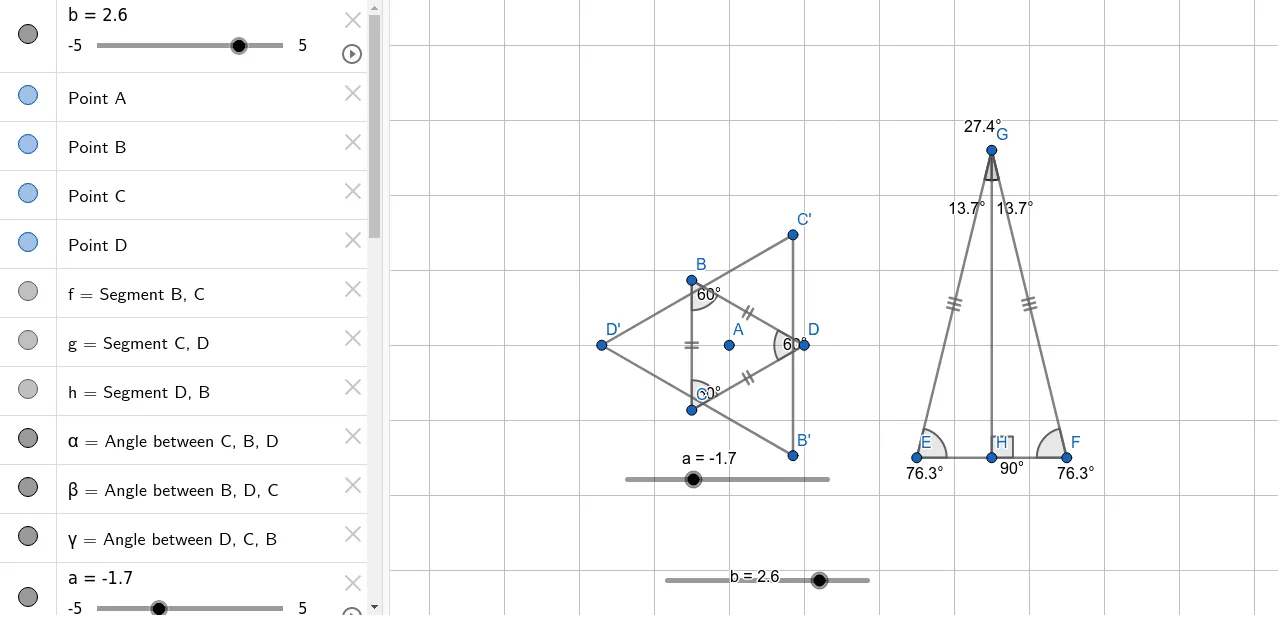
① This GeoGebra example dynamically demonstrates the construction of equilateral and isosceles triangles, visually illustrating the side-angle relationships and geometric properties of these two special triangle types. ② Core mathematical concepts include triangle classification by sides, the property that an equilateral triangle has all sides equal and all angles 60°, and that an isosceles triangle has two equal sides and equal base angles, verified through angle and segment measurements. ③ Construction highlights: using the Segment command to draw base sides, Angle to define angles, Dilate to scale segments to achieve equal side lengths, and Point to create vertices; key objects include triangle vertices A, B, C, sides a, b, c, angles α, β, γ, and auxiliary points B', D', C' generated by dilation, with polygons built to form the complete figures. ④ Suitable for middle school geometry lessons or high school review, helping students understand definitions, properties, and dynamic verification of special triangles, and useful for teachers creating interactive courseware.
GeoGebra Commands & Parameters
Segment(B, C) → fSegment(C, D) → gSegment(D, B) → hAngle(C, B, D) → αAngle(B, D, C) → βAngle(D, C, B) → γDilate(B, a, A) → B'Dilate(D, a, A) → D'Dilate(C, a, A) → C'Segment(B', C') → iSegment(C', D') → jSegment(D', B') → kSegment(G, E) → lSegment(E, F) → mSegment(G, F) → nAngle(G, E, F) → δAngle(G, F, E) → εAngle(E, G, F) → ζPoint(m) → HSegment(G, H) → pAngle(E, G, H) → ηAngle(H, G, F) → θAngle(G, H, F) → ι