
Equal Volumes Geometric Demonstration
Loading the math board and drawing, please wait…
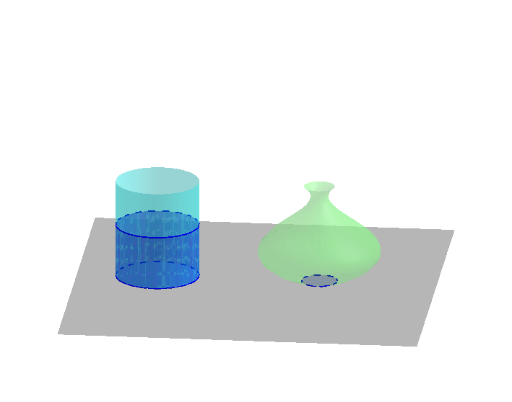
This example demonstrates how to construct and calculate to verify the equality of volumes of different geometric solids. Core math concepts include volume calculation, definite integral, Pythagorean theorem, confidence interval, quadrilaterals, and surface area. Construction highlights involve GeoGebra commands like points, segments, polygons, circles, loci, surfaces, and cylinders. Suitable for high school students and math enthusiasts for learning solid geometry and calculus.
GeoGebra Commands & Parameters
Point(Ray[(1, 0), (2, 0)]) → APointIn((x > 1) ∧ (y > y(A) + 1)) → BPointIn((x > 1) ∧ (y > y(B) + 1)) → CPointIn((x > 1) ∧ (y > y(C) + 1)) → DPointIn((x > 1) ∧ (y > y(D) + 1)) → ELength(P) → npSequence((y(Element[P, i]), x(Element[P, i])), i, 1, np) → PinvFitPoly(Pinv, np - 1) → rIntegral(ca, 0, y(E)) → volTCurveCartesian(r(t), t, t, 0, y(E)) → bMirror(b, yAxis) → b'Segment(A, Mirror[A, yAxis]) → cSegment(E, Mirror[E, yAxis]) → dPolygon(I, I + (0, ht), (-100 - x(I), ht), (-100 - x(I), 0)) → poly1, m, a, f, gCircumcircleArc((0, 0), H, F) → kPoint(b') → MIntegral(ca, 0, y(M)) → volMSegment(M, Mirror[M, yAxis]) → hLocus(FM, M) → lieu1Locus(FN, M) → lieu2Surface((r(u) * cos(v)), (r(u) * sin(v)), u, u, 0, y(E), v, 0, (2 * π)) → jCylinder((-50, 0, 0), (-50, 0, y(E)), la) → l, p, q, nOrthogonalLine(J, xAxis) → tClosestPoint(lieu1, J) → OSurface((r(u) * cos(v)), (r(u) * sin(v)), u, u, 0, y(O), v, 0, (2 * π)) → oCylinder((-50, 0, 0), (-50, 0, hcyl), la) → s, c_1, d_1, uCircle((0, 0, y(O)), r(y(O)), zAxis) → e_1Circle((0, 0, 0), x(A), zAxis) → f_1Point(lieu1) → LSequence(Segment[((-r(i)), i), (r(i), i)], i, 0, y(L), 0.5) → liste1Polygon({(-50 - la, 0), (-50 + la, 0), (-50 + la, hcyl), (-50 - la, hcyl)}) → poly2
AI Drawing Prompt Reference
Draw a geometric demonstration showing the equality of volumes of different solids. Start with a ray from (1,0) to (2,0), then place five points vertically above it to form a series of squares. Construct a curve through these points and calculate the volume under this curve. Rotate the curve around the x-axis to form a solid of revolution and calculate its volume. Also, draw a cylinder and compute its volume. Finally, use mirroring, rotation, and fitting to illustrate the volume relationships between different geometric shapes.
The prompt above was compiled from the original drawing commands and is for reference only.