
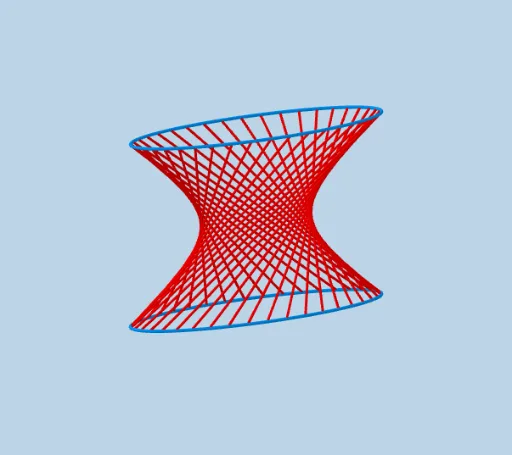
Elliptic Hyperboloid
Loading the math board and drawing, please wait…
This example demonstrates the geometric construction of an elliptic hyperboloid. Key mathematical concepts include the equation of a hyperboloid in coordinate geometry. Using GeoGebra commands such as CurveCartesian, Sequence, and Translate, the generation process of the hyperboloid can be dynamically shown. Suitable for high school mathematics education and learning.
GeoGebra Commands & Parameters
CurveCartesian((a * cos(t)), (b * sin(t)), t, 0, (2 * π)) → cSequence(c(((i * 2) * π / n)), i, 1, n) → L1CurveCartesian((a * cos(t)), (b * sin(t)), h, t, 0, (2 * π)) → dSequence(c(((i * 2) * π / n) + α), i, 1, n) → L2Translate(L2, Vector[(0, 0, h)]) → L2'Zip(Segment[A, B], A, L1, B, L2') → L3Segment(A, B) → fZip(Line[A, B], A, L1, B, L2') → L4
AI Drawing Prompt Reference
Draw an elliptic hyperboloid by first plotting the parametric equation of an ellipse, then generating a series of elliptical curves rotated around the z-axis, followed by translating these ellipses along the z-axis and connecting them to form the hyperboloid, and finally creating the wireframe structure of the hyperboloid.
The prompt above was compiled from the original drawing commands and is for reference only.