
Dynamic Solar System with Elliptical Orbits
Loading the math board and drawing, please wait…
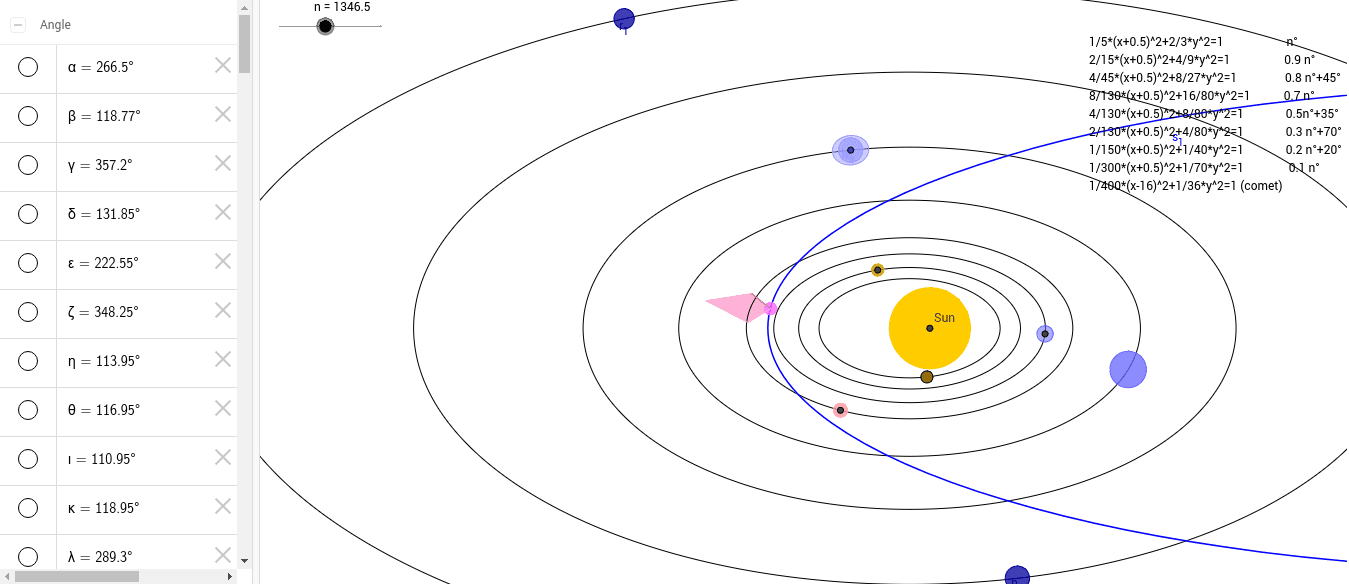
This example demonstrates a dynamic simulation of a solar system with elliptical orbits. It involves core mathematical concepts such as ellipses, unit circles, power functions, trigonometry, reflections, and polygons. The construction utilizes GeoGebra commands like Intersect, Circle, Rotate, Angle, Ray, Ellipse, Point, OrthogonalLine, Segment, and Polygon. It is suitable for high school and above students to learn about celestial motion and geometric constructions.
GeoGebra Commands & Parameters
Intersect(xAxis, yAxis) → SunCircle(Sun, 1.0) → cIntersect(d, xAxis) → B, CRotate(C, n°, Sun) → C'_1Angle(C, Sun, C'_1) → αRay(Sun, C'_1) → aIntersect(d, a) → D,Circle(D, 0.1) → eRotate(C, n + 10.0°, Sun) → C'_2Angle(C, Sun, C'_2) → βRay(Sun, C'_2) → bRotate(C, 1.2 * n + 45.0°, Sun) → C'_3Ray(Sun, C'_3) → iRotate(C, 0.8 * n + 45.0°, Sun) → C'_4Ray(Sun, C'_4) → jRotate(C, 0.8 * n°, Sun) → C'_5Angle(C, Sun, C'_5) → γRay(Sun, C'_5) → kIntersect(h, k) → F,Circle(F, 0.2) → pRotate(C, 0.9 * n°, Sun) → C'_6Angle(C, Sun, C'_6) → δRay(Sun, C'_6) → gIntersect(f, g) → E,Circle(E, 0.15) → qRotate(C, 0.7 * n°, Sun) → C'_7Angle(C, Sun, C'_7) → εRay(Sun, C'_7) → lIntersect(r, l) → G,Circle(G, 0.17) → sRotate(C, 0.5 * n° + 35.0°, Sun) → C'_8Angle(C, Sun, C'_8) → ζRay(Sun, C'_8) → mIntersect(t, m) → A,Rotate(C, 0.3 * n° + 70.0°, Sun) → C'_9Angle(C, Sun, C'_9) → ηRay(Sun, C'_9) → a_1Intersect(d_1, a_1) → H,Circle(H, 0.3) → e_1Rotate(C, 0.3 * n° + 73.0°, Sun) → C'_{10}Rotate(C, 0.3 * n° + 73.0°, Sun) → C'_{11}Angle(C, Sun, C'_{11}) → θRay(Sun, C'_{11}) → b_1Intersect(d_1, b_1) → I,Rotate(C, 0.3 * n° + 67.0°, Sun) → C'_{12}Angle(C, Sun, C'_{12}) → ιRay(Sun, C'_{12}) → f_1Intersect(d_1, f_1) → J,Rotate(C, 0.3 * n° + 75.0°, Sun) → C'_{13}Angle(C, Sun, C'_{13}) → κRay(Sun, C'_{13}) → g_1Intersect(d_1, g_1) → K,Ellipse(J, I, K) → h_1Circle(A, 0.45) → c_1Rotate(C, 0.2 * n° + 20.0°, Sun) → C'_{14}Angle(C, Sun, C'_{14}) → λRay(Sun, C'_{14}) → i_1Intersect(k_1, i_1) → L,Circle(L, 0.3) → p_1Rotate(C, 0.1 * n°, Sun) → C'_{15}Angle(C, Sun, C'_{15}) → μRay(Sun, C'_{15}) → j_1Intersect(q_1, j_1) → M,Circle(M, 0.25) → r_1Rotate(C, 2.0 * n°, Sun) → C'Angle(C, Sun, C') → νRay(Sun, C') → l_1Intersect(s_1, l_1) → N,Circle(N, 0.15) → t_1Point(l_1) → OPoint(l_1) → POrthogonalLine(O, l_1) → m_1OrthogonalLine(P, l_1) → n_1Point(m_1) → QPoint(m_1) → RSegment(N, Q) → a_2Polygon(N, Q, P, R) → poly1, n_2, q_2, p_2, r_2
AI Drawing Prompt Reference
Draw a dynamic solar system with elliptical orbits. Start with two intersecting axes to create a sun at the center, then draw a unit circle around it. Create multiple elliptical orbits by rotating and drawing rays, determining each planet's path through intersection points. Represent each planet as a small circle on its respective orbit. Adjust the angles and sizes of the orbits to simulate the planets moving around the sun, showcasing celestial motion and elliptical paths.
The prompt above was compiled from the original drawing commands and is for reference only.