
Dynamic Multiplication Model
Loading the math board and drawing, please wait…
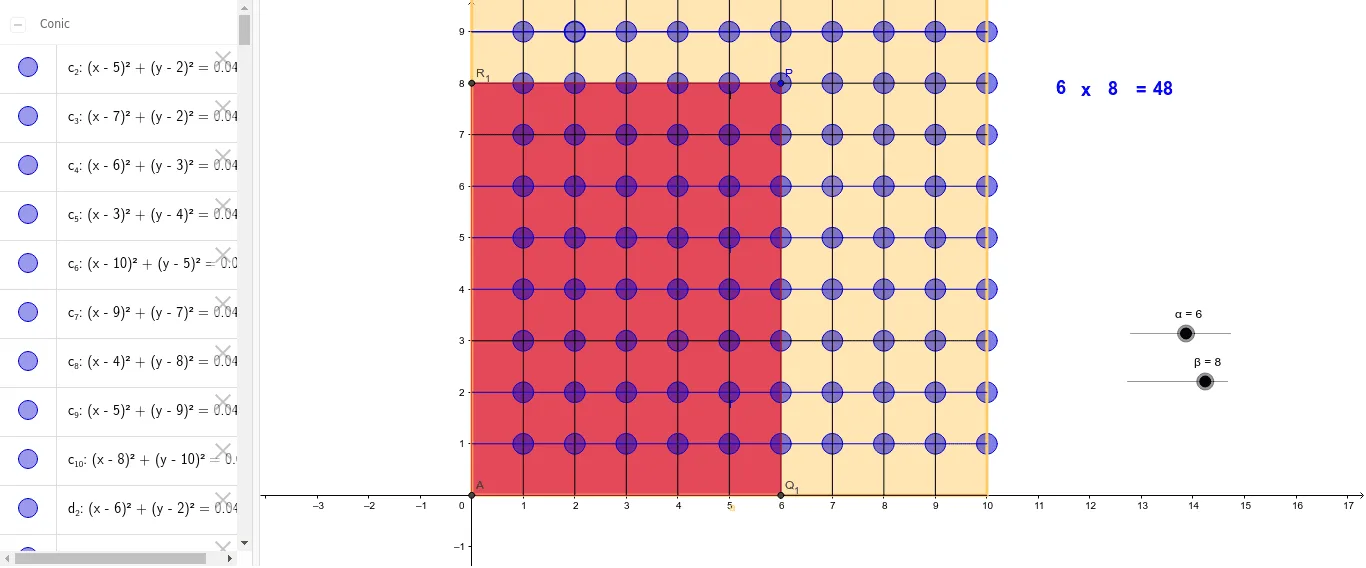
This model is designed for elementary school students or those in teacher education programs to compute different products of decimal numbers. It dynamically demonstrates the multiplication process, involving key concepts of decimal multiplication. Using GeoGebra commands such as Intersect, Point, Polygon, etc., the model allows for dynamic visualization of multiplication. Suitable for high-grade elementary and junior high school students.
GeoGebra Commands & Parameters
Intersect(xAxis, yAxis) → APoint(xAxis) → BPoint(yAxis) → DPolygon(A, B, C, D) → poly1, a, b, c, dPoint(d) → EPoint(b) → FSegment(E, F) → ePoint(d) → GPoint(b) → HSegment(G, H) → fPoint(d) → IPoint(b) → JSegment(I, J) → gPoint(d) → KPoint(b) → LSegment(K, L) → hPoint(d) → MPoint(b) → NSegment(M, N) → iPoint(d) → OPoint(b) → P2Segment(O, P2) → jPoint(d) → QPoint(b) → RSegment(Q, R) → kPoint(d) → SPoint(b) → TSegment(S, T) → lPoint(d) → UPoint(b) → VSegment(U, V) → mPoint(a) → WPoint(c) → ZSegment(W, Z) → nPoint(a) → A_1Point(c) → B_1Segment(A_1, B_1) → pPoint(a) → C_1Point(c) → D_1Segment(C_1, D_1) → qPoint(a) → E_1Point(c) → F_1Segment(E_1, F_1) → rPoint(a) → G_1Point(c) → H_1Segment(G_1, H_1) → sPoint(a) → I_1Point(c) → J_1Segment(I_1, J_1) → tPoint(c) → L_1Segment(K_1, L_1) → a_1Point(a) → M_1Segment(M_1, N_1) → b_1Point(a) → O_1Point(c) → P_1Segment(O_1, P_1) → c_1Segment(A, P) → d_1OrthogonalLine(P, a) → e_1OrthogonalLine(P, d) → f_1Intersect(e_1, a) → Q_1Intersect(f_1, d) → R_1Polygon(A, Q_1, P, R_1) → poly2, a_2, q_1, p_1, r_1Product({α, β}) → vIntersect(b, a) → S_1Segment(A, S_1) → g_1Polygon(P, R_1, A, Q_1) → poly3, p_2, r_2, a_3, q_2Intersect(f, n) → T_1Circle(T_1, 0.2) → h_1Intersect(f, p) → U_1Circle(U_1, 0.2) → k_1Intersect(f, q) → V_1Circle(V_1, 0.2) → s_1Intersect(f, r) → W_1Circle(W_1, 0.2) → t_1Intersect(f, s) → Z_1Circle(Z_1, 0.2) → c_2Intersect(f, t) → A_2Circle(A_2, 0.2) → d_2Intersect(f, b_1) → C_2Circle(C_2, 0.2) → f_2Intersect(f, c_1) → D_2Circle(D_2, 0.2) → g_2Intersect(b, f) → E_2Circle(E_2, 0.2) → h_2Intersect(b, e) → F_2Circle(F_2, 0.2) → k_2Intersect(e, c_1) → G_2Circle(G_2, 0.2) → s_2Intersect(e, b_1) → H_2Circle(H_2, 0.2) → t_2Point(t) → J_2Circle(J_2, 0.2) → d_3Intersect(e, s) → K_2Circle(K_2, 0.2) → e_3Intersect(e, r) → L_2Circle(L_2, 0.2) → f_3Intersect(e, q) → M_2Circle(M_2, 0.2) → g_3Intersect(e, p) → N_2Circle(N_2, 0.2) → h_3Intersect(e, n) → O_2Circle(O_2, 0.2) → k_3Intersect(g, n) → P_2Circle(P_2, 0.2) → p_3Intersect(g, p) → Q_2Circle(Q_2, 0.2) → q_3Intersect(g, q) → R_2Circle(R_2, 0.2) → r_3Intersect(g, r) → S_2Circle(S_2, 0.2) → s_3Intersect(g, s) → T_2Circle(T_2, 0.2) → t_3Intersect(g, t) → U_2Circle(U_2, 0.2) → c_4Intersect(g, b_1) → W_2Circle(W_2, 0.2) → e_4Intersect(g, c_1) → Z_2Circle(Z_2, 0.2) → f_4Intersect(b, g) → A_3Circle(A_3, 0.2) → g_4Intersect(b, h) → B_3Circle(B_3, 0.2) → h_4Intersect(h, c_1) → C_3Circle(C_3, 0.2) → k_4Intersect(h, b_1) → D_3Circle(D_3, 0.2) → p_4Intersect(h, t) → F_3Circle(F_3, 0.2) → r_4Intersect(h, s) → G_3Circle(G_3, 0.2) → s_4Intersect(h, r) → H_3Circle(H_3, 0.2) → t_4Intersect(h, q) → I_3Circle(I_3, 0.2) → c_5Intersect(h, p) → J_3Circle(J_3, 0.2) → d_5Intersect(h, n) → K_3Circle(K_3, 0.2) → e_5Intersect(i, n) → L_3Circle(L_3, 0.2) → f_5Intersect(i, p) → M_3Circle(M_3, 0.2) → g_5Intersect(i, q) → N_3Circle(N_3, 0.2) → h_5Intersect(i, r) → O_3Circle(O_3, 0.2) → k_5Intersect(i, s) → P_3Circle(P_3, 0.2) → p_5Intersect(i, t) → Q_3Circle(Q_3, 0.2) → q_5Intersect(i, a_1) → R_3Circle(R_3, 0.2) → r_5Intersect(i, b_1) → S_3Circle(S_3, 0.2) → s_5Intersect(i, c_1) → T_3Circle(T_3, 0.2) → t_5Intersect(b, i) → U_3Circle(U_3, 0.2) → c_6Intersect(e, a_1) → B_2Circle(B_2, 0.2) → e_2Intersect(f, a_1) → I_2Circle(I_2, 0.2) → c_3Intersect(g, a_1) → V_2Circle(V_2, 0.2) → d_4Intersect(h, a_1) → E_3Circle(E_3, 0.2) → q_4Intersect(j, n) → V_3Circle(V_3, 0.2) → d_6Intersect(j, p) → W_3Circle(W_3, 0.2) → e_6Intersect(j, q) → Z_3Circle(Z_3, 0.2) → f_6Intersect(j, r) → A_4Circle(A_4, 0.2) → g_6Intersect(j, s) → B_4Circle(B_4, 0.2) → h_6Intersect(j, t) → C_4Circle(C_4, 0.2) → k_6Intersect(j, a_1) → D_4Circle(D_4, 0.2) → p_6Intersect(j, b_1) → E_4Circle(E_4, 0.2) → q_6Intersect(j, c_1) → F_4Circle(F_4, 0.2) → r_6Intersect(b, j) → G_4Circle(G_4, 0.2) → s_6Intersect(b, k) → H_4Circle(H_4, 0.2) → t_6Intersect(k, c_1) → I_4Circle(I_4, 0.2) → c_7Intersect(k, b_1) → J_4Circle(J_4, 0.2) → d_7Intersect(k, a_1) → K_4Circle(K_4, 0.2) → e_7Intersect(k, t) → L_4Circle(L_4, 0.2) → f_7Intersect(k, s) → M_4Circle(M_4, 0.2) → g_7Intersect(k, r) → N_4Circle(N_4, 0.2) → h_7Intersect(k, q) → O_4Circle(O_4, 0.2) → k_7Intersect(k, p) → P_4Circle(P_4, 0.2) → p_7Intersect(k, n) → Q_4Circle(Q_4, 0.2) → q_7Intersect(l, n) → R_4Circle(R_4, 0.2) → r_7Intersect(l, p) → S_4Circle(S_4, 0.2) → s_7Intersect(l, q) → T_4Circle(T_4, 0.2) → t_7Intersect(l, r) → U_4Circle(U_4, 0.2) → c_8Intersect(l, s) → V_4Circle(V_4, 0.2) → d_8Intersect(l, t) → W_4Circle(W_4, 0.2) → e_8Intersect(l, a_1) → Z_4Circle(Z_4, 0.2) → f_8Intersect(l, b_1) → A_5Circle(A_5, 0.2) → g_8Intersect(l, c_1) → B_5Circle(B_5, 0.2) → h_8Intersect(b, l) → C_5Circle(C_5, 0.2) → k_8Intersect(b, m) → D_5Circle(D_5, 0.2) → p_8Intersect(m, c_1) → E_5Circle(E_5, 0.2) → q_8Intersect(m, b_1) → F_5Circle(F_5, 0.2) → r_8Intersect(m, a_1) → G_5Circle(G_5, 0.2) → s_8Intersect(m, t) → H_5Circle(H_5, 0.2) → t_8Intersect(m, s) → I_5Circle(I_5, 0.2) → c_9Intersect(m, r) → J_5Circle(J_5, 0.2) → d_9Intersect(m, q) → K_5Circle(K_5, 0.2) → e_9Intersect(m, p) → L_5Circle(L_5, 0.2) → f_9Intersect(m, n) → M_5Circle(M_5, 0.2) → g_9Intersect(c, n) → N_5Circle(N_5, 0.2) → h_9Intersect(c, p) → O_5Circle(O_5, 0.2) → k_9Intersect(c, q) → P_5Circle(P_5, 0.2) → p_9Intersect(c, r) → Q_5Circle(Q_5, 0.2) → q_9Intersect(c, s) → R_5Circle(R_5, 0.2) → r_9Intersect(c, t) → S_5Circle(S_5, 0.2) → s_9Intersect(c, a_1) → T_5Circle(T_5, 0.2) → t_9Intersect(c, b_1) → U_5Circle(U_5, 0.2) → c_{10}Intersect(c, c_1) → V_5Circle(V_5, 0.2) → d_{10}Intersect(c, b) → W_5Circle(W_5, 0.2) → e_{10}
AI Drawing Prompt Reference
Draw a coordinate system with the intersection point A of the x-axis and y-axis, and points B on the x-axis and D on the y-axis. Use these four points to draw a rectangle poly1. Then, take points E, F, G, H, I, J, K, L, M, N, O, P2, Q, R, S, T, U, V on the x-axis and y-axis respectively, and draw a series of parallel line segments to form a dynamic multiplication model to demonstrate the process of decimal multiplication.
The prompt above was compiled from the original drawing commands and is for reference only.