
Dynamic model for subtracting two 2-digit numbers
Loading the math board and drawing, please wait…
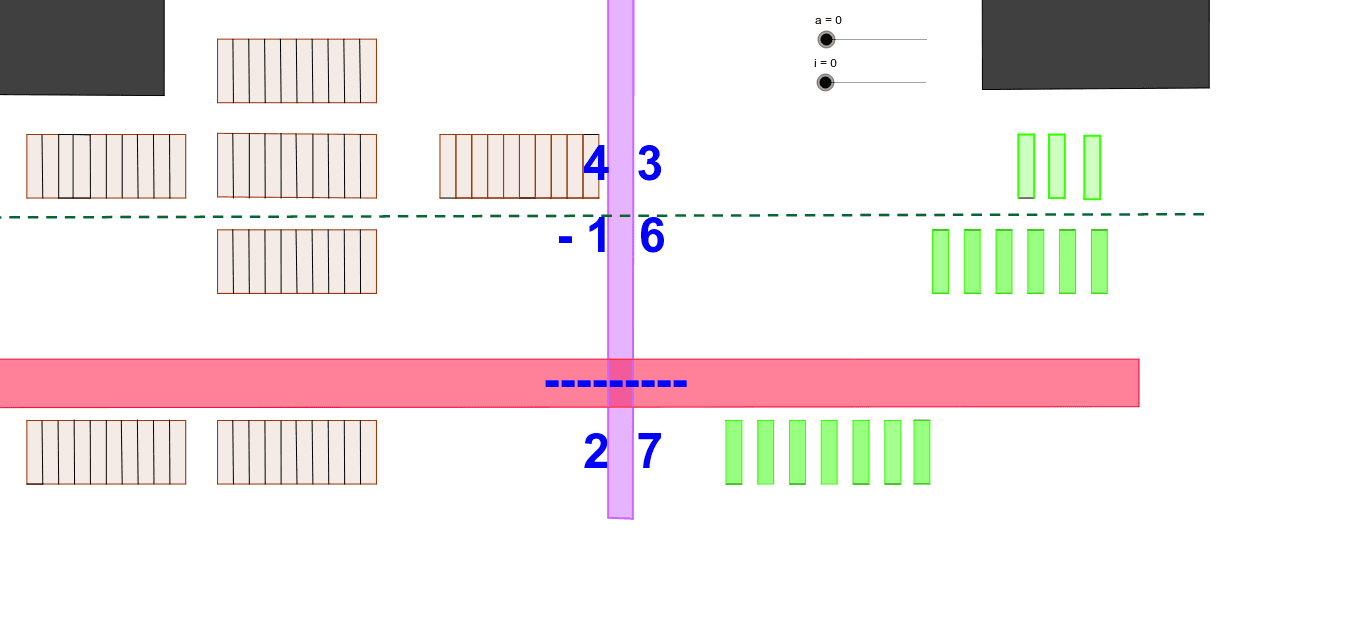
This example demonstrates the subtraction of two two-digit numbers using a slider to dynamically show the process. Key mathematical concepts include digit operations and subtraction rules. Construction involves GeoGebra commands like Point, Segment, and Polygon to create number blocks, with the slider controlling the values. Suitable for elementary high school or middle school mathematics teaching to visually understand subtraction and digit concepts.
GeoGebra Commands & Parameters
Point(Circle[A, 0.25]) → BSegment(A, B) → bPolygon(D, A, B, C) → poly1, d_1, a_1, b_1, c_1Point(Circle[E, 0.25]) → GSegment(E, G) → cPoint(Circle[F, 0.25]) → HPolygon(F, E, G, H) → poly2, f, e, g, hPoint(Circle[I, 0.25]) → KSegment(I, K) → jPoint(Circle[J, 0.25]) → LSegment(J, L) → kPolygon(J, I, K, L) → poly3, j_1, i_1, k_1, lPoint(Circle[M, 0.25]) → OSegment(M, O) → mPoint(Circle[N, 0.25]) → PSegment(N, P) → nPolygon(N, M, O, P) → poly4, n_1, m_1, o_{12}, pPoint(Circle[Q, 0.25]) → SSegment(Q, S) → qPoint(Circle[R, 0.25]) → TSegment(R, T) → rPolygon(R, Q, S, T) → poly5, r_1, q_1, s, t_{13}Point(Circle[U, 0.25]) → ZSegment(U, Z) → e_1Point(Circle[V, 0.25]) → A_1Segment(V, A_1) → f_1Point(Circle[W, 0.25]) → C_1Segment(W, C_1) → g_1Point(Circle[B_1, 0.25]) → D_1Segment(B_1, D_1) → h_1Polygon(B_1, W, C_1, D_1) → poly7, b_2, w, c_2, d_2Point(Circle[E_1, 0.25]) → G_1Segment(E_1, G_1) → l_1Point(Circle[F_1, 0.25]) → H_1Segment(F_1, H_1) → p_1Polygon(F_1, E_1, G_1, H_1) → poly8, f_2, e_2, g_2, h_2Point(Circle[I_1, 0.25]) → K_1Point(Circle[J_1, 0.25]) → L_1Point(Circle[K_1, 0.25]) → O_1Point(Circle[O_1, 0.25]) → Q_1Point(Circle[M_1, 0.25]) → U_1Segment(M_1, U_1) → i_2Point(Circle[N_1, 0.25]) → V_1Segment(N_1, V_1) → j_2Point(Circle[P_1, 0.25]) → S_1Segment(P_1, S_1) → s_1Point(Circle[R_1, 0.25]) → T_1Segment(R_1, T_1) → t_1Polygon(P_1, S_1, T_1, R_1) → poly9, p_2, s_2, t_2, r_2Polygon(M_1, U_1, V_1, N_1) → poly10, m_2, u_1, v_1, n_2Point(Circle[C_2, 0.25]) → E_2Segment(C_2, E_2) → q_2Point(Circle[D_2, 0.25]) → F_2Segment(D_2, F_2) → c_3Polygon(C_2, E_2, F_2, D_2) → poly12, c_4, e_3, f_3, d_3Point(Circle[G_2, 0.25]) → I_2Segment(G_2, I_2) → g_3Point(Circle[H_2, 0.25]) → J_2Segment(H_2, J_2) → h_3Polygon(G_2, I_2, J_2, H_2) → poly13, g_4, i_3, j_3, h_4Point(Circle[W_1, 0.25]) → A_2Segment(W_1, A_2) → k_2Point(Circle[Z_1, 0.25]) → B_2Segment(Z_1, B_2) → l_2Polygon(W_1, A_2, B_2, Z_1) → poly11, w_1, a_3, b_3, z_1Polygon(K_2, L_2, M_2, N_2) → poly14, k_4, l_4, m_3, n_3Point(Circle[O_2, 0.25]) → Q_2Segment(O_2, Q_2) → p_3Point(Circle[P_2, 0.25]) → R_2Segment(P_2, R_2) → q_3Polygon(O_2, Q_2, R_2, P_2) → poly15, o_3, q_4, r_3, p_4Point(Circle[S_2, 0.25]) → U_2Segment(S_2, U_2) → s_3Point(Circle[T_2, 0.25]) → V_2Segment(T_2, V_2) → t_3Polygon(S_2, U_2, V_2, T_2) → poly16, s_4, u_3, v_3, t_4Point(Circle[W_2, 0.25]) → A_3Segment(W_2, A_3) → a_4Point(Circle[Z_2, 0.25]) → B_3Segment(Z_2, B_3) → b_4Polygon(W_2, A_3, B_3, Z_2) → poly17, w_6, a_5, b_5, z_6Point(Circle[C_3, 0.25]) → E_3Segment(C_3, E_3) → d_4Point(Circle[D_3, 0.25]) → F_3Segment(D_3, F_3) → e_4Polygon(C_3, E_3, F_3, D_3) → poly18, c_5, e_5, f_4, d_5Point(Circle[G_3, 0.25]) → I_3Segment(G_3, I_3) → i_4Point(Circle[H_3, 0.25]) → J_3Segment(H_3, J_3) → j_4Polygon(G_3, I_3, J_3, H_3) → poly19, g_6, i_5, j_5, h_6Point(Circle[K_3, 0.25]) → M_3Segment(K_3, M_3) → m_4Point(Circle[L_3, 0.25]) → N_3Segment(L_3, N_3) → n_4Polygon(K_3, M_3, N_3, L_3) → poly20, k_5, m_5, n_5, l_5Point(yAxis) → Q_3Point(yAxis) → R_3Polygon(P_3, O_3, Q_3, R_3) → poly21, p_5, o_4, q_5, r_4Point(r_4) → D_4Segment(S_3, D_4) → f_5Point(r_4) → E_4Segment(T_3, E_4) → r_5Point(r_4) → F_4Segment(Z_3, F_4) → s_5Point(r_4) → G_4Segment(V_3, G_4) → t_5Point(r_4) → H_4Segment(B_4, H_4) → a_6Point(r_4) → I_4Segment(A_4, I_4) → b_6Point(r_4) → J_4Segment(C_4, J_4) → c_6Point(r_4) → K_4Segment(W_3, K_4) → d_6Point(r_4) → L_4Segment(U_3, L_4) → e_6Polygon(M_4, N_4, O_4, P_4) → poly22, m_6, n_6, o_5, p_6Segment(B_5, H_5) → j_6Polygon(S_4, Q_4, E_5, R_4, T_4) → poly23, s_6, q_6, e_7, r_6, t_6Segment(V_4, Z_4) → f_6Segment(Z_4, F_5) → i_6Point(t_6) → G_5Segment(A_5, G_5) → k_6Point(t_6) → I_5Segment(D_5, I_5) → l_6Point(t_6) → J_5Segment(C_5, J_5) → a_7Point(t_6) → K_5Segment(E_5, K_5) → b_7Point(t_6) → L_5Segment(W_4, L_5) → c_7Segment(V_4, M_5) → d_7Point(t_6) → N_5Segment(U_4, N_5) → f_7Segment(L_5, F_5) → g_7Segment(L_5, M_5) → h_7Segment(L_5, M_5) → i_7Segment(M_6, N_6) → r_8Polygon(P_6, O_6, Q_6, R_6) → poly25, p_9, o_8, q_9, r_9Point(r_9) → D_7Segment(T_6, D_7) → s_8Point(r_9) → E_7Segment(V_6, E_7) → t_8Point(r_9) → F_7Segment(Z_6, F_7) → a_9Point(r_9) → G_7Segment(B_7, G_7) → b_9Point(r_9) → H_7Segment(C_7, H_7) → c_9Point(r_9) → I_7Segment(A_7, I_7) → d_9Point(r_9) → J_7Segment(W_6, J_7) → e_9Point(r_9) → K_7Segment(U_6, K_7) → f_9Point(r_9) → L_7Segment(S_6, L_7) → g_9Polygon(M_7, N_7, O_7, P_7) → poly26, m_9, n_9, o_9, p_{10}Polygon(Q_7, R_7, T_7, S_7) → poly27, q_{10}, r_{10}, t_9, s_9Polygon(G_8, F_8, H_8, I_8) → poly28, g_{10}, f_{10}, h_9, i_9Point(s_9) → S_8Segment(V_7, S_8) → j_9Point(s_9) → T_8Segment(Z_7, T_8) → k_9Point(s_9) → U_8Segment(B_8, U_8) → l_9Point(s_9) → V_8Segment(D_8, V_8) → a_{10}Point(s_9) → W_8Segment(E_8, W_8) → b_{10}Point(s_9) → Z_8Segment(C_8, Z_8) → c_{10}Point(s_9) → A_9Segment(A_8, A_9) → d_{10}Point(s_9) → B_9Segment(W_7, B_9) → e_{10}Point(s_9) → C_9Segment(U_7, C_9) → h_{10}Point(i_9) → D_9Segment(O_8, D_9) → i_{10}Point(i_9) → E_9Segment(K_8, E_9) → j_{10}Point(i_9) → F_9Segment(M_8, F_9) → k_{10}Point(i_9) → G_9Segment(Q_8, G_9) → l_{10}Segment(P_8, H_9) → m_{10}Point(i_9) → I_9Segment(N_8, I_9) → n_{10}Segment(J_8, F_8) → s_{10}Point(i_9) → J_9Segment(J_8, J_9) → t_{10}Segment(L_8, K_9) → a_{11}Segment(R_8, L_9) → b_{11}Point(Circle[M_9, 0.25]) → C_{10}Segment(M_9, C_{10}) → c_{11}Point(Circle[U_9, 0.25]) → D_{10}Segment(U_9, D_{10}) → d_{11}Point(Circle[N_9, 0.25]) → E_{10}Segment(N_9, E_{10}) → e_{11}Point(Circle[V_9, 0.25]) → F_{10}Segment(V_9, F_{10}) → f_{11}Point(Circle[T_9, 0.25]) → H_{10}Segment(T_9, H_{10}) → h_{11}Point(Circle[B_{10}, 0.25]) → K_{10}Segment(B_{10}, K_{10}) → k_{11}Point(Circle[S_9, 0.25]) → L_{10}Segment(S_9, L_{10}) → l_{11}Point(Circle[A_{10}, 0.25]) → M_{10}Segment(A_{10}, M_{10}) → m_{11}Point(Circle[R_9, 0.25]) → N_{10}Segment(R_9, N_{10}) → n_{11}Polygon(S_9, L_{10}, K_{10}, B_{10}) → poly29, s_{11}, l_{12}, k_{12}, b_{12}Polygon(D_{10}, C_{10}, M_9, U_9) → poly30, d_{12}, c_{12}, m_{12}, u_9Polygon(N_9, E_{10}, F_{10}, V_9) → poly31, n_{12}, e_{12}, f_{12}, v_9Polygon(O_9, P_9, H_{10}, T_9) → poly32, o_{10}, p_{12}, h_{12}, t_{11}Polygon(R_{10}, P_{10}, Q_9, Z_9) → poly34, r_{11}, p_{11}, q_{11}, z_9Polygon(O_{10}, R_9, N_{10}, M_{10}) → poly35, o_{11}, r_{12}, n_{13}, m_{13}Point(Circle[S_{10}, 0.25]) → T_{10}Segment(S_{10}, T_{10}) → g_{11}Point(Circle[Q_{10}, 0.25]) → U_{10}Segment(Q_{10}, U_{10}) → i_{11}Polygon(S_{10}, Q_{10}, U_{10}, T_{10}) → poly33, s_{12}, q_{12}, u_{10}, t_{12}Polygon(V_{10}, W_{10}, Z_{10}, A_{11}) → poly36, v_{10}, w_{10}, z_{10}, a_{12}Polygon(F_6, D_6, E_6, G_6) → poly24, f_8, d_{13}, e_{13}, g_8Point(g_8) → I_{11}Segment(L_6, I_{11}) → k_7Point(g_8) → J_{11}Segment(E_{11}, J_{11}) → l_7Point(g_8) → K_{11}Segment(C_{11}, K_{11}) → p_7Point(g_8) → L_{11}Segment(G_{11}, L_{11}) → r_7Point(g_8) → M_{11}Segment(H_{11}, M_{11}) → c_8Point(g_8) → N_{11}Segment(D_{11}, N_{11}) → h_8Point(g_8) → O_{11}Segment(B_{11}, O_{11}) → j_8Point(g_8) → P_{11}Segment(J_6, P_{11}) → k_8Point(g_8) → Q_{11}Segment(F_{11}, Q_{11}) → l_8Point(Circle[R_{11}, 0.25]) → T_{11}Segment(R_{11}, T_{11}) → dPoint(Circle[S_{11}, 0.25]) → U_{11}Segment(S_{11}, U_{11}) → a_2Polygon(R_{11}, S_{11}, U_{11}, T_{11}) → poly6, r_{14}, s_{13}, u_{11}, t_{14}
AI Drawing Prompt Reference
Create a dynamic model for subtracting two 2-digit numbers using a slider to show the process, construct number blocks with points and segments, demonstrating subtraction rules and digit operations, suitable for middle school math teaching, start by drawing the number blocks then use the slider to show the subtraction process.
The prompt above was compiled from the original drawing commands and is for reference only.