
Dynamic Illustrations of Polygon Angle Sum Theorems
Loading the math board and drawing, please wait…
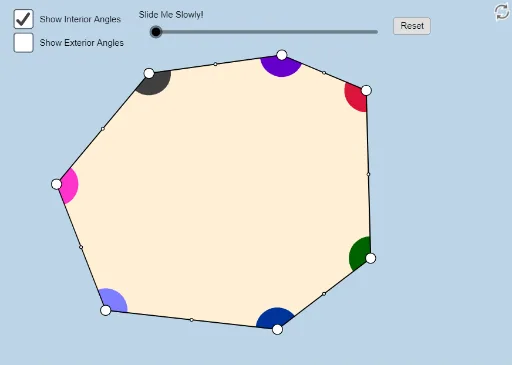
This example dynamically demonstrates the sum of interior and exterior angles in polygons through modifiable digital thinksheets. It covers core math concepts like the interior angle sum theorem, exterior angle sum theorem, and geometric constructions. The construction uses GeoGebra commands such as Ray, Circle, Intersect, Segment, CircleSector, Vector, Translate, Dilate, If, Polygon, Point, Midpoint, Rotate, and Line. Suitable for high school mathematics teaching or self-learning to understand polygonal angle properties.
GeoGebra Commands & Parameters
Ray(N_1, D) → l_4Circle(D, 3) → kIntersect(k, l_4) → W_1, Z_1Ray(D, A_1) → a_3Intersect(k, a_3, 1) → D_1Segment(C, A_1) → i_3Circle(C, 3) → hIntersect(h, i_3) → L,Ray(C, D) → cIntersect(h, c, 1) → PRay(A, B) → aRay(B, C) → bRay(E, A) → eCircle(A, 3) → fCircle(B, 3) → gCircle(E, 3) → pSegment(C, A) → iSegment(C, E) → jIntersect(f, a, 1) → FIntersect(f, i, 1) → GIntersect(f, e, 1) → HIntersect(f, e, 2) → IIntersect(p, e) → J,Intersect(p, j) → K,Intersect(k, c, 2) → OIntersect(h, j, 1) → QIntersect(h, i, 1) → RIntersect(h, b, 1) → SIntersect(g, a, 2) → TIntersect(g, b, 1) → UIntersect(g, a, 1) → VCircleSector(A, F, G) → qCircleSector(A, G, H) → rCircleSector(B, U, V) → sCircleSector(C, Q, R) → c_1CircleSector(C, R, S) → d_1Intersect(k, c, 1) → WCircleSector(E, J, K) → h_1CircleSector(A, I, F) → p_1CircleSector(B, T, U) → q_1Intersect(h, b, 2) → ZVector(A, B) → uVector(C, B) → vVector(E, D) → wVector(C, D) → u_1Vector(C, E) → v_1Vector(A, E) → w_1Translate(d_1, v) → s_1Dilate(A, If[0 < l ≤ 1, 1 - l, 0], B) → A'Dilate(C, If[0 < l ≤ 1, 1 - l, 0], B) → C'Dilate(A, If[1 < l ≤ 2, 2 - l, 0], E) → A'_1Dilate(C, If[1 < l ≤ 2, 2 - l, 0], E) → C'_1Dilate(C, If[2 < l ≤ 3, 3 - l, 0], D) → C'_2Dilate(E, If[2 < l ≤ 3, 3 - l, 0], D) → E'Vector(A, B) → a_1Vector(C, C') → b_1Vector(A, A'_1) → i_1Vector(E, E') → j_1Vector(C, C'_2) → l_1Vector(C, C'_1) → m_1Translate(d_1, b_1) → c_2Translate(r, i_1) → r'_1Translate(r, w_1) → r'_2Translate(c_1, v_1) → f_2Translate(c_1, m_1) → g_2CircleSector(C, P, L) → tTranslate(t, u_1) → t'Translate(t, l_1) → t'_1Translate(q, a_1) → r'Translate(d_1, b_1) → h_2Vector(A, A') → n_1Ray(C, E) → i_2Vector(D, C) → u_2Vector(E, C) → v_2Vector(A, C) → w_2Vector(B, C) → l_2Dilate(B, If[0 < o < 1, 1 - o, 0], C) → B'Dilate(A, If[1 < o < 2, 2 - o, 0], C) → A'_2Dilate(E, If[2 < o < 3, 3 - o, 0], C) → E'_1Dilate(D, If[3 < o < 4, 4 - o, 0], C) → D'Vector(B, B') → m_2Vector(A, A'_2) → n_2Vector(E, E'_1) → s_2Vector(D, D') → t_2Translate(q_1, m_2) → c_3Translate(q_1, l_2) → d_3Translate(p_1, w_2) → e_3If(1 < o < 2, Translate[p_1, n_2]) → h_3Ray(A_1, E) → b_3Circle(A_1, 3) → q_3Intersect(q_3, i_3) → M,Intersect(q_3, b_3, 1) → NIntersect(q_3, a_3, 2) → B_1Intersect(k, c, 2) → C_1Intersect(k, c, 1) → E_1CircleSector(C, L, Q) → dIntersect(p, b_3, 1) → F_1Intersect(p, i_2) → G_1, H_2CircleSector(E, G_1, N) → e_1Dilate(E, If[2 < l < 3, 3 - l, 0], A_1) → E'_2Dilate(C, If[2 < l < 3, 3 - l, 0], A_1) → C'_3Dilate(C, If[3 < l < 4, 4 - l, 0], D) → C'_4Dilate(A_1, If[3 < l < 4, 4 - l, 0], D) → H_1Vector(E, A_1) → f_1Vector(C, A_1) → g_1Translate(e_1, f_1) → k_1Translate(d, g_1) → d'Vector(E, E'_2) → a_2Vector(C, C'_3) → b_2Translate(e_1, a_2) → d_2Translate(d, b_2) → d'_1CircleSector(A_1, N, M) → f_3Intersect(q_3, a_3, 1) → I_1CircleSector(A_1, M, I_1) → g_3CircleSector(D, D_1, E_1) → k_3Vector(C, D) → j_2Vector(A_1, D) → u_3Translate(g_3, u_3) → p_3Translate(t, j_2) → t'_2Vector(A_1, H_1) → v_3Vector(C, C'_4) → w_3Translate(g_3, v_3) → s_3Translate(t, w_3) → t'_3Intersect(p, b_3, 2) → J_1Polygon(A, B, C) → poly1, c_4, a_4, b_4Polygon(A, C, E) → poly2, e_4, a_5, c_5Polygon(E, C, A_1) → poly3, a_6, e_5, c_6Polygon(A_1, C, D) → poly4, d_4, a_7, c_7Intersect(p, e, 1) → L_1CircleSector(E, J_1, L_1) → f_4CircleSector(A_1, B_1, N) → g_4Vector(E, C) → j_3Vector(A_1, C) → l_3Vector(D, C) → m_3Translate(f_4, j_3) → k_4Translate(g_4, l_3) → p_4CircleSector(D, Z_1, D_1) → h_4Translate(h_4, m_3) → q_4Dilate(E, If[2 < o < 3, 3 - o, 0], C) → E'_3Dilate(A_1, If[3 < o < 4, 4 - o, 0], C) → M_1Dilate(D, If[4 < o < 5, 5 - o, 0], C) → D'_1Vector(E, E'_3) → n_3Vector(A_1, M_1) → u_4Vector(D, D'_1) → v_4If(2 < o < 3, Translate[f_4, n_3]) → r_4If(3 < o < 4, Translate[g_4, u_4]) → s_4If(4 < o < 5, Translate[h_4, v_4]) → t_4Ray(C, N_1) → i_4Circle(N_1, 3) → d_5Intersect(d_5, i_4, 2) → K_1Intersect(d_5, l_4, 1) → O_1Intersect(d_5, i_4, 1) → P_1Intersect(h, i_4, 1) → Q_1CircleSector(C, Q_1, P) → f_5CircleSector(N_1, O_1, P_1) → g_5Intersect(k, l_4, 1) → R_1CircleSector(D, E_1, R_1) → h_5Dilate(D, If[4 < l < 5, 5 - l, 0], N_1) → D'_2Dilate(C, If[4 < l < 5, 5 - l, 0], N_1) → C'_5Vector(C, N_1) → w_4Vector(D, N_1) → j_4Translate(h_5, j_4) → p_5Vector(D, D'_2) → m_4Vector(C, C'_5) → n_4Translate(h_5, m_4) → r_5Polygon(D, C, N_1) → poly5, n_5, d_6, c_8Segment(D, C) → b_5Ray(C, E) → i_5Ray(C, A_1) → j_5Ray(C, D) → l_5Point(j_5) → T_1Point(l_5) → U_1Ray(A_1, T_1) → m_5Ray(D, U_1) → b_6Polygon(A_1, E, A, B, C, N_1, D) → poly6, a_8, e_6, a_9, b_7, c_9, n_6, d_7Intersect(d_5, l_4, 1) → S_1Intersect(d_5, i_4, 2) → V_1CircleSector(N_1, V_1, S_1) → f_6CircleSector(C, Z, Q_1) → r_1Vector(N_1, C) → u_5Translate(f_6, u_5) → g_6Dilate(N_1, If[5 < o < 6, 6 - o, 0], C) → A_2Vector(N_1, A_2) → v_5Translate(f_6, v_5) → h_6Vector(D, C) → w_5Translate(h_4, w_5) → k_6Segment(E, A) → i_6Segment(A, B) → j_6Segment(B, C) → l_6Segment(C, N_1) → m_6Segment(N_1, D) → p_6Segment(D, A_1) → q_6Segment(A_1, E) → r_6Midpoint(i_6) → B_2Midpoint(j_6) → C_2Midpoint(l_6) → D_2Midpoint(m_6) → E_2Midpoint(p_6) → F_2Midpoint(q_6) → G_2Midpoint(r_6) → I_2Rotate(d_1, If[0 < l ≤ 1, (((-l) * 180))°, (-(180°))], D_2) → t_1Rotate(C, If[0 < l ≤ 1, (((-l) * 180))°, (-(180°))], D_2) → C'_6Segment(D_2, C'_6) → k_2Rotate(A, If[0 < l ≤ 1, ((l * 180))°, 180°], C_2) → A'_3Segment(C_2, A'_3) → s_6Rotate(q, If[0 < l ≤ 1, ((l * 180))°, 180°], C_2) → q'Rotate(R, 180°, C_2) → R'Rotate(R, 180°, D_2) → R'_1Line(B, R'_1) → t_6Rotate(A, If[1 < l ≤ 2, (((-(l - 1)) * 180))°, 180°], B_2) → A'_4Rotate(r, If[1 < l ≤ 2, (((-(l - 1)) * 180))°, 180°], B_2) → r'_3Segment(B_2, A'_4) → q_2Ray(E, H_2) → e_7Rotate(e_1, If[2 < l ≤ 3, (((-(l - 2)) * 180))°, 180°], I_2) → e_2Rotate(E, If[2 < l ≤ 3, (((-(l - 2)) * 180))°, 180°], I_2) → E'_4Segment(I_2, E'_4) → f_7Rotate(g_3, If[3 < l ≤ 4, (((-(l - 3)) * 180))°, 180°], G_2) → t_3Rotate(A_1, If[3 < l ≤ 4, (((-(l - 3)) * 180))°, 180°], G_2) → J_2Segment(G_2, J_2) → g_7Rotate(h_5, If[4 < l ≤ 5, (((-(l - 4)) * 180))°, 180°], F_2) → t_5Rotate(D, If[4 < l ≤ 5, (((-(l - 4)) * 180))°, 180°], F_2) → D'_3Segment(F_2, D'_3) → h_7Rotate(f_5, If[4 < l ≤ 5, (((l - 4) * 180))°, 180°], E_2) → s_5Rotate(C, If[4 < l ≤ 5, (((l - 4) * 180))°, 180°], E_2) → C'_7Segment(E_2, C'_7) → i_7Rotate(W, 180°, F_2) → W'Line(N_1, W') → k_5
AI Drawing Prompt Reference
Draw a polygon to demonstrate the sum of its interior and exterior angles. Start by drawing a ray and a circle, marking their intersection points. Then, extend rays from the circle center to the initial ray and another ray, defining the polygon vertices. Connect these vertices to form the polygon, and draw rays from each vertex to represent interior and exterior angles, using sectors to visualize them. Finally, add vectors to indicate the lengths and directions of the polygon's sides for a dynamic illustration.
The prompt above was compiled from the original drawing commands and is for reference only.