
Dynamic Equilateral Triangle and Rectangle Area Problem
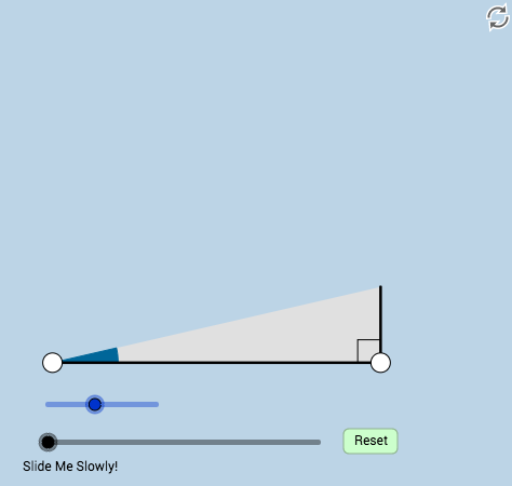
Loading the math board and drawing, please wait…
This example demonstrates a dynamic illustration of an equilateral triangle inside a rectangle, focusing on area calculations. Key math concepts include area computation, coordinate geometry, and geometric transformations. It utilizes GeoGebra commands like Line, Segment, Circle, Intersect, Rotate, and Polygon. Suitable for high school mathematics education, this tool helps students understand the relationships between areas of special shapes and the properties of transformations.
GeoGebra Commands & Parameters
Line(A, B) → iSegment(A, B) → lOrthogonalLine(B, i) → fCircle(B, l / 2) → dIntersect(d, f, 2) → COrthogonalLine(A, l) → qCircle(B, 1) → cIntersect(c, f, 2) → DRay(B, D) → gRotate(B, α, A) → B'Angle(B, A, B') → βRay(A, B') → hIntersect(g, h) → EPolygon(A, E, 3) → poly1, m, n, p, FPolygon(E, B, A) → poly3, a_1, e, bOrthogonalLine(F, q) → rIntersect(q, r) → GIntersect(r, g) → HPolygon(A, F, G) → poly2, g_1, a, f_1Polygon(E, H, F) → poly4, f_2, e_1, h_1Dilate(A, If[0 < o ≤ 1, 1 - o, 0], E) → A'Segment(A, A') → sDilate(E, If[1 < o ≤ 2, 2 - o, 0], F) → E'Rotate(A, If[1 < o ≤ 2, ((o - 1) * π / 3), π / 3], A) → A'_1Rotate(A', If[1 < o ≤ 2, ((o - 1) * π / 3), π / 3], A) → A''Segment(A'_1, A'') → s'Rotate(A'_1, If[2 < o ≤ 3, ((o - 2) * π / 3), π / 3], F) → IRotate(A'', If[2 < o ≤ 3, ((o - 2) * π / 3), π / 3], F) → A'''Segment(I, A''') → s''Angle(A, G, H) → γAngle(G, H, B) → δAngle(H, B, A) → εSegment(G, F) → tSegment(G, A) → i_1Segment(F, H) → j_1Segment(H, B) → k_1Segment(B, A) → l_1Circle(A, (0.2 * l_1)) → c_1Intersect(c_1, l_1) → J,Intersect(c_1, s) → K,CircleSector(A, J, K) → d_1Segment(B, E) → m_1Segment(B, A) → n_1Segment(H, E) → p_1OrthogonalLine(G, s') → r_1OrthogonalLine(B, s) → s_1Intersect(r_1, s') → LOrthogonalLine(H, s'') → q_1Intersect(q_1, s'') → MIntersect(s_1, s) → NDilate(G, If[4 < o ≤ 5, 5 - o, 0], L) → G'Segment(G, L) → t_1Circle(H, t_1) → c_2Segment(H, M) → b_1Intersect(c_2, b_1) → O, USegment(G, G') → g_2Dilate(B, If[5 < o ≤ 6, 6 - o, 0], N) → B'_1Segment(B, B'_1) → h_2Dilate(H, If[6 < o ≤ 7, 7 - o, 0], O) → H'Segment(H, H') → i_2Dilate(O, If[7 < o ≤ 8, 8 - o, 0], M) → O'Segment(O, O') → j_2Line(O, g_2) → k_2Point(k_2) → PAngle(H, O, P) → ζDilate(L, If[8 < o ≤ 9, 9 - o, 0], O) → L'Vector(L, L') → uTranslate(G, u) → G'_1Translate(G', u) → G''Segment(G'_1, G'') → l_2Rotate(G'_1, If[9 < o ≤ 10, (((-(o - 9)) * 2) * π / 3), (-2 * π / 3)], O) → QRotate(G'', If[9 < o ≤ 10, (((-(o - 9)) * 2) * π / 3), (-2 * π / 3)], O) → G'''Segment(Q, G''') → m_2Line(M, h_2) → n_2Point(n_2) → RAngle(H, M, R) → ηDilate(N, If[10 < o ≤ 11, 11 - o, 0], M) → N'Vector(N, N') → vTranslate(B, v) → B'_2Dilate(B, If[10 < o ≤ 11, 11 - o, 0], M) → B'_3Vector(B, B'_3) → wTranslate(B, w) → B'_4Translate(B'_1, w) → SSegment(B'_4, S) → p_2Rotate(B'_4, If[11 < o ≤ 12, ((-(o - 11)) * π / 3), ((-π)) / 3], M) → TRotate(S, If[11 < o ≤ 12, ((-(o - 11)) * π / 3), ((-π)) / 3], M) → S'Segment(T, S') → q_2Angle(G, L, A) → θAngle(A, N, B) → ιAngle(H, M, A'') → κ