
Dynamic Demonstration of the Sine Rule
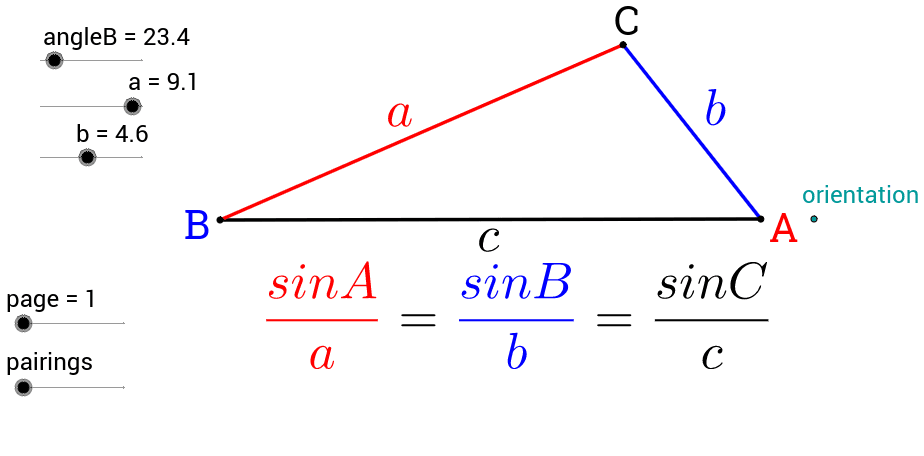
Loading the math board and drawing, please wait…
This GeoGebra example dynamically illustrates the sine rule in any triangle, showing the proportional relationship between each side and the sine of its opposite angle. The core mathematical concepts include triangle side-angle relationships, the sine rule, angle measurement, and geometric construction. The construction employs commands such as Line, Rotate, Circle, Intersect, Segment, Angle, Midpoint, If, and Vector, with objects including angle variables α, β, γ, side lengths a, b, c, and dynamic text labels. By rotating and constructing circles, the triangle's vertices are determined via intersections, and angles and sides are computed in real time. This resource is suitable for secondary school mathematics or introductory geometry, helping learners grasp the geometric meaning of the sine rule and its application in solving triangles.
GeoGebra Commands & Parameters
Line(R, orientation) → b_1Rotate(orientation, angleB°, R) → U'_1Line(R, U'_1) → a_1Circle(R, a) → c_1Intersect(c_1, a_1) → Z_1, PCircle(P, b) → d_1Intersect(d_1, b_1) → V_1, QSegment(P, Q) → b_2Segment(R, Q) → cSegment(R, P) → a_2Angle(Q, P, R) → γAngle(R, Q, P) → αAngle(P, R, Q) → βMidpoint(a_2) → A'Midpoint(c) → C'Midpoint(b_2) → B'Midpoint(C', Q) → DMidpoint(B', Q) → EMidpoint(D, E) → FIf(sin(α) < 0, "-", "") → signsinAAngle(orientation, R, U'_1) → α_2Segment(P, Q) → e_1Circle(P, R) → f_1Intersect(f_1, b_1) → W_1, W'_1Segment(P, W'_1) → g_1Vector(Q, A') → uVector(R, B') → vVector(P, C') → wSegment(V_1, P) → iSegment(R, V_1) → lAngle(P, V_1, R) → δMidpoint(R, A') → AMidpoint(R, C') → BMidpoint(A, B) → C
AI Drawing Prompt Reference
Draw a dynamic triangle to demonstrate the sine rule geometrically. The triangle is formed by rotating lines and intersecting circles, with three angles α, β, γ and three sides a, b, c. Real-time calculation of angles and sides, and display of the sine rule's proportional relationship. Construction order: start from a fixed point, rotate a line to generate the first side, intersect circles and lines to find vertices, then use midpoints to calculate the triangle's center. Label dynamic text to explain the sine rule. Suitable for math teaching to understand triangle side-angle relationships.
The prompt above was compiled from the original drawing commands and is for reference only.