
Dynamic Demo of a Theorem on Concentric Circles and a Secant
Loading the math board and drawing, please wait…
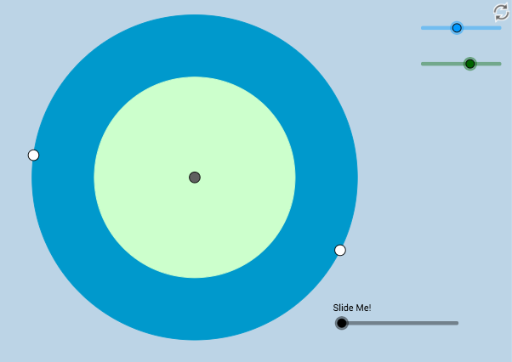
This example dynamically illustrates a theorem involving two concentric circles and a secant segment drawn through both. Key math concepts include circle, secant line, rectangle, fractions, symmetry. It is constructed using GeoGebra commands like Circle, Point, Tangent, Intersect, CircleArc, Segment, Dilate, Angle, Rotate. Suitable for high school mathematics education to understand the dynamic changes in geometric theorems.
GeoGebra Commands & Parameters
Circle(A, a) → cCircle(A, b) → dPoint(c) → DTangent(D, d) → f, gIntersect(d, g) → EIntersect(d, f) → FIntersect(c, g, 2) → GIntersect(c, f, 2) → HCircleArc(A, H, G) → ePoint(e) → ISegment(D, I) → hIntersect(d, h, 1) → JIntersect(d, h, 2) → KDilate(D, If[0 < i ≤ 1, 1 - i, 0], J) → D'Segment(D, D') → jDilate(J, If[1 < i ≤ 2, 2 - i, 0], K) → J'Segment(J, J') → kDilate(K, If[2 < i ≤ 3, 3 - i, 0], I) → K'Segment(K, K') → lAngle(K, A, J) → αRotate(D, If[3 < i ≤ 4, ((-(i - 3)) * α), (-α)], A) → D'_1Rotate(D', If[3 < i ≤ 4, ((-(i - 3)) * α), (-α)], A) → D''Segment(D'_1, D'') → j'Rotate(D, (-α), J) → D'_2Rotate(D', (-α), J) → D''_1Segment(D'_2, D''_1) → j'_1Angle(K, J, D'_2) → βRotate(D'_1, If[4 < i ≤ 5, ((-(i - 4)) * β), (-β)], K) → LRotate(D'', If[4 < i ≤ 5, ((-(i - 4)) * β), (-β)], K) → D'''Segment(L, D''') → j''
AI Drawing Prompt Reference
Draw two concentric circles with centers at point A and radii a and b. Choose a point D on the larger circle, draw tangents from D to the smaller circle, and let the intersection points be E and F. Connect E and F, and let the intersection points with the larger circle be G and H. Draw an arc e with GH as the arc. Choose a point I on arc e, and draw line segment DI. Let the intersection points of DI with the smaller circle be J and K. Dilate DI with J as the center and DI as the radius, and let the resulting segments be j and k. Dilate DI with K as the center and DI as the radius, and let the resulting segments be l. Measure angle KJD, rotate points D and D' around J, and let the resulting segment be j'. Rotate points D and D' around J, and let the resulting segment be j'_1. Measure angle KJD'_2, rotate points D'_1 and D''_1 around K, and let the resulting segment be j''_1.
The prompt above was compiled from the original drawing commands and is for reference only.