
Dynamic Construction of Fermat Point in 2D
Loading the math board and drawing, please wait…
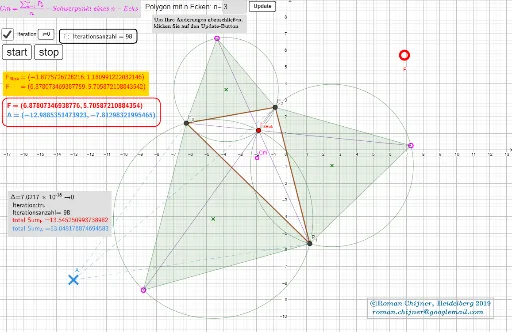
This example demonstrates the dynamic construction of the Fermat point in an n-gon using the Weiszfeld iteration method. Key mathematical concepts include geometric points, polygons, and iterative algorithms. Commands used include Textfield, Sequence, Zip, Polygon, and others. Suitable for high school mathematics education and learning.
GeoGebra Commands & Parameters
Textfield(r) → InputBox1UnicodeToLetter(34) → u34Sequence((x(Corner[1]) + (random() * x(Corner[2] - Corner[1])), y(Corner[1]) + (random() * y(Corner[4] - Corner[1]))), i, 1, n) → Points0Textfield(n) → InputBox2Zip(Length[a - F], a, lP) → lsegSum(Zip[Length[a - F], a, lP]) → TotalSumZip(Segment[A, a], a, lP) → lAPolygon(lP) → t1Zip(120° ≤ t ≤ 240°, t, lAngle) → lLogSum(lLog) → brZip(Rotate[a1, If[b < 180°, (-(60°)), 60°], a2], a1, {P_{2}, P_{1}, P_{1}}, a2, {P_{3}, P_{3}, P_{2}}, b, {lAngle(3), lAngle(1), lAngle(2)}) → lP'Zip(Center[c], c, lCircle) → OiSequence(Segment[Element[lP', i], Element[lP, i]], i, 1, 3) → lrIf(lLog(2), P_{2}, lLog(3), P_{3}, lLog(1), P_{1}, Intersect[lr(2), lr(1)]) → F_{3Eck}LaTeX(Text[text7, Atxt]) → text9