
Dynamic Construction of a Parallelogram and Angle Relationships
Loading the math board and drawing, please wait…
In collections
Geom. & Alg. Quadrilateral & Polygons
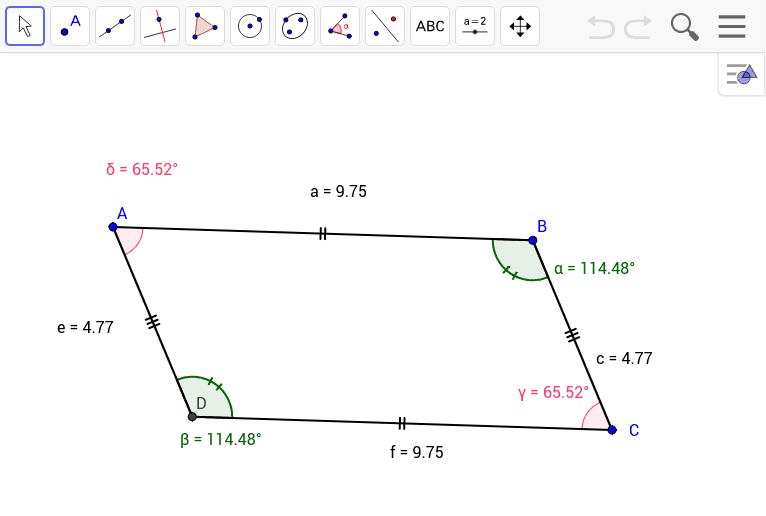
This GeoGebra example demonstrates the step-by-step construction of a parallelogram using fundamental geometric objects and commands. It illustrates how points A, B, C, and D, together with segments and lines, form a quadrilateral with two pairs of parallel sides, while angles α, β, γ, and δ are measured at the vertices to explore interior angle relationships. Core mathematical concepts include the definition and properties of parallelograms, opposite angles equality, consecutive angles supplementary, polygon angle sum, and Euclidean construction principles. The construction employs the Segment command to draw sides, the Line command to create supporting lines, the Intersect command to locate vertices, and the Angle command to label angle measures; objects involved include points A, B, C, D, lines a through f, and angle markers. Suitable for middle school geometry (grades 7–9) and high school review, this resource supports classroom teaching, teacher demonstrations, and student exploration of parallelogram properties and geometric construction techniques.
GeoGebra Commands & Parameters
Segment(A, B) → aLine(C, a) → bSegment(B, C) → cLine(A, c) → dIntersect(d, b) → DSegment(A, D) → eSegment(D, C) → fAngle(A, B, C) → αAngle(C, D, A) → βAngle(B, C, D) → γAngle(D, A, B) → δ
AI Drawing Prompt Reference
Draw a parallelogram by first constructing a base segment. From one endpoint, draw a line parallel to the base, and from the other endpoint, draw a line that intersects the parallel line, marking the intersection as the fourth vertex. Connect this vertex to both endpoints to complete the quadrilateral. Label the four interior angles at the vertices with their measures, showing that opposite angles are equal and adjacent angles are supplementary. Include the two supporting lines extending beyond the vertices to emphasize parallelism.
The prompt above was compiled from the original drawing commands and is for reference only.