
Dynamic Box Volume: Adjust Length, Width, and Height
Loading the math board and drawing, please wait…
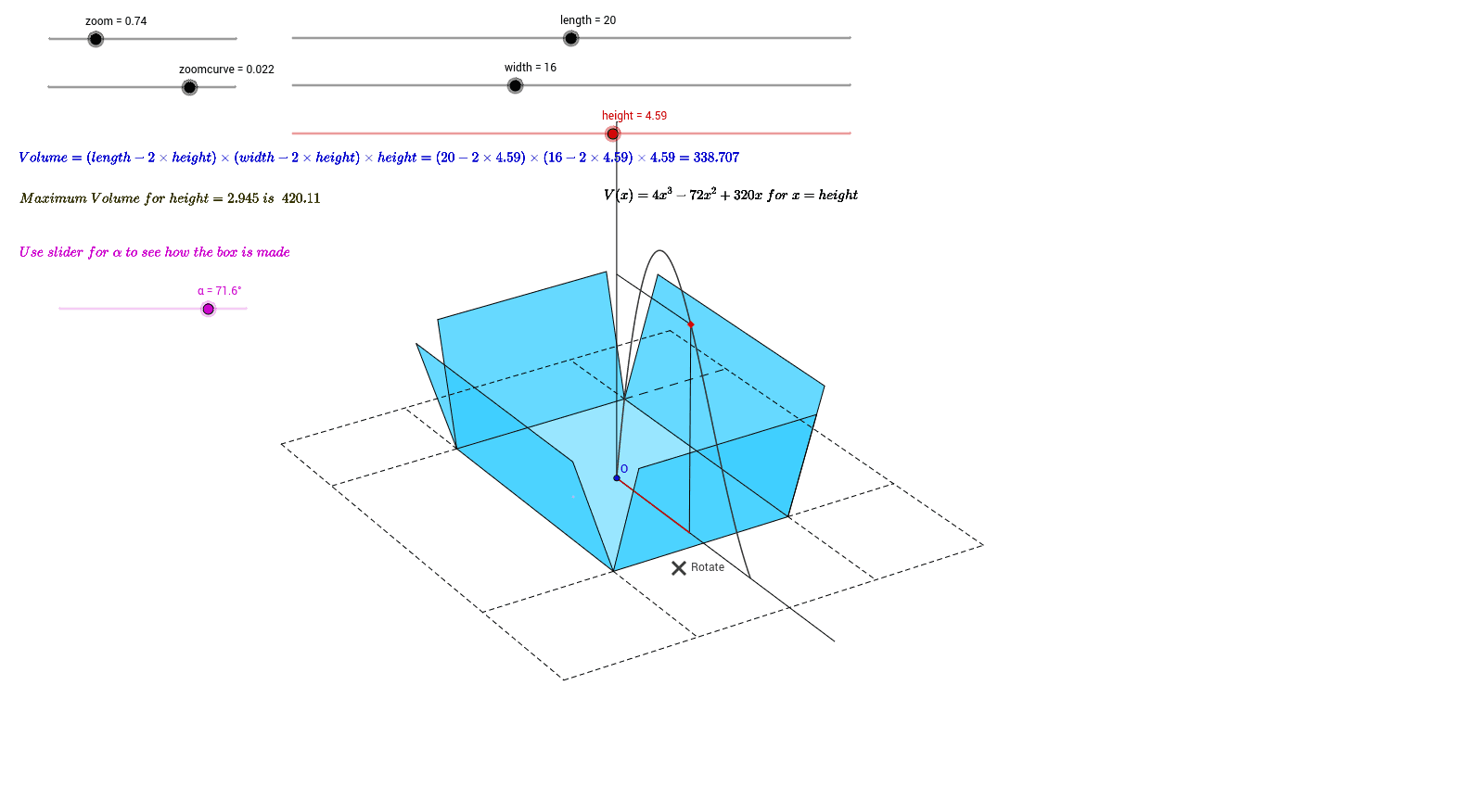
This GeoGebra example demonstrates an interactive rectangular prism model in which users can change the length, width, and height to observe the box volume changing in real time. The core mathematical concept is the solid geometry volume formula V = length × width × height, highlighting the proportional relationship between linear dimensions and volume in three-dimensional space. Construction points: the example uses GeoGebra commands such as Line, OrthogonalLine, Circle, Polygon, Distance, Rotate, Dilate, Midpoint, If, Segment, and Locus, together with objects including points AA, BB, CC, segments a, b, c, l, and labels such as br, d, e, D, E, F, G to build the box geometry and dynamic controls. It is suitable for middle school geometry (grades 7–9), upper elementary volume introductions, and classroom demonstrations that help students develop an intuitive understanding of how box dimensions determine volume.
GeoGebra Commands & Parameters
Line(AA, BB) → aOrthogonalLine(CC, a) → bOrthogonalLine(CC, b) → cCircle(CC, l) → dCircle(CC, br) → eIntersect(d, c) → D, EIntersect(e, b) → F, GOrthogonalLine(G, b) → fOrthogonalLine(D, c) → gOrthogonalLine(F, b) → hOrthogonalLine(E, c) → iIntersect(f, i) → HIntersect(g, f) → IIntersect(g, h) → JIntersect(h, i) → KPolygon(H, I, J, K) → mangekant1, h_1, i_1, j, kOrthogonalLine(Rotate, h_1) → mOrthogonalLine(Rotate, k) → nIntersect(h_1, m) → MIntersect(k, n) → NDistance(Rotate, M) → avstandLMDistance(Rotate, N) → avstandLNOrthogonalLine(O, a) → pOrthogonalLine(O, p) → qCircle(O, size) → rIntersect(r, q) → P, QIntersect(r, p) → R, SOrthogonalLine(S, p) → sOrthogonalLine(P, q) → tOrthogonalLine(R, p) → a_1OrthogonalLine(Q, q) → b_1Intersect(s, b_1) → TIntersect(s, t) → UIntersect(a_1, t) → VIntersect(a_1, b_1) → WPolygon(U, T, W, V) → mangekant2, u, t_1, w, vRotate(U, ho, O) → U'Rotate(T, ho, O) → T'Rotate(W, ho, O) → W'Rotate(V, ho, O) → V'Polygon(U', T', W', V') → mangekant2', u', t', w', v'OrthogonalLine(T', q) → c_1OrthogonalLine(W', q) → d_1OrthogonalLine(V', q) → e_1OrthogonalLine(U', q) → f_1OrthogonalLine(T', q) → g_1OrthogonalLine(V', q) → j_1OrthogonalLine(U', q) → k_1OrthogonalLine(W', q) → l_1Intersect(g_1, q) → ZIntersect(l_1, q) → A_1Intersect(q, k_1) → B_1Intersect(q, j_1) → C_1Distance(Z, T') → avstandZT'Distance(B_1, U') → avstandB1U'Dilate(T', l1, Z) → T''Dilate(W', l1, A_1) → W''Dilate(U', l1, B_1) → U''Dilate(V', l1, C_1) → V''Polygon(T'', W'', V'', U'') → mangekant3, t'', w'', v'', u''Midpoint(W'', V'') → D_1Midpoint(V'', U'') → E_1Distance(O, D_1) → avstandOD1Distance(O, E_1) → avstandOE1If(((-π < ve) ∧ (ve < (-π) / 2) ∨ (π / 2 < ve) ∧ (ve < π)) ∧ ((-π) / 2 < ho) ∧ (ho < π / 2) ∨ ((-π) / 2 < ve) ∧ (ve < π / 2) ∧ ((-π < ho) ∧ (ho < (-π) / 2) ∨ (π / 2 < ho) ∧ (ho < π)), van / (size - xp) + 3, (-van) / (size - xp) - 3) → ixDilate(D_1, ix, O) → F_1If((0 < ho) ∧ (ho < π) ∧ ((-π) / 2 < ve) ∧ (ve < π / 2) ∨ (-π < ho) ∧ (ho < 0) ∧ ((-π < ve) ∧ (ve < (-π) / 2) ∨ (π / 2 < ve) ∧ (ve < π)), van / (size - yp) + 3, (-van) / (size - yp) - 3) → iyDilate(E_1, iy, O) → G_1If((-π < ve) ∧ (ve < (-π) / 2) ∨ (0 < ve) ∧ (ve < π / 2), (-van) / (size - zp) - 3, van / (size - zp) + 3) → izCircle(O, size) → p_1Circle(O, zp) → q_1Intersect(q_1, p) → J_1, K_1Dilate(K_1, iz, O) → H_1Dilate(D_1, xpos, O) → I_1Dilate(D_1, xneg, O) → L_1Dilate(E_1, ypos, O) → M_1Dilate(E_1, yneg, O) → N_1Line(M_1, F_1) → m_1Line(N_1, F_1) → n_1Line(L_1, G_1) → r_1Line(I_1, G_1) → s_1Intersect(n_1, r_1) → O_1Intersect(m_1, r_1) → P_1Intersect(s_1, m_1) → Q_1Intersect(s_1, n_1) → R_1Polygon(P_1, O_1, R_1, Q_1) → mangekant4, p_2, o_1, r_2, q_2Dilate(K_1, zpos, O) → S_1Dilate(K_1, zneg, O) → T_1Segment(I_1, L_1) → a_2Segment(N_1, M_1) → b_2Line(F_1, S_1) → c_2Line(T_1, F_1) → d_2Line(S_1, G_1) → e_2Line(T_1, G_1) → f_2Line(H_1, N_1) → g_2Line(H_1, I_1) → h_2Line(H_1, L_1) → i_2Line(H_1, M_1) → j_2Intersect(g_2, e_2) → V_1Intersect(g_2, f_2) → W_1Intersect(e_2, j_2) → Z_1Intersect(f_2, j_2) → A_2Line(V_1, F_1) → k_2Line(Z_1, F_1) → l_2Line(W_1, F_1) → m_2Line(A_2, F_1) → n_2Intersect(i_2, c_2) → B_2Intersect(i_2, d_2) → C_2Intersect(c_2, h_2) → D_2Intersect(h_2, d_2) → E_2Line(B_2, G_1) → s_2Line(D_2, G_1) → t_2Line(E_2, G_1) → a_3Line(C_2, G_1) → b_3Intersect(k_2, s_2) → F_2Intersect(s_2, l_2) → G_2Intersect(t_2, l_2) → H_2Intersect(t_2, k_2) → I_2Intersect(m_2, b_3) → J_2Intersect(m_2, a_3) → K_2Intersect(a_3, n_2) → L_2Intersect(n_2, b_3) → M_2Segment(F_2, G_2) → c_3Segment(G_2, H_2) → d_3Segment(H_2, I_2) → e_3Segment(I_2, F_2) → f_3Segment(F_2, J_2) → g_3Segment(I_2, K_2) → h_3Segment(L_2, H_2) → i_3Segment(G_2, M_2) → j_3Segment(M_2, L_2) → k_3Segment(L_2, K_2) → l_3Segment(K_2, J_2) → m_3Segment(J_2, M_2) → n_3Segment(T_1, S_1) → p_3Dilate(I_1, enxm, O) → S_2Line(S_2, G_1) → g_4Intersect(q_2, g_4) → S_3Intersect(o_1, g_4) → P_4Dilate(M_1, enym, O) → N_5Line(N_5, F_1) → h_6Intersect(p_2, h_6) → H_6Intersect(r_2, h_6) → E_7Dilate(I_1, x1, O) → ADilate(I_1, x1m, O) → BDilate(M_1, y1, O) → CDilate(M_1, y1m, O) → LLine(L, F_1) → q_3Line(C, F_1) → r_3Line(B, G_1) → s_3Line(A, G_1) → t_3Intersect(r_3, s_3) → N_2Intersect(q_3, s_3) → O_2Intersect(r_3, t_3) → P_2Intersect(q_3, t_3) → Q_2Polygon(O_2, Q_2, P_2, N_2) → poly1, o_2, q_4, p_4, n_4Dilate(I_1, x3, O) → R_2Dilate(I_1, x2, O) → T_2Dilate(I_1, x3m, O) → U_2Dilate(I_1, x2m, O) → V_2Dilate(M_1, y3, O) → W_2Dilate(M_1, y2, O) → Z_2Dilate(M_1, y3m, O) → A_3Dilate(M_1, y2m, O) → B_3Dilate(S_1, z1, O) → C_3Line(V_2, G_1) → a_4Line(R_2, G_1) → b_4Line(Z_2, F_1) → c_4Line(B_3, F_1) → d_4Intersect(a_4, d_4) → D_3Intersect(c_4, a_4) → E_3Intersect(c_4, b_4) → F_3Intersect(d_4, b_4) → G_3Polygon(D_3, G_3, F_3, E_3) → poly2, d_5, g_5, f_4, e_4Line(H_1, T_2) → h_4Line(H_1, U_2) → i_4Line(H_1, A_3) → j_4Line(H_1, W_2) → k_4Line(C_3, G_1) → l_4Line(T_2, G_1) → m_4Line(U_2, G_1) → r_4Line(A_3, F_1) → s_4Line(W_2, F_1) → t_4Line(C_3, F_1) → a_5Intersect(i_4, a_5) → H_3Intersect(h_4, a_5) → I_3Intersect(j_4, l_4) → J_3Intersect(k_4, l_4) → K_3Intersect(c_4, m_4) → L_3Intersect(m_4, d_4) → M_3Intersect(r_4, c_4) → N_3Intersect(r_4, d_4) → O_3Intersect(s_4, a_4) → P_3Intersect(b_4, s_4) → Q_3Intersect(t_4, b_4) → R_3Intersect(t_4, a_4) → T_3Line(H_1, Q_3) → b_5Line(H_1, P_3) → c_5Line(H_1, R_3) → e_5Line(H_1, T_3) → f_5Line(H_1, M_3) → h_5Line(H_1, L_3) → i_5Line(H_1, O_3) → j_5Line(H_1, N_3) → k_5Line(I_3, G_1) → l_5Line(H_3, G_1) → m_5Line(J_3, F_1) → n_5Line(K_3, F_1) → p_5Intersect(j_5, m_5) → U_3Intersect(k_5, m_5) → V_3Polygon(D_3, U_3, V_3, E_3) → poly3, d_6, u_3, v_3, e_6Intersect(f_5, p_5) → W_3Intersect(e_5, p_5) → Z_3Polygon(E_3, W_3, Z_3, F_3) → poly4, e_7, w_3, z_3, f_6Intersect(c_5, n_5) → A_4Intersect(b_5, n_5) → B_4Polygon(A_4, D_3, G_3, B_4) → poly5, a_6, d_7, g_6, b_6Intersect(i_5, l_5) → C_4Intersect(h_5, l_5) → D_4Polygon(G_3, D_4, C_4, F_3) → poly6, g_7, d_8, c_6, f_7Intersect(a_4, q_3) → E_4Intersect(b_4, q_3) → F_4Intersect(t_3, d_4) → G_4Intersect(t_3, c_4) → H_4Intersect(r_3, b_4) → I_4Intersect(r_3, a_4) → J_4Intersect(d_4, s_3) → K_4Intersect(s_3, c_4) → L_4Polygon(L_4, E_3, J_4, N_2) → poly7, l_6, e_8, j_6, n_6Polygon(E_4, D_3, K_4, O_2) → poly8, e_9, d_9, k_6, o_3Polygon(I_4, F_3, H_4, P_2) → poly9, i_6, f_8, h_7, p_6Polygon(Q_2, G_4, G_3, F_4) → poly10, q_5, g_8, g_9, f_9Segment(O_2, N_2) → r_5Segment(O_2, Q_2) → s_5Segment(Q_2, P_2) → t_5Segment(P_2, N_2) → m_6Segment(L_4, N_2) → q_6Segment(N_2, J_4) → r_6Segment(K_4, O_2) → s_6Segment(O_2, E_4) → t_6Segment(F_4, Q_2) → a_7Segment(Q_2, G_4) → b_7Segment(H_4, P_2) → c_7Segment(P_2, I_4) → i_7Segment(O, C_3) → j_7Segment(D_3, E_3) → k_7Segment(E_3, F_3) → l_7Segment(F_3, G_3) → m_7Segment(G_3, D_3) → n_7Segment(D_3, K_4) → p_7Segment(D_3, E_4) → q_7Segment(G_3, F_4) → r_7Segment(G_3, G_4) → s_7Segment(F_3, H_4) → t_7Segment(F_3, I_4) → a_8Segment(E_3, J_4) → b_8Segment(E_3, L_4) → c_8Dilate(I_1, hei, O) → M_4Dilate(S_1, vol, O) → N_4Line(N_4, F_1) → h_8Line(H_1, M_4) → i_8Intersect(h_8, i_8) → O_4Locus(O_4, height) → loc1Segment(O, S_1) → j_8Segment(O, I_1) → k_8Segment(O_4, N_4) → l_8Segment(O_4, M_4) → m_8Segment(O, M_4) → n_8Segment(T_3, N_2) → p_8Segment(D_3, U_3) → q_8Segment(U_3, V_3) → r_8Segment(V_3, E_3) → s_8Segment(E_3, W_3) → t_8Segment(W_3, Z_3) → a_9Segment(Z_3, F_3) → b_9Segment(C_4, F_3) → c_9Segment(C_4, D_4) → h_9Segment(D_4, G_3) → i_9Segment(G_3, B_4) → j_9Segment(B_4, A_4) → k_9Segment(A_4, D_3) → l_9Polygon(D_3, E_3, F_3, G_3) → poly11, d_{10}, e_{10}, f_{10}, g_{10}
AI Drawing Prompt Reference
Draw a rectangular prism that can be adjusted in length, width, and height by moving points A, B, and C. Start by drawing the base AB, then draw a line segment CC perpendicular to AB, followed by line segments AA and BB perpendicular to CC. Use rotation and translation to generate the other edges of the prism, and finally connect the points to form the rectangular prism.
The prompt above was compiled from the original drawing commands and is for reference only.