
Interactive Vector and Normal Geometry in Coordinate System
Loading the math board and drawing, please wait…
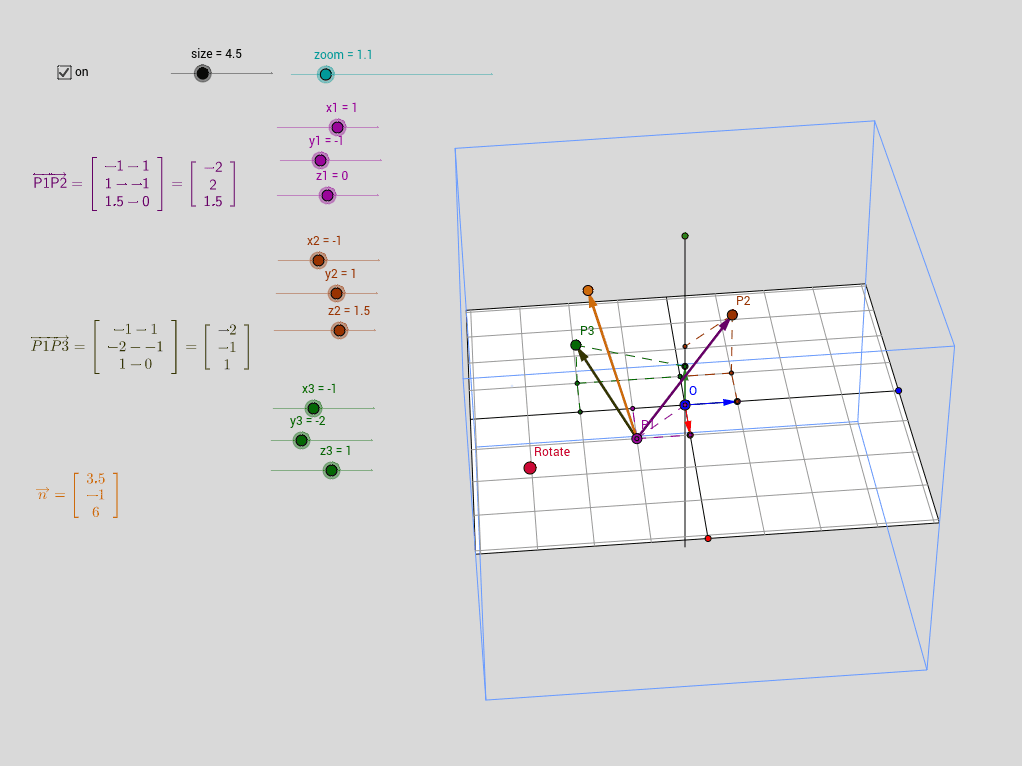
This GeoGebra example demonstrates how changing vectors in a coordinate system dynamically updates the configuration of normal vectors and associated geometric shapes, such as triangles and polygons. The core mathematical concepts covered include vector algebra, normal vectors, coordinate geometry (intersection of lines and circles), and geometric transformations including rotation, dilation, midpoint construction, and distance measurement. To build this model, various GeoGebra commands are integrated, such as Line, OrthogonalLine, Circle, Intersect, Polygon, Distance, Rotate, Dilate, Midpoint, If, Segment, and Vector, managing complex objects from coordinates x, y, z to points A through K. It is highly suitable for high school and university students studying linear algebra, vector calculus, and analytical geometry, serving as an excellent visual tool for classroom instruction and interactive exploration.
GeoGebra Commands & Parameters
Line(A, B) → aOrthogonalLine(C, a) → bOrthogonalLine(C, b) → cCircle(C, l) → dCircle(C, br) → eIntersect(d, c) → D, EIntersect(e, b) → F, GOrthogonalLine(G, b) → fOrthogonalLine(D, c) → gOrthogonalLine(F, b) → hOrthogonalLine(E, c) → iIntersect(f, i) → HIntersect(g, f) → IIntersect(g, h) → JIntersect(h, i) → KPolygon(H, I, J, K) → mangekant1, h_1, i_1, j, kOrthogonalLine(Rotate, h_1) → mOrthogonalLine(Rotate, k) → nIntersect(h_1, m) → MIntersect(k, n) → NDistance(Rotate, M) → avstandLMDistance(Rotate, N) → avstandLNOrthogonalLine(O, a) → pOrthogonalLine(O, p) → qCircle(O, size) → rIntersect(r, q) → P, QIntersect(r, p) → R, SOrthogonalLine(S, p) → sOrthogonalLine(P, q) → tOrthogonalLine(R, p) → a_1OrthogonalLine(Q, q) → b_1Intersect(s, b_1) → TIntersect(s, t) → UIntersect(a_1, t) → VIntersect(a_1, b_1) → WPolygon(U, T, W, V) → mangekant2, u, t_1, w, vRotate(U, ho, O) → U'Rotate(T, ho, O) → T'Rotate(W, ho, O) → W'Rotate(V, ho, O) → V'Polygon(U', T', W', V') → mangekant2', u', t', w', v'OrthogonalLine(T', q) → c_1OrthogonalLine(W', q) → d_1OrthogonalLine(V', q) → e_1OrthogonalLine(U', q) → f_1OrthogonalLine(T', q) → g_1OrthogonalLine(V', q) → j_1OrthogonalLine(U', q) → k_1OrthogonalLine(W', q) → l_1Intersect(g_1, q) → ZIntersect(l_1, q) → A_1Intersect(q, k_1) → B_1Intersect(q, j_1) → C_1Distance(Z, T') → avstandZT'Distance(B_1, U') → avstandB1U'Dilate(T', l1, Z) → T''Dilate(W', l1, A_1) → W''Dilate(U', l1, B_1) → U''Dilate(V', l1, C_1) → V''Polygon(T'', W'', V'', U'') → mangekant3, t'', w'', v'', u''Midpoint(W'', V'') → D_1Midpoint(V'', U'') → E_1Distance(O, D_1) → avstandOD1Distance(O, E_1) → avstandOE1If(((-π < ve) ∧ (ve < (-π) / 2) ∨ (π / 2 < ve) ∧ (ve < π)) ∧ ((-π) / 2 < ho) ∧ (ho < π / 2) ∨ ((-π) / 2 < ve) ∧ (ve < π / 2) ∧ ((-π < ho) ∧ (ho < (-π) / 2) ∨ (π / 2 < ho) ∧ (ho < π)), van / (size - xp) + 3, (-van) / (size - xp) - 3) → ixDilate(D_1, ix, O) → F_1If((0 < ho) ∧ (ho < π) ∧ ((-π) / 2 < ve) ∧ (ve < π / 2) ∨ (-π < ho) ∧ (ho < 0) ∧ ((-π < ve) ∧ (ve < (-π) / 2) ∨ (π / 2 < ve) ∧ (ve < π)), van / (size - yp) + 3, (-van) / (size - yp) - 3) → iyDilate(E_1, iy, O) → G_1If((-π < ve) ∧ (ve < (-π) / 2) ∨ (0 < ve) ∧ (ve < π / 2), (-van) / (size - zp) - 3, van / (size - zp) + 3) → izCircle(O, size) → p_1Circle(O, zp) → q_1Intersect(q_1, p) → J_1, K_1Dilate(K_1, iz, O) → H_1Dilate(D_1, xpos, O) → I_1Dilate(D_1, xneg, O) → L_1Dilate(E_1, ypos, O) → M_1Dilate(E_1, yneg, O) → N_1Line(M_1, F_1) → m_1Line(N_1, F_1) → n_1Line(L_1, G_1) → r_1Line(I_1, G_1) → s_1Intersect(n_1, r_1) → O_1Intersect(m_1, r_1) → P_1Intersect(s_1, m_1) → Q_1Intersect(s_1, n_1) → R_1Polygon(P_1, O_1, R_1, Q_1) → mangekant4, p_2, o_1, r_2, q_2Dilate(K_1, zpos, O) → S_1Dilate(K_1, zneg, O) → T_1Segment(I_1, L_1) → a_2Segment(N_1, M_1) → b_2Line(F_1, S_1) → c_2Line(T_1, F_1) → d_2Line(S_1, G_1) → e_2Line(T_1, G_1) → f_2Line(H_1, N_1) → g_2Line(H_1, I_1) → h_2Line(H_1, L_1) → i_2Line(H_1, M_1) → j_2Intersect(g_2, e_2) → V_1Intersect(g_2, f_2) → W_1Intersect(e_2, j_2) → Z_1Intersect(f_2, j_2) → A_2Line(V_1, F_1) → k_2Line(Z_1, F_1) → l_2Line(W_1, F_1) → m_2Line(A_2, F_1) → n_2Intersect(i_2, c_2) → B_2Intersect(i_2, d_2) → C_2Intersect(c_2, h_2) → D_2Intersect(h_2, d_2) → E_2Line(B_2, G_1) → s_2Line(D_2, G_1) → t_2Line(E_2, G_1) → a_3Line(C_2, G_1) → b_3Intersect(k_2, s_2) → F_2Intersect(s_2, l_2) → G_2Intersect(t_2, l_2) → H_2Intersect(t_2, k_2) → I_2Intersect(m_2, b_3) → J_2Intersect(m_2, a_3) → K_2Intersect(a_3, n_2) → L_2Intersect(n_2, b_3) → M_2Segment(F_2, G_2) → c_3Segment(G_2, H_2) → d_3Segment(H_2, I_2) → e_3Segment(I_2, F_2) → f_3Segment(F_2, J_2) → g_3Segment(I_2, K_2) → h_3Segment(L_2, H_2) → i_3Segment(G_2, M_2) → j_3Segment(M_2, L_2) → k_3Segment(L_2, K_2) → l_3Segment(K_2, J_2) → m_3Segment(J_2, M_2) → n_3Segment(T_1, S_1) → p_3Dilate(I_1, enx, O) → N_2Dilate(I_1, tox, O) → O_2Dilate(I_1, trex, O) → P_2Dilate(I_1, fix, O) → Q_2Dilate(I_1, fex, O) → R_2Dilate(I_1, enxm, O) → S_2Dilate(I_1, six, O) → T_2Dilate(I_1, sevx, O) → U_2Dilate(I_1, eix, O) → V_2Dilate(I_1, nix, O) → W_2Dilate(I_1, tex, O) → Z_2Dilate(I_1, toxm, O) → A_3Dilate(I_1, trexm, O) → B_3Dilate(I_1, fixm, O) → C_3Dilate(I_1, fexm, O) → D_3Dilate(I_1, sixm, O) → E_3Dilate(I_1, sevxm, O) → F_3Dilate(I_1, eixm, O) → G_3Dilate(I_1, nixm, O) → H_3Dilate(I_1, texm, O) → I_3Line(Z_2, G_1) → q_3Line(W_2, G_1) → r_3Line(V_2, G_1) → s_3Line(U_2, G_1) → t_3Line(T_2, G_1) → a_4Line(R_2, G_1) → b_4Line(Q_2, G_1) → c_4Line(P_2, G_1) → d_4Line(O_2, G_1) → e_4Line(N_2, G_1) → f_4Line(S_2, G_1) → g_4Line(A_3, G_1) → h_4Line(B_3, G_1) → i_4Line(C_3, G_1) → j_4Line(D_3, G_1) → k_4Line(E_3, G_1) → l_4Line(F_3, G_1) → m_4Line(G_3, G_1) → n_4Line(H_3, G_1) → p_4Line(I_3, G_1) → q_4Intersect(q_2, q_4) → J_3Intersect(q_2, p_4) → K_3Intersect(q_2, n_4) → L_3Intersect(q_2, m_4) → M_3Intersect(q_2, l_4) → N_3Intersect(q_2, k_4) → O_3Intersect(q_2, j_4) → P_3Intersect(q_2, i_4) → Q_3Intersect(q_2, h_4) → R_3Intersect(q_2, g_4) → S_3Intersect(q_2, f_4) → T_3Intersect(q_2, e_4) → U_3Intersect(q_2, d_4) → V_3Intersect(q_2, c_4) → W_3Intersect(q_2, b_4) → Z_3Intersect(q_2, a_4) → A_4Intersect(q_2, t_3) → B_4Intersect(q_2, s_3) → C_4Intersect(q_2, r_3) → D_4Intersect(q_2, q_3) → E_4Intersect(o_1, q_3) → F_4Intersect(o_1, r_3) → G_4Intersect(o_1, s_3) → H_4Intersect(o_1, t_3) → I_4Intersect(o_1, a_4) → J_4Intersect(o_1, b_4) → K_4Intersect(o_1, c_4) → L_4Intersect(o_1, d_4) → M_4Intersect(o_1, e_4) → N_4Intersect(o_1, f_4) → O_4Intersect(o_1, g_4) → P_4Intersect(o_1, h_4) → Q_4Intersect(o_1, i_4) → R_4Intersect(o_1, j_4) → S_4Intersect(o_1, k_4) → T_4Intersect(o_1, m_4) → W_4Intersect(o_1, n_4) → Z_4Intersect(o_1, p_4) → A_5Intersect(o_1, q_4) → B_5Segment(B_5, J_3) → r_4Segment(A_5, K_3) → s_4Segment(Z_4, L_3) → t_4Segment(W_4, M_3) → a_5Segment(T_4, O_3) → c_5Segment(S_4, P_3) → d_5Segment(R_4, Q_3) → e_5Segment(Q_4, R_3) → f_5Segment(P_4, S_3) → g_5Segment(O_4, T_3) → h_5Segment(N_4, U_3) → i_5Segment(M_4, V_3) → j_5Segment(L_4, W_3) → k_5Segment(K_4, Z_3) → l_5Segment(J_4, A_4) → m_5Segment(I_4, B_4) → n_5Segment(H_4, C_4) → p_5Segment(G_4, D_4) → q_5Segment(F_4, E_4) → r_5Dilate(M_1, eny, O) → C_5Dilate(M_1, toy, O) → D_5Dilate(M_1, trey, O) → E_5Dilate(M_1, firy, O) → F_5Dilate(M_1, femy, O) → G_5Dilate(M_1, sixy, O) → H_5Dilate(M_1, sevy, O) → I_5Dilate(M_1, eiy, O) → J_5Dilate(M_1, niy, O) → K_5Dilate(M_1, tey, O) → L_5Dilate(M_1, toym, O) → M_5Dilate(M_1, enym, O) → N_5Dilate(M_1, treym, O) → O_5Dilate(M_1, firym, O) → P_5Dilate(M_1, sixym, O) → Q_5Dilate(M_1, femym, O) → R_5Dilate(M_1, sevym, O) → S_5Dilate(M_1, eiym, O) → T_5Dilate(M_1, niym, O) → U_5Dilate(M_1, teym, O) → V_5Line(V_5, F_1) → s_5Line(U_5, F_1) → t_5Line(T_5, F_1) → a_6Line(S_5, F_1) → b_6Line(Q_5, F_1) → c_6Line(R_5, F_1) → d_6Line(P_5, F_1) → e_6Line(O_5, F_1) → f_6Line(M_5, F_1) → g_6Line(N_5, F_1) → h_6Line(C_5, F_1) → i_6Line(D_5, F_1) → j_6Line(E_5, F_1) → k_6Line(F_5, F_1) → l_6Line(G_5, F_1) → m_6Line(H_5, F_1) → n_6Line(I_5, F_1) → p_6Line(J_5, F_1) → q_6Line(K_5, F_1) → r_6Line(L_5, F_1) → s_6Intersect(p_2, s_5) → W_5Intersect(p_2, t_5) → Z_5Intersect(p_2, a_6) → A_6Intersect(p_2, b_6) → B_6Intersect(p_2, c_6) → C_6Intersect(p_2, d_6) → D_6Intersect(p_2, e_6) → E_6Intersect(p_2, f_6) → F_6Intersect(p_2, g_6) → G_6Intersect(p_2, h_6) → H_6Intersect(p_2, i_6) → I_6Intersect(p_2, j_6) → J_6Intersect(p_2, k_6) → K_6Intersect(p_2, l_6) → L_6Intersect(p_2, m_6) → M_6Intersect(p_2, n_6) → N_6Intersect(p_2, p_6) → O_6Intersect(p_2, q_6) → P_6Intersect(p_2, r_6) → Q_6Intersect(p_2, s_6) → R_6Intersect(r_2, s_6) → S_6Intersect(r_2, r_6) → T_6Intersect(r_2, q_6) → U_6Intersect(r_2, p_6) → V_6Intersect(r_2, n_6) → W_6Intersect(r_2, m_6) → Z_6Intersect(r_2, l_6) → A_7Intersect(r_2, k_6) → B_7Intersect(r_2, j_6) → C_7Intersect(r_2, i_6) → D_7Intersect(r_2, h_6) → E_7Intersect(r_2, g_6) → F_7Intersect(r_2, f_6) → G_7Intersect(r_2, e_6) → H_7Intersect(r_2, d_6) → I_7Intersect(r_2, c_6) → J_7Intersect(r_2, b_6) → K_7Intersect(r_2, a_6) → L_7Intersect(r_2, t_5) → M_7Intersect(r_2, s_5) → N_7Segment(N_7, W_5) → t_6Segment(M_7, Z_5) → a_7Segment(L_7, A_6) → b_7Segment(K_7, B_6) → c_7Segment(J_7, C_6) → d_7Segment(I_7, D_6) → e_7Segment(H_7, E_6) → f_7Segment(G_7, F_6) → g_7Segment(F_7, G_6) → h_7Segment(E_7, H_6) → i_7Segment(D_7, I_6) → j_7Segment(C_7, J_6) → k_7Segment(B_7, K_6) → l_7Segment(A_7, L_6) → m_7Segment(Z_6, M_6) → n_7Segment(W_6, N_6) → p_7Segment(V_6, O_6) → q_7Segment(U_6, P_6) → r_7Segment(T_6, Q_6) → s_7Segment(S_6, R_6) → t_7Intersect(o_1, l_4) → U_4Intersect(q_2, l_4) → V_4Segment(U_4, V_4) → b_5Dilate(S_1, enz, O) → O_7Vector(O, N_2) → zVector(O, C_5) → u_1Vector(O, O_7) → v_1Dilate(I_1, xx1, O) → P_7Dilate(M_1, yy1, O) → Q_7Dilate(S_1, zz1, O) → R_7Line(P_7, G_1) → a_8Line(R_7, G_1) → b_8Line(Q_7, F_1) → c_8Line(R_7, F_1) → d_8Line(H_1, P_7) → e_8Line(H_1, Q_7) → f_8Intersect(b_8, f_8) → S_7Intersect(e_8, d_8) → T_7Line(T_7, G_1) → g_8Line(S_7, F_1) → h_8Intersect(h_8, g_8) → P1Intersect(c_8, a_8) → V_7Segment(P1, R_7) → i_8Segment(P1, V_7) → j_8Segment(V_7, P_7) → k_8Segment(V_7, Q_7) → l_8Dilate(I_1, xx2, O) → LDilate(M_1, yy2, O) → W_7Dilate(S_1, zz2, O) → Z_7Line(H_1, L) → m_8Line(H_1, W_7) → n_8Line(W_7, F_1) → p_8Line(Z_7, F_1) → q_8Line(L, G_1) → r_8Line(Z_7, G_1) → s_8Intersect(m_8, q_8) → A_8Intersect(n_8, s_8) → B_8Line(A_8, G_1) → t_8Line(B_8, F_1) → a_9Intersect(t_8, a_9) → P2Intersect(p_8, r_8) → D_8Segment(W_7, D_8) → b_9Segment(D_8, L) → c_9Segment(D_8, P2) → d_9Segment(P2, Z_7) → e_9Dilate(I_1, xx3, O) → E_8Dilate(M_1, yy3, O) → F_8Dilate(S_1, zz3, O) → G_8Line(H_1, F_8) → f_9Line(H_1, E_8) → g_9Line(F_8, F_1) → h_9Line(G_8, F_1) → i_9Line(E_8, G_1) → j_9Line(G_8, G_1) → k_9Intersect(g_9, i_9) → H_8Intersect(f_9, k_9) → I_8Line(H_8, G_1) → l_9Line(I_8, F_1) → m_9Intersect(m_9, l_9) → P3Intersect(j_9, h_9) → K_8Segment(F_8, K_8) → n_9Segment(K_8, P3) → p_9Segment(K_8, E_8) → q_9Segment(P3, G_8) → r_9Vector(P1, P2) → w_1Vector(P1, P3) → z_1Dilate(I_1, nnx, O) → U_7Dilate(M_1, nny, O) → C_8Dilate(S_1, nnz, O) → J_8Line(H_1, U_7) → s_9Line(H_1, C_8) → t_9Line(C_8, F_1) → a_{10}Line(J_8, F_1) → b_{10}Line(U_7, G_1) → c_{10}Line(J_8, G_1) → d_{10}Intersect(s_9, b_{10}) → L_8Intersect(t_9, d_{10}) → M_8Line(L_8, G_1) → e_{10}Line(M_8, F_1) → f_{10}Intersect(e_{10}, f_{10}) → N_8Intersect(c_{10}, a_{10}) → O_8Vector(P1, N_8) → u_2
AI Drawing Prompt Reference
Demonstrate dynamic vector and normal vector geometry in a coordinate system, with associated shapes like triangles and polygons. Adjust vectors to see how normal vectors, lines, circles, and intersections change, applying transformations such as rotation, dilation, midpoint construction, and distance measurement to build complex figures.
The prompt above was compiled from the original drawing commands and is for reference only.