
Duality of Hyperbolic Cosh and Cos Functions
Loading the math board and drawing, please wait…
In collections
Phantom Graphs
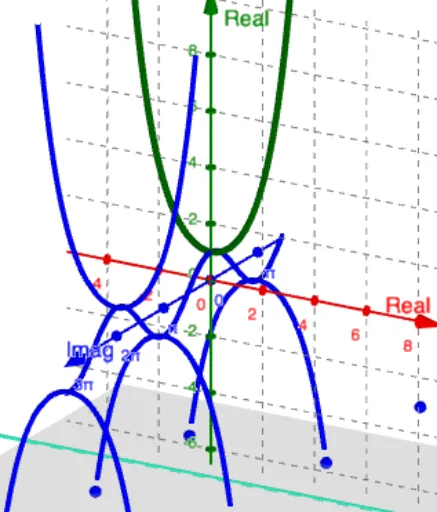
This example demonstrates the dual relationship between the hyperbolic cosine function (cosh) and the cosine function (cos). It involves core mathematical concepts such as hyperbolic functions, trigonometric functions, duality, and analytical geometry. The construction uses commands like Plane, Sequence, CurveCartesian, and objects including f, c, g, a, CurvNeg2, CurvNeg1, b, CurvPos2, CurvPos1, Pts1, Pts2, Pts3, Pts4, P1, P2, Pts5, Pts6, PtsCos1, PtsCos2, text1, text2, kk, text3. It is suitable for high school and above, ideal for teaching demonstrations and explorations of the geometric meaning of function graphs and dual relationships.
GeoGebra Commands & Parameters
Plane((0, c, 0), (1, c, 1), (-1, c, 3)) → aSequence(CurveCartesian[u, ((-1)^(n) * cosh(u)), (n * π), u, -25, 25], n, -9, -1, 2) → CurvNeg2Sequence(CurveCartesian[u, ((-1)^(n) * cosh(u)), (n * π), u, -25, 25], n, 1, 9, 2) → CurvNeg1CurveCartesian(0, cos(v), v, v, -25, 25) → bSequence(CurveCartesian[u, cosh(u), (n * π), u, -25, 25], n, -8, -2, 2) → CurvPos2Sequence(CurveCartesian[u, cosh(u), (n * π), u, -25, 25], n, 2, 8, 2) → CurvPos1Sequence((acosh(c), c, (π * n)), n, -8, -2, 2) → Pts1Sequence(((-acosh(c)), c, (π * n)), n, -8, -2, 2) → Pts2Sequence((acosh(c), c, (π * n)), n, 2, 8, 2) → Pts3Sequence(((-acosh(c)), c, (π * n)), n, 2, 8, 2) → Pts4Sequence((acosh(abs(c)), c, (n * π)), n, -7, 7, 2) → Pts5Sequence(((-acosh(abs(c))), c, (n * π)), n, -7, 7, 2) → Pts6Sequence((0, c, acos(c) + (n * π)), n, -8, 8, 2) → PtsCos1Sequence((0, c, (-acos(c)) + (n * π)), n, -8, 8, 2) → PtsCos2
AI Drawing Prompt Reference
Draw the graphs of the hyperbolic cosine function cosh(u) and the cosine function cos(v) to demonstrate their duality. Start by drawing the plane a, then plot the curves of cosh(u) and cos(v), followed by the graphs of the inverse hyperbolic cosine function. Finally, mark key points such as the positive and negative inverse hyperbolic cosine values and the positive and negative cosine values.
The prompt above was compiled from the original drawing commands and is for reference only.