
Draw Rational Numbers with Thales Theorem
Loading the math board and drawing, please wait…
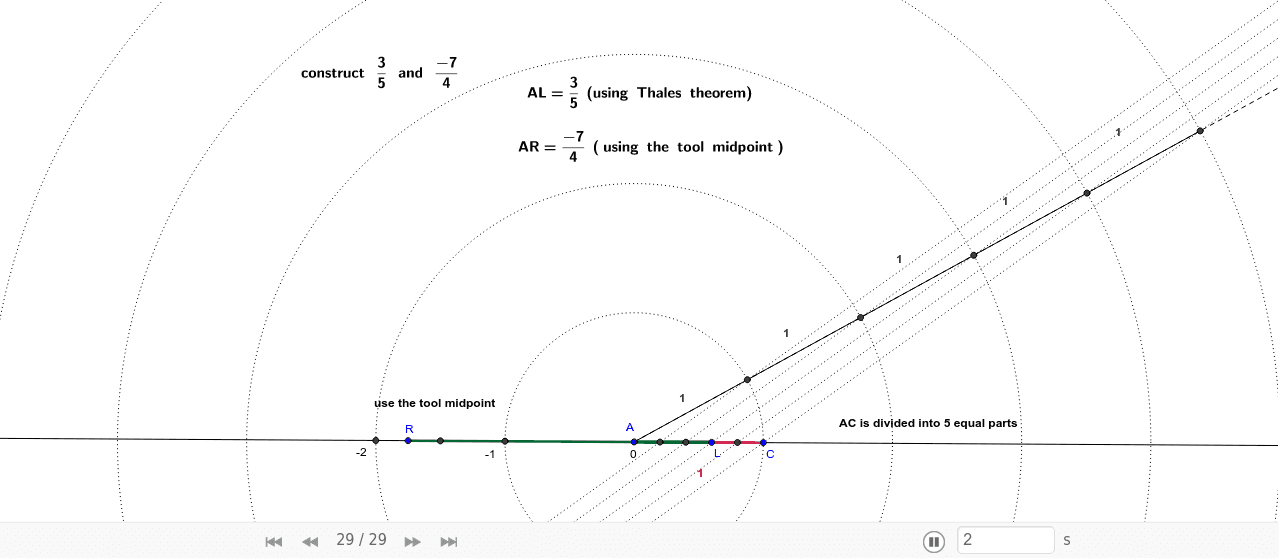
This example dynamically demonstrates how to construct rational points within the rational number range using Thales' theorem. It involves core mathematical concepts such as rational numbers, unit circle, tangent function, and properties of circles. Key GeoGebra commands/objects used in the construction include Line, Circle, Intersect, Segment, Ray, and Midpoint. Suitable for high school mathematics education to understand the geometric representation of rational numbers and the application of Thales' theorem.
GeoGebra Commands & Parameters
Line(A, B) → aCircle(A, 1) → cIntersect(c, a, 2) → CSegment(A, C) → bRay(A, D) → dIntersect(c, d, 1) → ESegment(A, E) → eCircle(A, 2) → fCircle(A, 3) → gCircle(A, 4) → hCircle(A, 5) → kIntersect(f, d, 1) → FIntersect(g, d, 1) → GIntersect(h, d, 1) → HIntersect(k, d, 1) → ISegment(E, F) → iSegment(F, G) → jSegment(G, H) → lSegment(H, I) → mLine(C, I) → nLine(H, n) → pLine(G, p) → qLine(F, q) → rLine(E, r) → sIntersect(a, s) → JIntersect(a, r) → KIntersect(a, q) → LIntersect(a, p) → MSegment(A, L) → tIntersect(c, a, 1) → OIntersect(f, a, 1) → PMidpoint(P, O) → QMidpoint(P, Q) → RSegment(A, R) → a_1
AI Drawing Prompt Reference
Draw a unit circle and a horizontal line, mark their intersection point. From this point, draw a tangent to the circle and a line from the center to the tangent point. Then draw circles with radii 2, 3, 4, and 5 centered at the circle's center. Connect the intersections of these circles with the tangent line to form a zigzag line. Finally, draw perpendiculars from the circle's intersection with the horizontal line to the zigzag line, and connect these intersections to form another zigzag line.
The prompt above was compiled from the original drawing commands and is for reference only.