
Dome 6: Geometric Dome Construction via Rotation and Mirroring
Loading the math board and drawing, please wait…
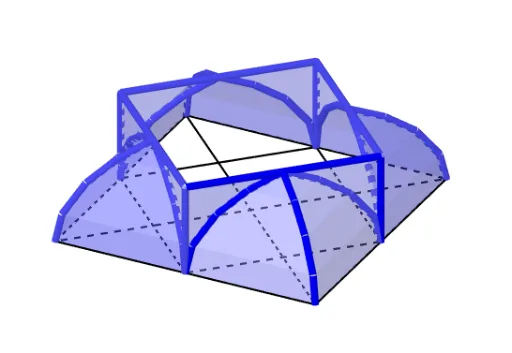
This example demonstrates a dome-shaped geometric structure formed by combining polygons, line segments, circular arcs, and mirror transformations, creating a regular pattern through rotation and symmetry operations. The core mathematical concepts include median lines, natural numbers, angles, trigonometric functions, and right triangle properties, showcasing the integration of geometric transformations with trigonometric relationships. Construction highlights: using GeoGebra commands such as Polygon, Intersect, Segment, Point, Midpoint, Rotate, CircleArc, Line, Plane, Mirror, and Sequence, the construction involves numerous points (O, A, B, C, D, etc.), a polygon named vierhoek1, and segments a, b, c, d, etc. Rotations and mirroring generate symmetric arcs and lines, ultimately forming the dome outline. Suitable for high school or early college students to explore geometric transformations, trigonometry, and constructive geometry, and also useful as a reference for mathematical modeling or artistic geometric design.
GeoGebra Commands & Parameters
Polygon(A, B, C, D) → vierhoek1, a, b, c, dIntersect(d, xAxis) → EIntersect(a, yAxis) → FSegment(E, F) → fIntersect(b, xAxis) → GSegment(F, G) → gPoint(c) → HSegment(G, H) → hSegment(H, E) → iMidpoint(f) → IMidpoint(g) → JMidpoint(h) → KMidpoint(i) → LSegment(D, B) → jRotate(C, 90°, j) → C'CircleArc(O, C, C') → ePoint(e) → NPoint(e) → PPoint(e) → QPoint(e) → RLine(K, zAxis) → kIntersect(k, e, 1) → SLine(U, b) → lLine(V, b) → mLine(W, b) → nPlane(G, H, T) → pIntersect(n, p) → ZIntersect(m, p) → A_1Intersect(l, p) → B_1Polygon(G, C, W, Z) → vierhoek2, g_1, c_1, w, z_1Polygon(Z, W, V, A_1) → vierhoek3, z_2, w_1, v, a_1Polygon(B_1, A_1, V, U) → vierhoek4, b_1, q, v_1, uPolygon(B_1, U, T) → driehoek1, t, r, u_1Plane(C, A, M) → p_1Mirror(vierhoek2, p_1) → vierhoek2'Mirror(vierhoek3, p_1) → vierhoek3'Mirror(vierhoek4, p_1) → vierhoek4'Mirror(driehoek1, p_1) → driehoek1'Polygon(G, Z, A_1, B_1, T, C_1) → veelhoek1, g_2, z_3, s, f_1, t_1, h_1Mirror(veelhoek1, p_1) → veelhoek1'Sequence(Rotate[l1, (nn * 90°), zAxis], nn, 1, 3) → l2Sequence(Rotate[l3, (nn * 90°), zAxis], nn, 1, 3) → l4Mirror(C_1, D_1) → E_1Rotate(C_1, 90°, zAxis) → F_1Line(C_1, E_1) → i_1Rotate(F_1, (-(90°)), i_1) → G_1CircleArc(D_1, F_1, G_1) → d_1Point(d_1) → I_1Point(d_1) → J_1Point(d_1) → K_1Point(d_1) → L_1Point(d_1) → M_1Mirror(N_1, p_1) → S_1Mirror(O_1, p_1) → T_1Mirror(P_1, p_1) → U_1Mirror(Q_1, p_1) → V_1Mirror(R_1, p_1) → W_1Polygon(C_1, F_1, R_1, W_1) → vierhoek5, j_1, k_1, r_1, l_1Polygon(W_1, R_1, Q_1, V_1) → vierhoek6, m_1, n_1, q_1, s_1Polygon(V_1, Q_1, P_1, U_1) → vierhoek7, e_1, f_2, h_2, i_2Polygon(U_1, P_1, O_1, T_1) → vierhoek8, j_2, k_2, o_1, l_2Polygon(T_1, O_1, N_1, S_1) → vierhoek9, m_2, n_2, p_2, q_2Polygon(S_1, N_1, H_1) → driehoek2, r_2, s_2, t_2Segment(C, W) → a_2Segment(W, V) → b_2Segment(V, U) → c_2Segment(U, T) → d_2Sequence(Rotate[l7, (nn * 90°), zAxis], nn, 1, 3) → l8Segment(C_1, W_1) → e_2Segment(W_1, V_1) → f_3Segment(V_1, U_1) → g_3Segment(U_1, T_1) → h_3Segment(T_1, S_1) → i_3Segment(S_1, H_1) → j_3Sequence(Rotate[l9, (nn * 90°), zAxis], nn, 1, 3) → l10Segment(G, Z) → k_3Segment(Z, A_1) → l_3Segment(A_1, B_1) → m_3Segment(B_1, T) → n_3Sequence(Rotate[l11, (nn * 90°), zAxis], nn, 1, 3) → l12Mirror(l11, p_1) → l11'Sequence(Rotate[l11', (nn * 90°), zAxis], nn, 1, 3) → l13Segment(F_1, H) → p_3Sequence(Segment[Rotate[F_1, (nn * 90°), zAxis], Rotate[H, (nn * 90°), zAxis]], nn, 1, 3) → l14Segment(C_1, F_1) → q_3Sequence(Segment[Rotate[C_1, (nn * 90°), zAxis], Rotate[F_1, (nn * 90°), zAxis]], nn, 1, 3) → l15Sequence(Rotate[l5, (nn * 90°), zAxis], nn, 1, 3) → l6Segment(A, C) → r_3