
Division of Fractions by Beena Mavani
Loading the math board and drawing, please wait…
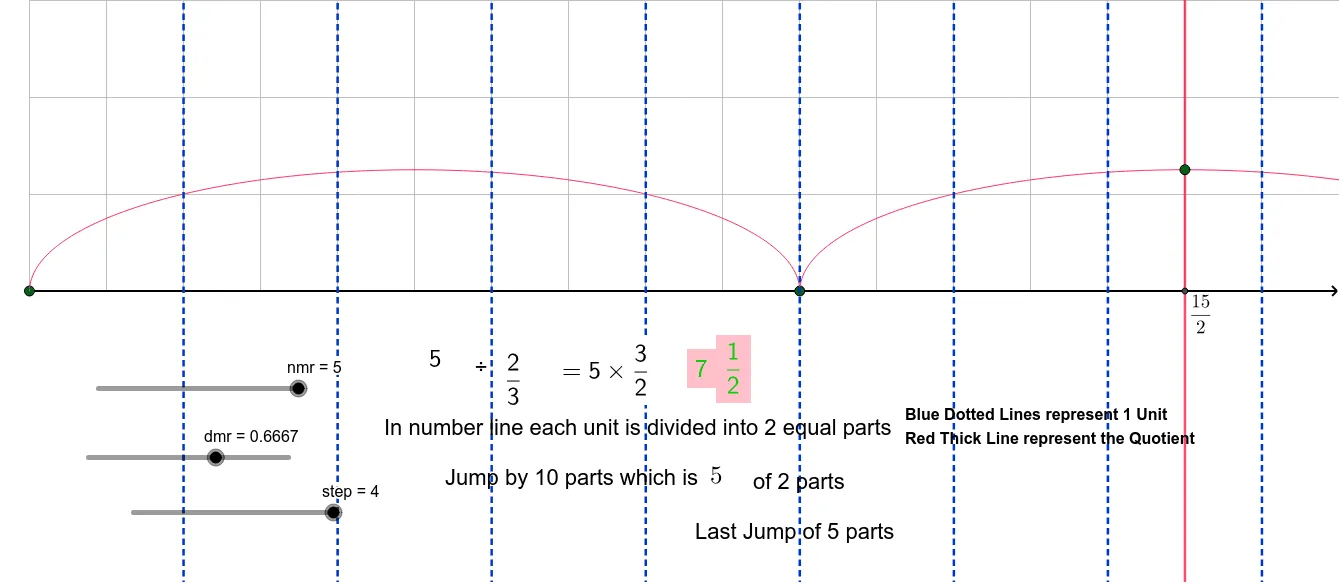
This example demonstrates the process of dividing fractions. Key mathematical concepts include fraction division. Using GeoGebra commands such as LaTeX, If, Sequence, etc., it dynamically illustrates the geometric meaning of fraction division. Suitable for middle school and above students.
GeoGebra Commands & Parameters
LaTeX(b, true, true) → text1If(round(j) < j, round(j) + 1, round(j)) → dSequence((nmr * n) - nmr, n, 1, d + 1) → list1Sequence((list1(i), 0), i, 1, d + 1) → list2FractionText(nmr) → text2Denominator(nmr) → eNumerator(b) → drIf(round(j, 0) ≟ j, 0, fractionalPart(j)) → fSequence(Semicircle[list2(n), list2(n + 1)], n, 1, d) → list3Line((c, 0), x = 0) → hFractionText(b) → text3If(c ≥ 1, If[round(c, 0) > c, round(c, 0) - 1, round(c, 0)]) → ansDefined(ans) → aIf(a, If[ans ≟ c, 0, c - ans], c) → ansdIntersect(list3(d), h) → A,Intersect(h, y = 0) → BSequence(x = n, n, 1, Max[Numerator[nmr] + 1, c + 1]) → list4
AI Drawing Prompt Reference
Draw a geometric representation of fraction division. Start by drawing a circle to represent the fraction b. Then, based on the numerator and denominator of fraction nmr, draw a sequence of semicircles with diameters increasing sequentially. These semicircles represent the result of dividing the numerator by the denominator. Finally, draw a vertical line at x=0, and the intersection points of this line with the semicircles and the x-axis indicate the result of the fraction division.
The prompt above was compiled from the original drawing commands and is for reference only.