
Displaying Radical Numbers on the Number Line
Loading the math board and drawing, please wait…
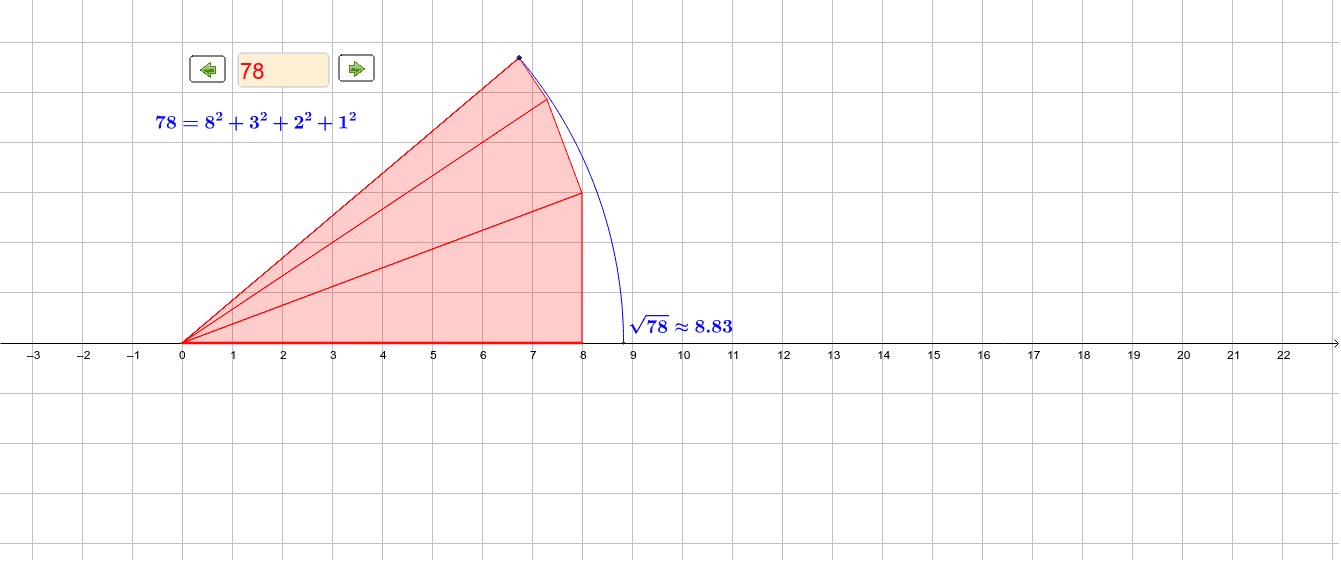
① This GeoGebra example demonstrates how to precisely locate radical numbers (such as √2, √3) on the number line using geometric construction, making irrational numbers visually tangible. ② The core mathematical concept is the geometric representation of square roots: by constructing right triangles whose hypotenuse equals the desired radical length (via the Pythagorean theorem), the irrational value is transferred onto the axis. ③ Construction details: the example employs Textfield for numeric input, Intersect to find perpendicular foot points, Polygon to build right triangles, OrthogonalLine for perpendiculars, Circle and CircleArc to transfer lengths, and multiple labeled points and polygons to iteratively construct successive radicals. ④ This resource is ideal for middle-to-high school students learning irrational numbers and for teachers demonstrating the geometric meaning of radicals in an interactive classroom setting.
GeoGebra Commands & Parameters
Textfield(a) → InputBox1Intersect(xAxis, yAxis) → OPolygon(O, A, B) → poly1, b_1, o, a_1OrthogonalLine(B, a_1) → pCircle(B, h) → qIntersect(q, p, 1) → CPolygon(O, B, C) → poly2, c_1, o_1, b_2OrthogonalLine(C, b_2) → rCircle(C, j) → sIntersect(s, r, 1) → DPolygon(O, C, D) → poly3, d_1, o_2, c_2OrthogonalLine(D, c_2) → tCircle(D, l) → e_1Intersect(e_1, t, 1) → EPolygon(O, D, E) → poly4, e_2, o_3, d_2OrthogonalLine(E, d_2) → f_1Circle(E, n) → g_1Intersect(g_1, f_1, 1) → FPolygon(O, E, F) → poly5, f_2, o_4, e_3Circle(O, F) → h_1Intersect(h_1, xAxis, 2) → GCircleArc(O, G, F) → k_1
AI Drawing Prompt Reference
Starting from the origin on a number line, construct a series of right triangles to precisely locate radical numbers. First, draw a vertical line above the origin, using the input length as one leg, and form the first right triangle with the origin, so its hypotenuse equals the square root of 2. Then, using that hypotenuse as a new leg, draw another perpendicular to create the next triangle, yielding the square root of 3, and repeat this process to obtain successive radicals. Finally, draw a circle centered at the origin with the latest hypotenuse as radius, intersecting the positive x-axis at the point representing the radical value. All triangles share the origin as a common vertex, with legs increasing sequentially, and vertices are labeled.
The prompt above was compiled from the original drawing commands and is for reference only.