
Visualizing Division of Fractions
Loading the math board and drawing, please wait…
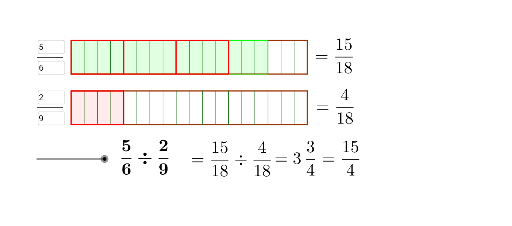
① This GeoGebra example dynamically demonstrates the process and result of dividing fractions, helping learners understand the principle that dividing by a fraction is equivalent to multiplying by its reciprocal. ② Core mathematical concepts include fractions, division, reciprocals, unit fractions, and geometric representations of fraction operations using number lines, area models, or segment partitions. ③ Construction highlights: from the construction summary, commands such as LCM (least common multiple) for denominators, DivPoint for locating fraction points on a number line, Polygon and Segment for building area or segment models, Textfield and InputBox for interactive input, and Sequence for generating point sequences are used. Objects include multiple points (A, B, C, D, etc.), segments (a, b, c, etc.), polygons (poly1, poly2), and lists (list1, list2, list3), all combined to show the steps and results of fraction division interactively. ④ Suitable for upper elementary to middle school students learning fraction operations, and for teachers to demonstrate in class or for students to explore independently, fostering visual and algebraic thinking.
GeoGebra Commands & Parameters
LCM(b, d) → oDivPoint(B, C, o) → list8DivPoint(A, D, o) → list7Polygon(E, F, G, H) → poly2, e, f_2, g, hSegment(I, J) → iSegment(K, L) → jTextfield(a) → InputBox1Textfield(b) → InputBox2Textfield(c) → InputBox3Textfield(d) → InputBox4Polygon(A, D, C, B) → poly1, a_1, d_1, c_1, b_1DivPoint(A, D, b) → list1DivPoint(B, C, b) → list2DivPoint(E, F, d) → list3DivPoint(H, G, d) → list4Sequence(Segment[Element[list1, i], Element[list2, i]], i, 1, b) → list5Sequence(Segment[Element[list3, i], Element[list4, i]], i, 1, d) → list6Polygon(A, Element[list1, a], Element[list2, a], B) → poly3, a_2, k, l, b_2Polygon(E, Element[list3, c], Element[list4, c], H) → poly4, e_1, m, n, h_1DivPoint(E, F, o) → list9DivPoint(H, G, o) → list10Sequence(Segment[Element[list7, i], Element[list8, i]], i, 1, o) → list11Sequence(Segment[Element[list9, i], Element[list10, i]], i, 1, o) → list12Polygon(A, Element[list7, t], Element[list8, t], B) → poly5, q, r, f_1, g_1Sequence(Polygon[Element[list7, (t * i)], Element[list7, (t * (i + 1))], Element[list8, (t * (i + 1))], Element[list8, (t * i)]], i, 1, p - 1) → list13