
Disk Pyramid Puzzle
Loading the math board and drawing, please wait…
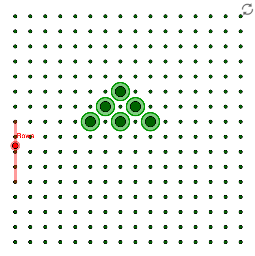
Turn the pyramid upside down with the fewest number of moves possible. Explore the minimum moves required for 2 rows, 3 rows, 4 rows, 5 rows, and 6 rows. This example demonstrates geometric transformations and sequences, using Circle and Sequence commands in GeoGebra. Suitable for middle school and above students to learn about geometric transformations and optimization problems.
GeoGebra Commands & Parameters
Circle(A, disksize) → cCircle(A_1, disksize) → c_1Circle(A_2, disksize) → c_2Circle(A_3, disksize) → c_3Circle(A_4, disksize) → c_4Circle(A_5, disksize) → c_5Circle(A_6, disksize) → c_6Circle(A_7, disksize) → c_7Circle(A_8, disksize) → c_8Circle(A_9, disksize) → c_9Circle(A_{10}, disksize) → c_{10}Circle(A_{11}, disksize) → c_{11}Circle(A_{12}, disksize) → c_{12}Circle(A_{13}, disksize) → c_{13}Circle(A_{14}, disksize) → c_{14}Sequence(Sequence[(w, k), w, 0, widthadjuster], k, 0, heightadjuster) → gridCircle(A_{15}, disksize) → c_{15}Circle(A_{16}, disksize) → c_{16}Circle(A_{17}, disksize) → c_{17}Circle(A_{18}, disksize) → c_{18}Circle(A_{19}, disksize) → c_{19}Circle(A_{20}, disksize) → c_{20}
AI Drawing Prompt Reference
Draw a pyramid-shaped stack of disks with six layers, containing 1, 2, 3, 4, 5, and 6 disks respectively from bottom to top. Each disk should be the same size and stacked stably to form a pyramid.
The prompt above was compiled from the original drawing commands and is for reference only.