
Dilations and Area by Dolores Strom
Loading the math board and drawing, please wait…
In collections
Dilation and Similarity Project: Part One
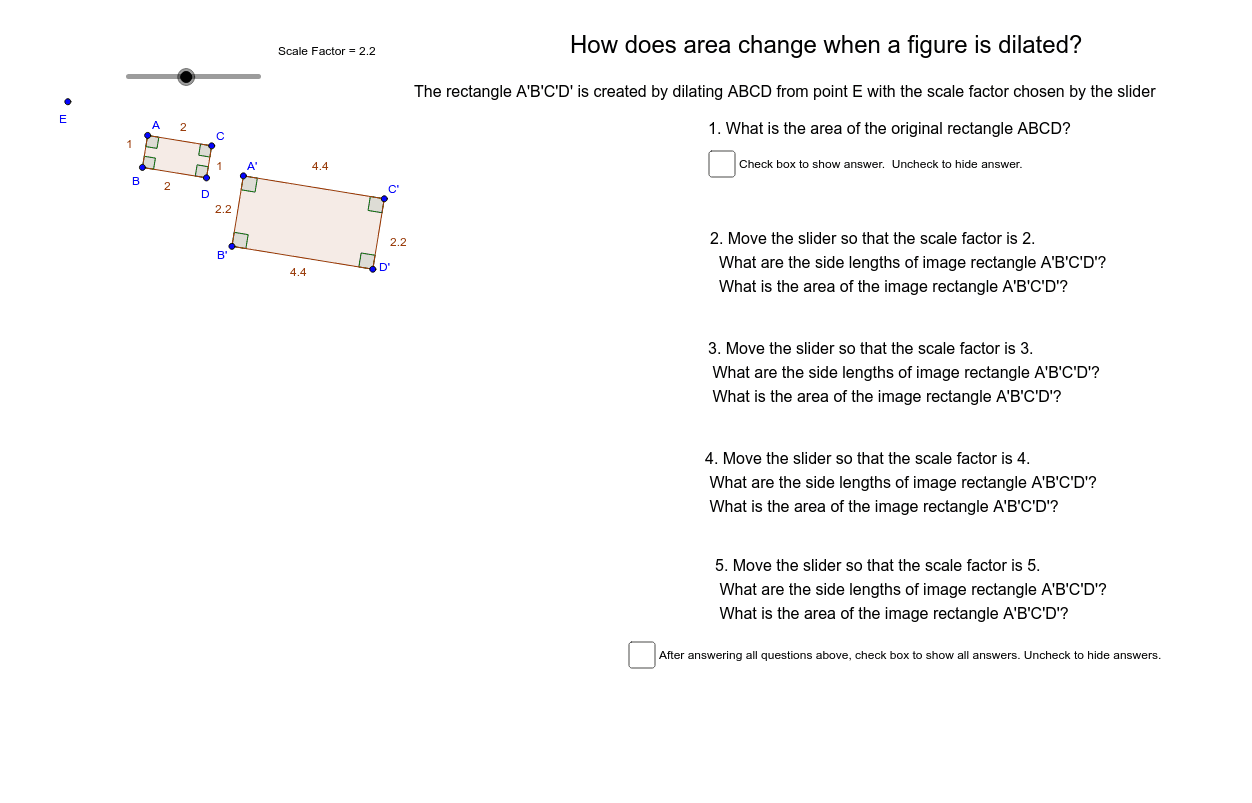
This example demonstrates how the area of a figure changes under dilation transformations. Key math concepts include dilation, area calculation, and similarity ratio. It is constructed using GeoGebra commands like Point, Segment, Circle, Polygon, and Dilate. Suitable for high school students learning geometric transformations and area properties.
GeoGebra Commands & Parameters
Point(Circle[A, 1]) → BSegment(A, B) → a_2OrthogonalLine(A, a_2) → b_2Circle(A, 2) → cIntersect(c, b_2, 2) → COrthogonalLine(C, b_2) → d_2OrthogonalLine(B, a_2) → eIntersect(d_2, e) → DPolygon(A, C, D, B) → poly1, a, c_1, d, bDilate(A, Dilation, E) → A'Dilate(C, Dilation, E) → C'Dilate(D, Dilation, E) → D'Dilate(B, Dilation, E) → B'Polygon(A', C', D', B') → poly1', a', c', d', b'Angle(A, C, D) → αAngle(B, A, C) → βAngle(D, B, A) → γAngle(C, D, B) → δAngle(B', A', C') → εAngle(D', B', A') → ζAngle(A', C', D') → ηAngle(C', D', B') → θ