
Dilation on a Sphere
Loading the math board and drawing, please wait…
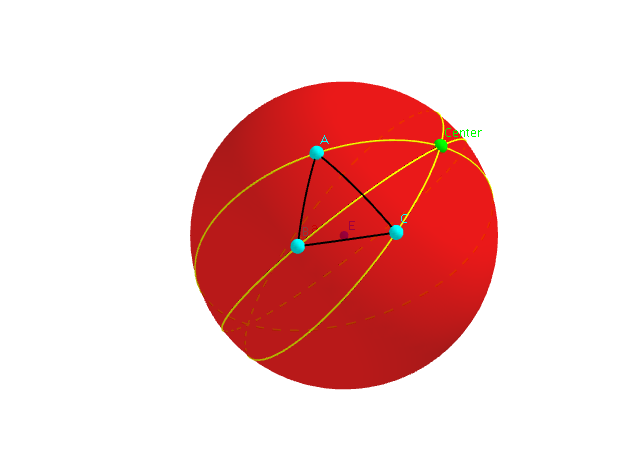
This example demonstrates the concept of dilation on a spherical surface. It involves core mathematical concepts such as spherical geometry, dilation transformations, parametric curves, and coordinate geometry. The construction utilizes GeoGebra commands like Sphere, PointIn, Plane, IntersectPath, OrthogonalLine, Intersect, and CurveCartesian. It is suitable for high school students and educators studying spherical geometry and transformation geometry.
GeoGebra Commands & Parameters
Sphere((0, 0, 0), 1) → aPointIn(a) → APointIn(a) → BPointIn(a) → CPointIn(a) → CenterPlane(E, A, Center) → bPlane(E, Center, C) → cPlane(E, B, Center) → dIntersectPath(b, a) → eIntersectPath(d, a) → fIntersectPath(c, a) → gPlane(E, A, C) → hOrthogonalLine(E, h) → iIntersect(i, a) → D, FPlane(A, i) → jOrthogonalLine(E, j) → kIntersect(k, a) → G, HCurveCartesian((x(A) * cos(t)) + (x(H) * sin(t)), (y(A) * cos(t)) + (y(H) * sin(t)), (z(A) * cos(t)) + (z(H) * sin(t)), t, 0, Angle[A, E, C]) → lPlane(B, A, E) → mOrthogonalLine(E, m) → nPlane(A, n) → oOrthogonalLine(E, o) → pIntersect(p, a, 1) → ICurveCartesian((x(A) * cos(t)) + (x(I) * sin(t)), (y(A) * cos(t)) + (y(I) * sin(t)), (z(A) * cos(t)) + (z(I) * sin(t)), t, 0, Angle[A, E, B]) → qPlane(B, C, E) → rOrthogonalLine(E, r) → sPlane(B, s) → tOrthogonalLine(E, t) → a_1Intersect(a_1, a, 2) → JCurveCartesian((x(B) * cos(t)) + (x(J) * sin(t)), (y(B) * cos(t)) + (y(J) * sin(t)), (z(B) * cos(t)) + (z(J) * sin(t)), t, 0, Angle[B, E, C]) → u
AI Drawing Prompt Reference
Demonstrate dilation on a spherical surface with three points, generate three planes through these points intersecting the sphere to form three curves. Create orthogonal lines through these points and the sphere's center to get two intersection points. Finally, draw two parametric curves using these points and an angle parameter to illustrate the dilation transformation.
The prompt above was compiled from the original drawing commands and is for reference only.