
Dilation and Reflection: Geometric Transformations
Loading the math board and drawing, please wait…
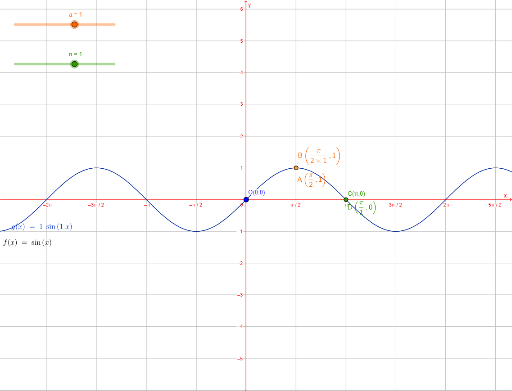
This GeoGebra example dynamically demonstrates the combined geometric transformations of dilation (scaling) and reflection on polygons, illustrating symmetry, scaling ratios, and coordinate mapping. Core mathematical concepts include homothetic transformation, axial symmetry, trigonometric sine wave reflections, and vertex coordinate geometry. The construction utilizes parameters `a`, `n`, `f`, `g` and sliders to control scaling factors and reflection cycles, mapping vertices `A`, `B`, `C`, `D` through center `O` to generate key transformed points like `D_1`, `PtA`, `PtD`, `nTimes2`, and `PtB_2` to trace dynamic loci. This resource is highly suitable for secondary school geometry, coordinate geometry, and trigonometry curricula, providing an intuitive way to understand geometric transformations and symmetry.
GeoGebra Commands & Parameters
Numeric a(1)Numeric n(1)f(x) = sin(x)g(x) = (a * sin((n * x)))(π / 2, 1)(π / ((2 * n)), a)(π, 0)(π / n, 0)(0, 0)(π / n, 0)(2 * n)
AI Drawing Prompt Reference
Create a dynamic geometric figure showing combined dilation and reflection of a polygon. Start with a basic sine curve and a second sine curve with adjustable amplitude and frequency, creating a symmetric pattern. Mark key points on the axes: the origin, intersections with the x-axis, and peak points determined by parameters. Use these points to construct a polygon centered at the origin. Then apply scaling and reflection transformations to the polygon's vertices, generating a series of transformed points that trace along the curves, producing a dynamic symmetric shape. The figure illustrates the interplay of trigonometric functions and geometric transformations.
The prompt above was compiled from the original drawing commands and is for reference only.