
Dilation 1: Geometric Transformation and Scaling
Loading the math board and drawing, please wait…
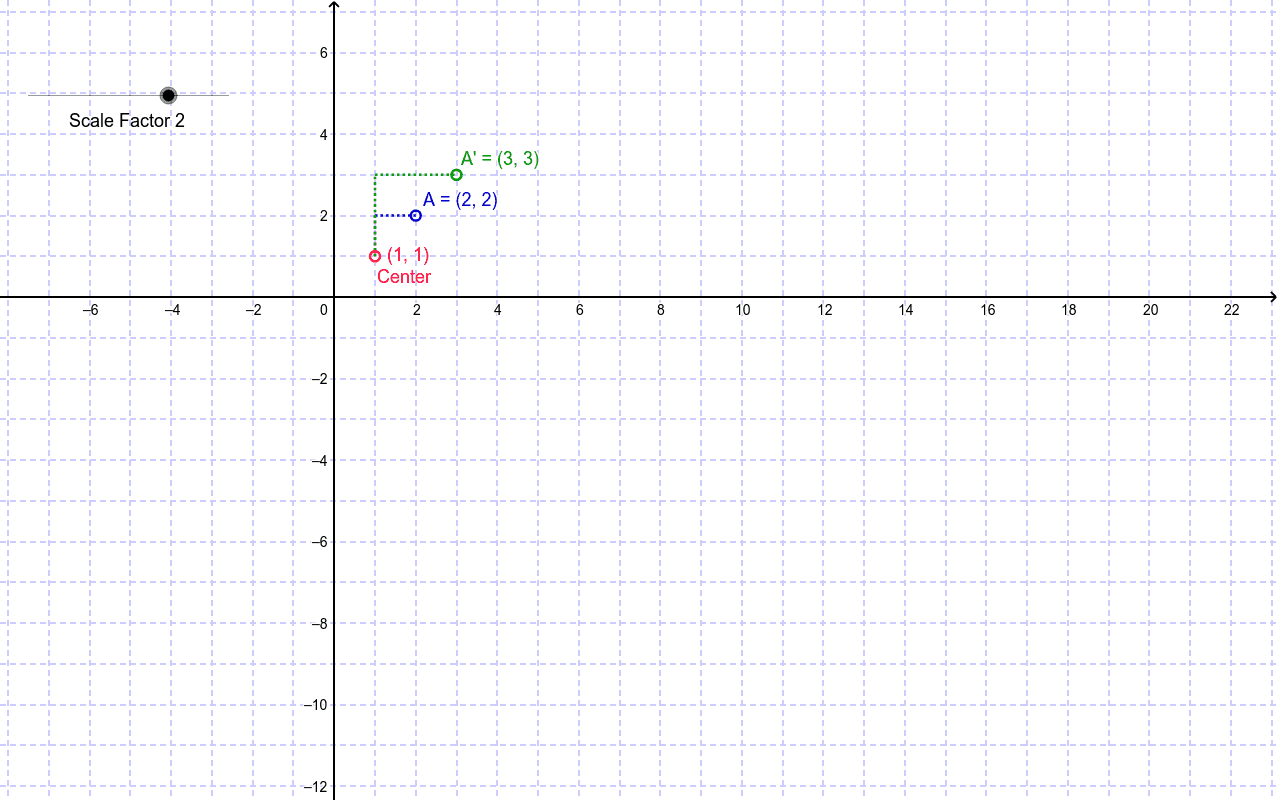
Dilation 1 demonstrates the principle of scaling transformations in geometry. It shows how figures can be enlarged or reduced proportionally, highlighting the importance of geometric transformations in mathematics. Key mathematical concepts include similarity transformations, proportional scaling, and coordinate transformations. Construction involves GeoGebra commands like Segment, Dilate, Rotate, using objects such as A, b, i, E, text1, Angle, A_p, a, g, G, A', g', E', H, a', F, text2. Suitable for middle or high school mathematics courses to understand geometric transformations and scaling applications.
GeoGebra Commands & Parameters
Segment(E, A_p) → aSegment(A_p, A) → gDilate(A_p, Angle, E) → GDilate(A, Angle, E) → A'Segment(G, A') → g'Rotate(E, ((-Angle) * 3.141592653589793 / 180), E) → E'Dilate(A_p, Angle, E) → HSegment(E', H) → a'Dilate(A_p, Angle, E) → F
AI Drawing Prompt Reference
Draw a triangle and a circle. The triangle ABC and circle O intersect at two points. The vertices A, B, C of triangle ABC lie on circle O. The center of circle O is O. The sides AB, BC, CA of triangle ABC intersect circle O. A point E is located on circle O. The construction order: first draw circle O, then draw triangle ABC, then mark point E. The figure should clearly show the intersection of the triangle and circle, and the position of point E.
The prompt above was compiled from the original drawing commands and is for reference only.