
Dilating a Line by John Williams
Loading the math board and drawing, please wait…
In collections
Dilation Introduction
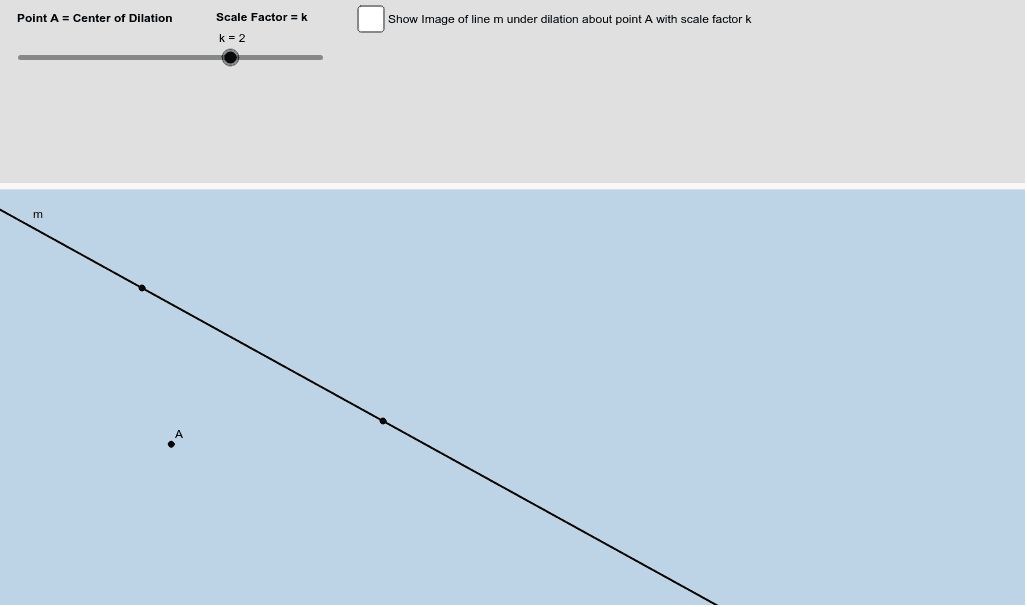
This example demonstrates how to use dilation (scaling) to study a line that does not pass through the center of dilation. Key mathematical concepts include similarity transformation, lines, and the center of dilation. Commands used include Line, Dilate, Intersect, etc. Suitable for high school geometry lessons.
GeoGebra Commands & Parameters
Line(B, C) → mDilate(m, k, A) → m'Intersect(m, t) → OLine(A, C) → fCircle(C, 2) → gIntersect(m', f) → ECircle(E, 2) → hIntersect(g, m, 2) → FIntersect(g, f, 2) → GIntersect(h, m', 2) → HIntersect(h, f, 2) → IIntersect(g, m, 1) → JIntersect(g, f, 1) → KCircleSector(C, F, G) → qAngle(F, C, G) → αAngle(J, C, G) → βCircleSector(C, J, G) → cIntersect(h, m', 1) → NDilate(C, 1 - i, E) → C'Vector(C, C') → uTranslate(q, u) → q'Translate(c, u) → c'Circle(A, 2) → e
AI Drawing Prompt Reference
Draw a line and its dilation image with a center off the line. Intersect a circle with the line and the image to find two points, then draw circles centered at these points. Connect the center of dilation to the intersection points of the circle with the line and image. Highlight key angles, sectors, and translate sectors using a vector to show the dilation effect.
The prompt above was compiled from the original drawing commands and is for reference only.