
Digitalization of Controllers: Damping Factor Lines
Loading the math board and drawing, please wait…
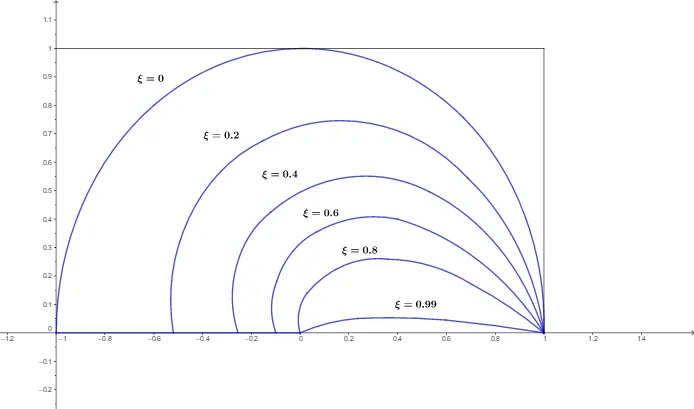
This GeoGebra example demonstrates the construction of damping factor (constant damping ratio) lines in the complex plane, which are essential for controller digitalization in control systems engineering. The core mathematical concepts involve damping ratio, natural frequency, root locus, and the geometric representation of constant damping ratio curves. The construction utilizes GeoGebra commands such as CircumcircleArc, Intersect, and Segment, along with numerous points (A through Z, A_1 to D_1) and auxiliary circles (c, d, e, etc.) to generate these lines, which typically appear as radial rays or logarithmic spirals from the origin. This resource is suitable for university-level control theory courses or advanced mathematical modeling, helping students visualize how the damping ratio affects second-order system transient response and how analog controllers are mapped to digital equivalents.
GeoGebra Commands & Parameters
CircumcircleArc(A, I, J) → cCircumcircleArc(J, C, K) → dCircumcircleArc(K, L, B) → eCircumcircleArc(G, M, N) → fCircumcircleArc(N, D, O) → gCircumcircleArc(O, P, B) → hCircumcircleArc(F, Q, R) → kCircumcircleArc(R, S, T) → pCircumcircleArc(T, U, B) → qCircumcircleArc(E, V, W) → rCircumcircleArc(W, Z, A_1) → sCircumcircleArc(A_1, B_1, C_1) → tCircumcircleArc(C_1, D_1, B) → c_1CircumcircleArc(H, E_1, F_1) → d_1CircumcircleArc(F_1, G_1, H_1) → e_1CircumcircleArc(H_1, I_1, J_1) → f_1CircumcircleArc(J_1, K_1, B) → g_1CircumcircleArc(H, L_1, M_1) → h_1CircumcircleArc(M_1, N_1, O_1) → k_1CircumcircleArc(O_1, P_1, B) → p_1Intersect(c, xAxis, 1) → Q_1Intersect(d_1, h_1, 1) → R_1Segment(Q_1, R_1) → iSegment(Q_1, R_1) → jSegment(S_1, T_1) → lIntersect(e, h, 1) → U_1Segment(T_1, U_1) → m