
Diagonals of a Rhombus
Loading the math board and drawing, please wait…
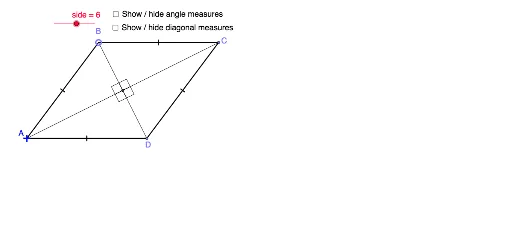
This example demonstrates the properties and relationships of the diagonals in a rhombus. Key math concepts include the symmetry of a rhombus, the diagonals being perpendicular bisectors of each other, and the diagonals dividing the rhombus into four congruent right triangles. Construction involves commands/objects like Point, Segment, Line, OrthogonalLine, Intersect, Angle, Polygon in GeoGebra. Suitable for middle school and above students learning geometric constructions and property exploration.
GeoGebra Commands & Parameters
Point(Circle[A, side]) → BSegment(A, B) → bLine(A, B) → cPoint(Circle[A, side]) → DSegment(A, D) → dPoint(Circle[B, side]) → CSegment(B, C) → eLine(D, C) → fLine(C, c) → gSegment(D, C) → hLine(E, F) → iOrthogonalLine(E, i) → jOrthogonalLine(F, i) → kPoint(k) → GOrthogonalLine(G, j) → lIntersect(j, l) → HSegment(E, H) → mSegment(H, G) → nSegment(G, F) → pSegment(F, E) → qAngle(E, F, G) → αAngle(F, G, H) → βAngle(G, H, E) → γAngle(H, E, F) → δAngle(B, C, D) → εAngle(C, D, A) → ζAngle(D, A, B) → ηAngle(A, B, C) → θPolygon(I, J, 4) → poly1, i_1, j_1, r, s, K_1, L_1Angle(I, L_1, K_1) → ιAngle(L_1, K_1, J) → κAngle(K_1, J, I) → λAngle(J, I, L_1) → μIntersect(s, r) → LIntersect(j_1, r) → KSegment(A, C) → tSegment(D, B) → a_1Intersect(t, a_1) → MSegment(M, B) → b_1Segment(M, D) → c_1Segment(M, C) → d_1Segment(M, A) → e_1Angle(B, M, C) → νAngle(D, M, C) → ξAngle(A, M, D) → οAngle(B, M, A) → ρAngle(M, C, B) → σAngle(M, C, D) → τAngle(C, D, M) → υAngle(M, D, A) → φAngle(D, A, M) → χAngle(A, B, M) → ψAngle(M, A, B) → ωAngle(M, B, C) → α_1Segment(M, C) → f_1Segment(M, D) → g_1Segment(M, B) → h_1Segment(A, M) → k_1