
Determining Exact Values of Trig Ratios
Loading the math board and drawing, please wait…
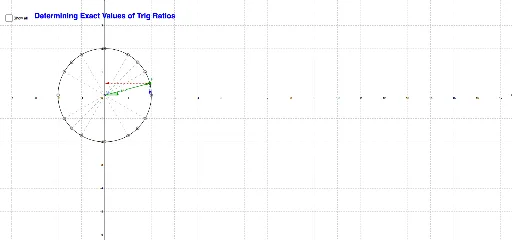
This example demonstrates how to geometrically construct and determine exact values of trigonometric ratios. Key math concepts include trigonometry, equilateral triangles, circles, and angle measurement. GeoGebra commands used in the construction are: Intersect, Point, Circle, Segment, Distance, Angle, Vector, Polygon, Line, and Mirror. Suitable for high school mathematics education to help students understand the geometric meaning and calculation of trigonometric values.
GeoGebra Commands & Parameters
Intersect(xAxis, yAxis) → OPoint(xAxis) → ECircle(O, E) → c_1Point(c_1) → PSegment(O, P) → aDistance(P, A_1) → bAngle(E, O, P) → αSegment(A_1, (x(A_1), 0)) → fSegment(A_2, (x(A_2), 0)) → gSegment(B_2, B_1) → hSegment(C_2, C_1) → iVector(O, P) → uVector(P, (x(P), 0)) → vVector(P, (0, y(P))) → wPoint(u) → ASegment(A, C_2) → eSegment(A, B_2) → jSegment(A, A_2) → kSegment(A, A_3) → lSegment(A, B_3) → mSegment(A, C_3) → nSegment(A, C_4) → pSegment(A, B_4) → qSegment(A, A_4) → rSegment(A, A_1) → s_1Segment(A, B_1) → tSegment(A, C_1) → a_1Polygon(P, (x(P), 0), A) → poly1, a_2, B, b_1Polygon((abs(x(P)), abs(y(P))), A, (abs(x(P)), 0)) → poly2, d_1, e_1, a_3Point(d_1) → CLine(C, C_1) → sPoint(e) → DLine(C, D) → cPoint(j) → FLine(C, F) → f_1Point(k) → GLine(C, G) → g_1Point(l) → HLine(C, H) → h_1Point(m) → ILine(C, I) → i_1Intersect(c_1, c) → J, KIntersect(c_1, f_1) → L, MIntersect(c_1, h_1) → R, TIntersect(c_1, i_1) → U, VIntersect(c_1, s) → Z, D_1Segment(M, L) → l_1Segment(V, U) → m_1Segment(D_1, Z) → n_1Segment(K, J) → p_1Segment(T, R) → k_1Mirror(R, xAxis) → R'Point(l_1) → QLine(R', Q) → j_1Intersect(c_1, j_1) → E_1, F_1Segment(F_1, E_1) → q_1