
Determining Area vs Perimeter with Block Shapes
Loading the math board and drawing, please wait…
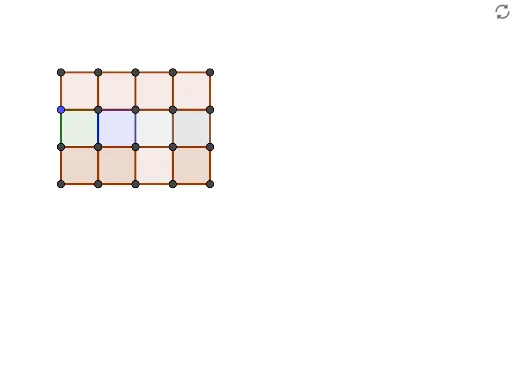
This GeoGebra example lets users edit a picture made of blocks to create three different shapes, then find the perimeter and area of each shape, demonstrating that shapes with the same area can have different perimeters and vice versa. Core math concepts include area and perimeter of polygons, their calculation, and the relationship between shape configuration and these measurements. Construction uses the Polygon command to define multiple polygons (poly1, poly2, poly4, poly5, poly6) with vertices at points A, B, C, D, E, F, G, H, L, K, M, N, O, P, Q, R, and segments (f, g, h, i, j, k, l, m, s, t, a, b, c, d, e, f_1, g_1, h_1, i_1) to outline and measure the shapes. Suitable for upper elementary and middle school students, this interactive activity reinforces geometric concepts and encourages exploration of how changing a shape's outline affects its area and perimeter.
GeoGebra Commands & Parameters
Polygon(A, B, 4) → poly1, f, g, h, i, C, DPolygon(E, D, 4) → poly2, j, k, l, m, F, GPolygon(K, L, 4, xOyPlane) → poly4, s, t, a, b, M, NPolygon(G, O, 4) → poly5, c, d, e, f_1, P, QPolygon(O, R, 4) → poly6, g_1, h_1, i_1, j_1, S, TPolygon(E, I, 4) → poly3, n, p, q, r, J, UPolygon(L, G, 4) → poly7, k_1, l_1, m_1, n_1, V, WPolygon(O, G, 4) → poly8, p_1, q_1, r_1, s_1, Z, A_1Polygon(O, R, 4) → poly9, t_1, a_1, b_1, c_1, B_1, C_1Polygon(P, S, 4) → poly10, d_1, e_1, f_2, g_2, D_1, E_1Polygon(E, P, 4) → poly11, h_2, i_2, j_2, k_2, F_1, G_1Polygon(A, D, 4) → poly12, l_2, m_2, n_2, p_2, H_1, I_1Polygon(C, B, 4) → poly13, q_2, r_2, s_2, t_2, J_1, K_1Polygon(R, O, 4) → poly14, a_2, b_2, c_2, d_2, L_1, M_1Polygon(J_1, K, 4, xOyPlane) → poly15, e_2, f_3, g_3, h_3, N_1, O_1Polygon(A_1, M_1, 4) → poly16, i_3, j_3, k_3, l_3, P_1, Q_1