
Deriving the Sum of Cubes Formula - Through Volume
Loading the math board and drawing, please wait…
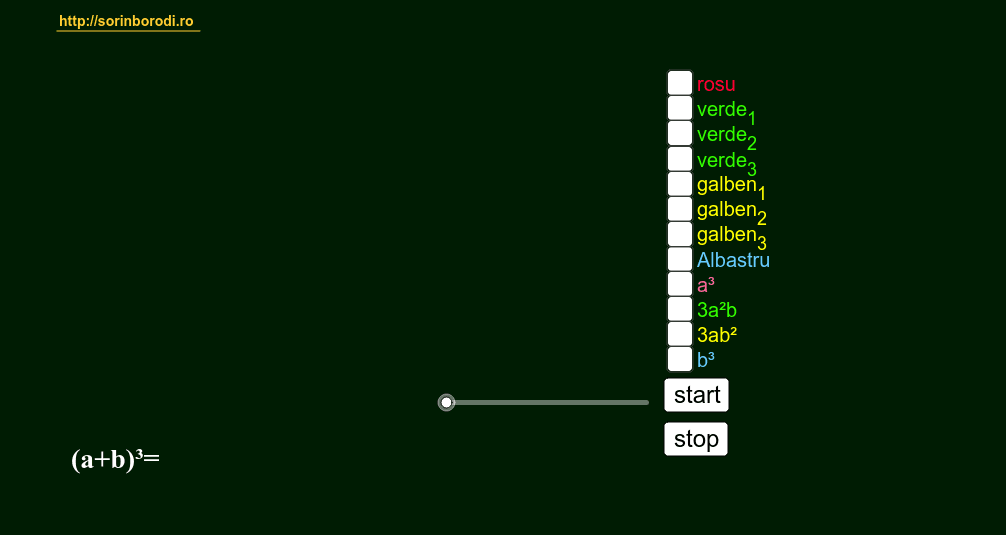
This example demonstrates the derivation of the sum of cubes formula through geometric volume calculations. Key mathematical concepts include cube volume, geometric transformations, and vectors. It uses commands like Polygon, Segment, Point, and Line in GeoGebra. Suitable for middle school and above students learning geometry and algebra.
GeoGebra Commands & Parameters
Polygon(A, B, C, D) → poly1, a, b, c, dPolygon(D, E, F, A) → poly2, d_1, e, f, a_1Polygon(C, G, E, D) → poly3, c_1, g, e_1, d_2Segment(F, H) → hSegment(H, G) → iSegment(H, B) → jPoint(c) → IPoint(b) → KPolygon(C, I, J, K) → poly4, c_2, i_1, j_1, kPoint(c_1) → MPolygon(I, L, M, C) → poly5, i_2, l, m, c_3Polygon(L, N, J, I) → poly6, l_1, n_{18}, j_2, i_3Point(g) → OLine(I, O) → pLine(J, N) → qPoint(h) → QPolygon(N, P, Q, R) → poly7, n_1, p_1, q_1, rPoint(e) → SPolygon(R, S, F, Q) → poly8, r_1, s, f_1, q_2Point(f) → TPolygon(P, T, U, N) → poly9, p_2, t, u, n_2Polygon(U, S, R, N) → poly10, u_1, s_1, r_2, n_3Polygon(T, F, S, U) → poly11, t_1, f_2, s_2, u_2Segment(N, V) → b_1Segment(V, K) → g_1Segment(V, M) → h_1Segment(Q, R) → k_1Segment(Q, P) → m_1Polygon(L, O, G, M) → poly12, l_2, o, g_2, m_2Polygon(O, R, N, L) → poly13, o_1, r_3, n_4, l_3Polygon(N, L, M, V) → poly14, n_5, l_4, m_3, vSegment(R, W) → a_2Segment(W, G) → b_2Segment(W, V) → e_2Point(j) → ZPolygon(V, Z, B, K) → poly15, v_1, z_1, b_3, k_2Point(a) → A_1Polygon(J, A_1, B, K) → poly16, j_3, a_3, b_4, k_3Polygon(A_1, P, N, J) → poly17, a_4, p_3, n_6, j_4Polygon(K, V, N, J) → poly18, k_4, v_2, n_7, j_5Point(d) → B_1Point(d_1) → C_1Polygon(U, B_1, D, C_1) → poly19, u_3, b_5, d_3, c_4Polygon(D, C_1, L, I) → poly20, d_4, c_5, l_5, i_4Polygon(I, J, B_1, D) → poly21, i_5, j_6, b_6, d_5Polygon(C_1, E, O, L) → poly22, c_6, e_3, o_2, l_6Polygon(C_1, E, S, U) → poly23, c_7, e_4, s_3, u_4Polygon(U, N, L, C_1) → poly24, u_5, n_8, l_7, c_8Polygon(B_1, A, A_1, J) → poly25, b_7, a_5, a_6, j_7Polygon(A, B_1, U, T) → poly26, a_7, b_8, u_6, t_2Polygon(U, N, J, B_1) → poly27, u_7, n_9, j_8, b_9Segment(B, C) → h_2Segment(C, G) → f_3Segment(G, H) → g_3Segment(H, B) → h_3Segment(B, A) → q_3Segment(C, D) → t_3Segment(D, E) → f_4Segment(E, G) → g_4Segment(A, D) → h_4Segment(A, F) → m_4Segment(F, E) → p_4Segment(K, B_1) → q_4Segment(A_1, I) → r_4Segment(I, O) → s_4Segment(M, C_1) → t_4Segment(B_1, S) → e_5Segment(T, C_1) → f_5Segment(P, L) → g_5Segment(A_1, Q) → h_5Segment(J, R) → k_5Segment(W, S) → m_5Segment(V, U) → p_5Segment(Q, O) → q_5Segment(Z, M) → r_5Segment(Z, T) → s_5Polygon(K, C, M, V) → poly28, k_6, c_9, m_6, v_3Polygon(K, V, N, J) → poly29, k_7, v_4, n_{10}, j_9Polygon(V, M, G, W) → poly30, v_5, m_7, g_6, w_3Polygon(J, I, L, N) → poly31, j_{10}, i_6, l_8, n_{11}Polygon(Z, V, N, P) → poly32, z_2, v_6, n_{12}, p_6Polygon(V, W, R, N) → poly33, v_7, w_4, r_6, n_{13}Polygon(P, N, R, Q) → poly34, p_7, n_{14}, r_7, q_6Polygon(Z, V, W, H) → poly35, z_3, v_8, w_5, h_6Polygon(N, L, O, R) → poly36, n_{15}, l_9, o_6, r_8Polygon(A_1, J, N, P) → poly37, a_8, j_{11}, n_{16}, p_8Polygon(P, N, R, Q) → poly38, p_9, n_{17}, r_9, q_7Polygon(P, Q, F, T) → poly39, p_{10}, q_8, f_6, t_6Segment(D_1, E_1) → e_6Segment(R, S) → f_7
AI Drawing Prompt Reference
Draw a cube and demonstrate the derivation of the volume formula through geometric volume calculations. Start by constructing a cube, then cut it into several parts using geometric transformations, and rearrange these parts to form new geometric shapes. Show the calculation and derivation of the cube's volume, and the role of vectors in geometric transformations.
The prompt above was compiled from the original drawing commands and is for reference only.