
Deriving the Circumference and Area of a Circle
Loading the math board and drawing, please wait…
In collections
Area and circumference of a circle
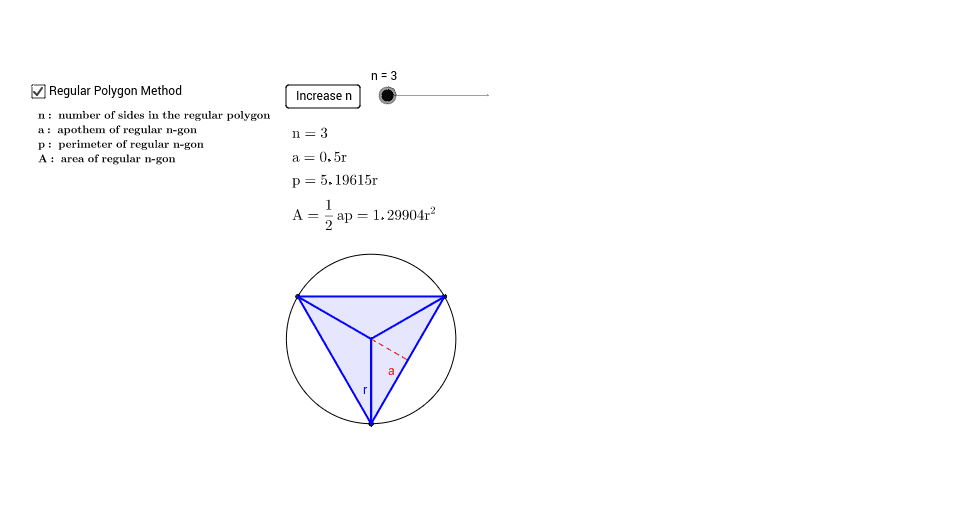
This example demonstrates the derivation of the formulas for the circumference and area of a circle using the regular polygon method and a modified onion method. It utilizes commands such as Sequence, Polygon, Circle, Point, and Segment in GeoGebra, suitable for students in middle school and above studying geometry and calculus.
GeoGebra Commands & Parameters
Sequence((sin(2 * π * k / n), -cos(2 * π * k / n)), k, 0, n, 1) → verticesPolygon(vertices) → regpoly, , , ,Segment((0, 0), Midpoint[Element[vertices, 1], Element[vertices, 2]]) → aPerimeter(regpoly) → pSequence(Segment[(0, 0), Element[vertices, k]], k, 1, n) → trisidesArea(regpoly) → ACircle(O, 1) → cSegment(O, B) → rSequence(Circle[O, j / k], j, 1, k, 1) → circles_0Sequence(O + (0, (-j) / k), j, 1, k, 1) → initialZip(Circle[C, P], P, initial) → circlesZip(Rotate[P, 360° * Distance[O, P] / Radius[S], C], P, initial, S, circles) → finalZip(Ray[C, P], P, final) → raysSequence(Intersect[Element[circles, j], Element[rays, j + 1]], j, 1, k - 1, 1) → final_2Zip(CircleArc[C, P, P'], P, initial, P', final_2) → arcsCircleArc(C, O, Rotate[O, 360° * Distance[O, Element[initial, 1]] / Radius[Element[circles, 1]], C]) → arc_0Sequence(Segment[Element[final, j + 1], Element[final_2, j]], j, 1, k - 1, 1) → endsegCircleArc(C, B, Rotate[B, 360° * Distance[O, B] / Radius[Element[circles, k]], C]) → arc_kSequence(Element[initial, j] + (2 * π * Radius[Element[circles_0, j + 1]], 0), j, 1, k - 1, 1) → finalh_2Sequence(Segment[Element[initial, j], Element[finalh_2, j]], j, 1, k - 1, 1) → basesSegment(O, O + (2 * π * Radius[Element[circles_0, 1]], 0)) → base_0Segment(B, B + (2 * π * Radius[Element[circles_0, k]], 0)) → base_kZip(P + (2 * π * Radius[S], 0), P, initial, S, circles_0) → finalhSequence(Segment[Element[finalh_2, j - 1], Element[finalh, j]], j, 2, k, 1) → heightsSegment(finalh_0, Element[finalh, 1]) → height_0Intersect(arc_0, Element[rays, 1]) → final_0,Segment(final_0, Element[final, 1]) → endseg_0Point(Circle[D, 6.283185307179586]) → ESegment(D, E) → eSequence(1 / k * 2 * π * Radius[Element[circles_0, j]], j, 1, k) → areasSum(areas) → area
AI Drawing Prompt Reference
Draw a circle and demonstrate the derivation of its circumference and area. Start by approximating the circle with a regular polygon, then use rotations and divisions to approximate the circumference and area. Next, construct a series of arcs and segments to illustrate the limit definitions of the circumference and area. Finally, draw the diameter and radius of the circle, and show the area formula.
The prompt above was compiled from the original drawing commands and is for reference only.