
Derivative Intuition Exploration
Loading the math board and drawing, please wait…
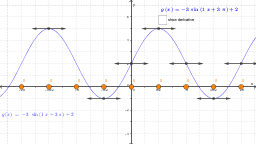
This example demonstrates the relationship between a function's derivative and its tangent line at a point. Core math concepts include derivatives, tangent lines, vectors, and function graphs. It uses GeoGebra commands like Random, Point, Circle, Intersect, and Vector. Suitable for high school and above to understand the geometric meaning of derivatives and optimization problems.
GeoGebra Commands & Parameters
Random(-3, 3, true) → cRandom(-3, 3, true) → dRandom(-3, 3, true) → aRandom(1, 2, true) → bPoint(vert_A) → ACircle((x(A), g(x(A))), 1) → circle_AIntersect(circle_A, line_A, 1) → A_2Intersect(circle_A, line_A, 2) → A_3Intersect(g, vert_A, (0, 2)) → A_1Vector(A_1, A_3) → u_AVector(A_1, A_2) → v_APoint(vert_B) → BCircle((x(B), g(x(B))), 1) → circle_BIntersect(g, vert_B, (1.5707963267948966, 5)) → B_1Intersect(circle_B, line_B, 1) → B_2Intersect(circle_B, line_B, 2) → B_3Vector(B_1, B_2) → u_BVector(B_1, B_3) → v_BPoint(vert_C) → CIntersect(g, vert_C, (3.141592653589793, 2)) → C_1Circle((x(C), g(x(C))), 1) → circle_CIntersect(circle_C, line_C, 1) → C_2Intersect(circle_C, line_C, 2) → C_3Vector(C_1, C_3) → u_CVector(C_1, C_2) → v_CPoint(vert_D) → DCircle((x(D), g(x(D))), 1) → circle_DIntersect(g, vert_D, (4.71238898038469, -1)) → D_1Intersect(circle_D, line_D, 1) → D_2Intersect(circle_D, line_D, 2) → D_3Vector(D_1, D_2) → u_DVector(D_1, D_3) → v_DPoint(vert_E) → ECircle((x(E), g(x(E))), 1) → circle_EIntersect(g, vert_E, (6.283185307179586, 2)) → E_1Intersect(circle_E, line_E, 1) → E_2Intersect(circle_E, line_E, 2) → E_3Vector(E_1, E_2) → u_EVector(E_1, E_3) → v_EPoint(vert_F) → FCircle((x(F), g(x(F))), 1) → circle_FIntersect(g, vert_F, (-1.5707963267948966, -1)) → F_1Intersect(circle_F, line_F, 1) → F_3Intersect(circle_F, line_F, 2) → F_2Vector(F_1, F_3) → u_FVector(F_1, F_2) → v_FPoint(vert_G) → GCircle((x(G), g(x(G))), 1) → circle_GIntersect(g, line_G, (-4.712388980384618, -3)) → G_1Intersect(circle_G, line_G, 1) → G_2Intersect(circle_G, line_G, 2) → G_3Vector(G_1, G_2) → u_GVector(G_1, G_3) → v_GPoint(vert_H) → HCircle((x(H), g(x(H))), 1) → circle_HIntersect(g, line_H, (-4.71238898038469, 5)) → H_1Intersect(circle_H, line_H, 1) → H_2Intersect(circle_H, line_H, 2) → H_3Vector(H_1, H_2) → u_HVector(H_1, H_3) → v_HPoint(vert_I) → ICircle((x(I), g(x(I))), 1) → circle_IIntersect(circle_I, line_I, 1) → I_2Intersect(circle_I, line_I, 2) → I_3Intersect(g, line_I, (-7.853981633974411, -3)) → I_1Vector(I_1, I_2) → u_IVector(I_1, I_3) → v_I