
Demonstration of Sine, Cosine, and Tangent
Loading the math board and drawing, please wait…
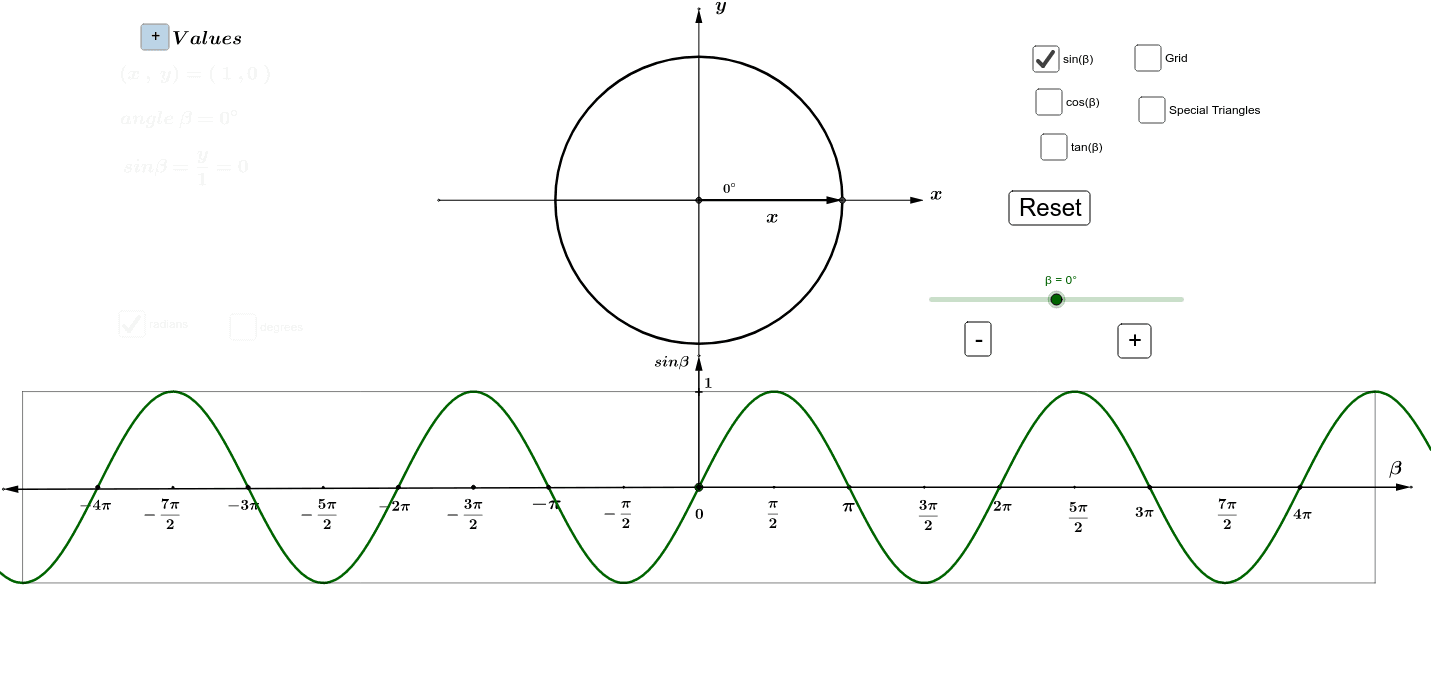
This example dynamically demonstrates the relationship between sine, cosine, and tangent functions in a right triangle, visually showcasing the definition and geometric meaning of trigonometric functions. Core math concepts include trigonometry, right triangles, unit circle, vectors, and coordinate geometry. Construction highlights GeoGebra commands like Intersect, Circle, Point, Rotate, Vector, Midpoint, Segment, CurveCartesian, Polygon, OrthogonalLine, and If. Suitable for high school students learning trigonometric geometry and university foundational mathematics education.
GeoGebra Commands & Parameters
Intersect(xAxis, yAxis) → ACircle(A, 3) → cPoint(c) → BRotate(B, β, A) → B'_1Vector(A, B'_1) → vPoint(v) → EMidpoint(I, F) → JMidpoint(F, J) → KMidpoint(J, I) → LMidpoint(B, G) → MMidpoint(B, H) → NSegment(J, B) → kSegment(K, M) → lMidpoint(I, H) → OMidpoint(I, O) → PMidpoint(O, H) → QMidpoint(F, G) → RMidpoint(F, R) → SMidpoint(R, G) → TSegment(P, S) → mSegment(Q, T) → pPoint(g) → UPoint(g) → VPoint(g) → WPoint(g) → ZSegment(R, O) → a_1CurveCartesian(((a * α) * cos(α)), ((a * α) * sin(α)), α, 0, β) → dCurveCartesian(((a * α) * cos(α)), (((-a) * α) * sin(α)), α, 0, (-β)) → eSegment(L, N) → tVector(C_3, C_2) → uVector(C_4, C_1) → wPoint(g) → CPoint(g) → DPoint(g) → A_1Point(g) → B_1Point(g) → D_1Point(g) → E_1Point(j) → F_1Point(g) → G_1Point(g) → H_1Point(g) → I_1Point(g) → J_1Point(g) → K_1Intersect(g, yAxis, (0, -6)) → L_1Vector(C_6, C_5) → u_1Polygon(M_1, N_1, O_1, P_1) → poly2, m_1, n_1, o_1, p_3Vector(J_1, W_1) → v_1Vector(J_1, Z_1) → w_1Point(yAxis) → A_2Vector(J_1, A_2) → c_1Point(xAxis) → B_2Point(xAxis) → D_2Vector(B_2, D_2) → d_1Point(yAxis) → E_2Vector(A_2, E_2) → e_1OrthogonalLine(B'_1, xAxis) → i_1Intersect(i_1, xAxis) → F_2Vector(F_2, B'_1) → j_1Segment(B'_1, F_2) → k_1Point(e_1) → G_2Midpoint(F_2, B'_1) → H_2Segment(G_2, F_2) → l_1Midpoint(G_2, F_2) → I_2OrthogonalLine(B'_1, a_1) → a_2Intersect(a_1, yAxis) → J_2Intersect(a_2, yAxis) → K_2Vector(G_2, F_2) → u_2Polygon(L_2, M_2, N_2, O_2) → poly1, l_2, m_2, n_2, o_2Segment(A, B'_1) → bMidpoint(A, B'_1) → P_2Point(b) → Q_2Polygon(R_2, S_2, T_2, U_2) → poly3, r_2, s_2, t_2, u_3If(1000 < yxtan < -1000, text45) → text46Point(c_1) → V_2Point(c) → W_2Point(c) → Z_2Point(c) → A_3Point(c) → B_3Point(c) → D_3Point(c) → E_3Point(c) → F_3Point(c) → G_3Point(c) → H_3Point(c) → I_3Point(c) → J_3Point(c) → K_3Point(c) → L_3Point(c) → M_3Point(c) → N_3Point(c) → O_3