
Demonstrating i-squared = -1
Loading the math board and drawing, please wait…
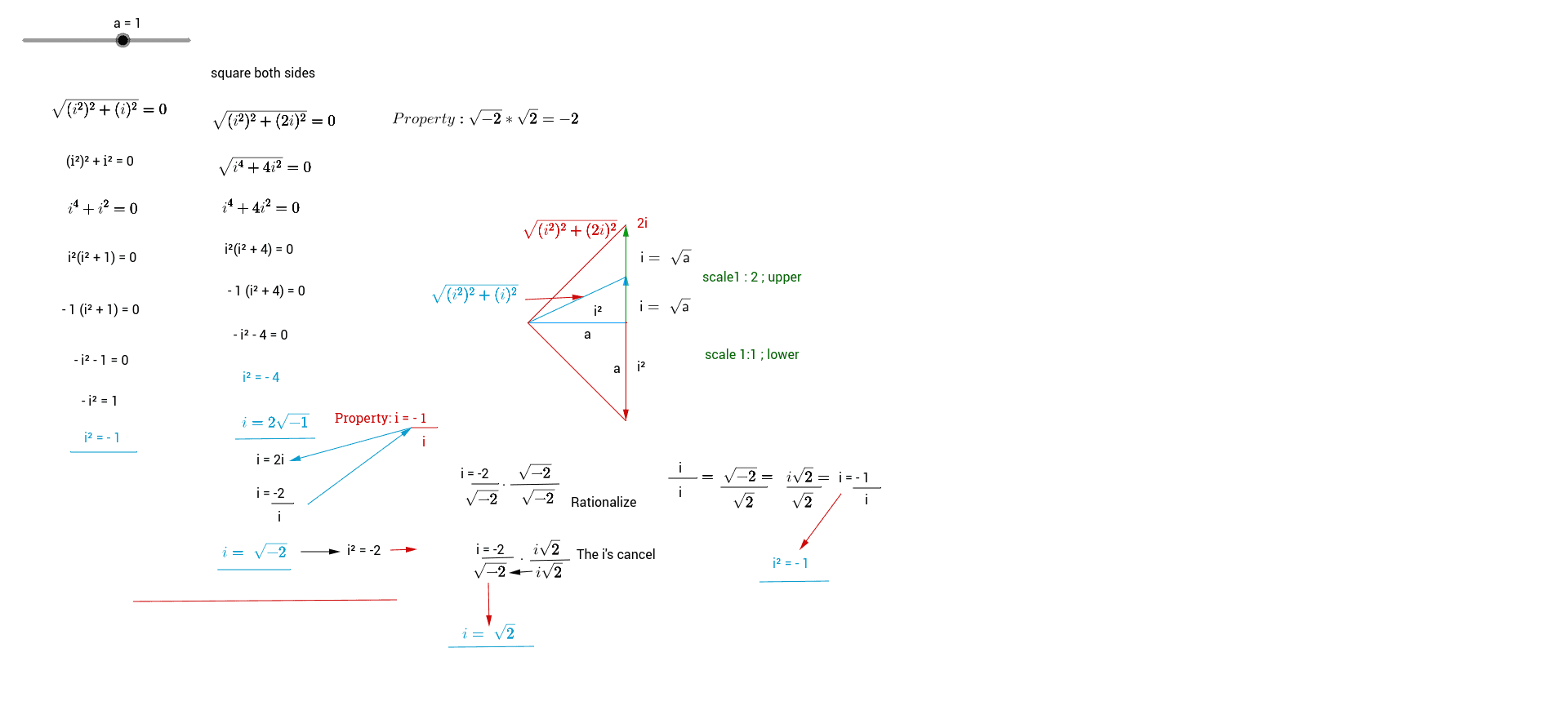
This example dynamically illustrates the geometric meaning of the imaginary unit i, visually showing that i-squared equals -1. It involves core mathematical concepts such as complex numbers, the imaginary unit, and the rotation of vectors with unchanged magnitude. GeoGebra commands like Vector, Mirror, Segment, and Point are used to construct the rotation of vectors, demonstrating the geometric effect of multiplying the imaginary unit by itself. Suitable for high school students to understand the geometric interpretation of complex number operations, or for teaching complex number calculations in calculus or linear algebra.
GeoGebra Commands & Parameters
Vector((1, 0), (1, c)) → uVector((1, 0), (1, b)) → vMirror(v, xAxis) → v'Segment(A, B) → fPoint(u) → CPoint(v) → DSegment(A, C) → gSegment(A, D) → hPoint(v') → ESegment(A, E) → i_2Point(g) → GVector(F, G) → wSegment(H, I) → jSegment(J, K) → kVector(L, M) → dVector(P, Q) → lSegment(R, S) → mSegment(T, U) → nVector(V, W) → pSegment(Z, A_1) → qSegment(B_1, C_1) → rSegment(D_1, E_1) → sSegment(F_1, G_1) → tVector(H_1, I_1) → u_1Segment(J_1, K_1) → eSegment(L_1, M_1) → f_1Segment(N_1, O_1) → g_1Segment(P_1, Q_1) → h_1Segment(R_1, S_1) → i_1Segment(T_1, U_1) → j_1Segment(V_1, W_1) → k_1Segment(Z_1, A_2) → l_1Vector(B_2, C_2) → v_1Point(j) → K_2Vector(J_2, K_2) → w_1Point(j) → L_2Vector(L_2, M_2) → a_1Vector((1, 0), (1, (-a))) → b_1Point(b_1) → N_2Segment(N_2, A) → m_1