
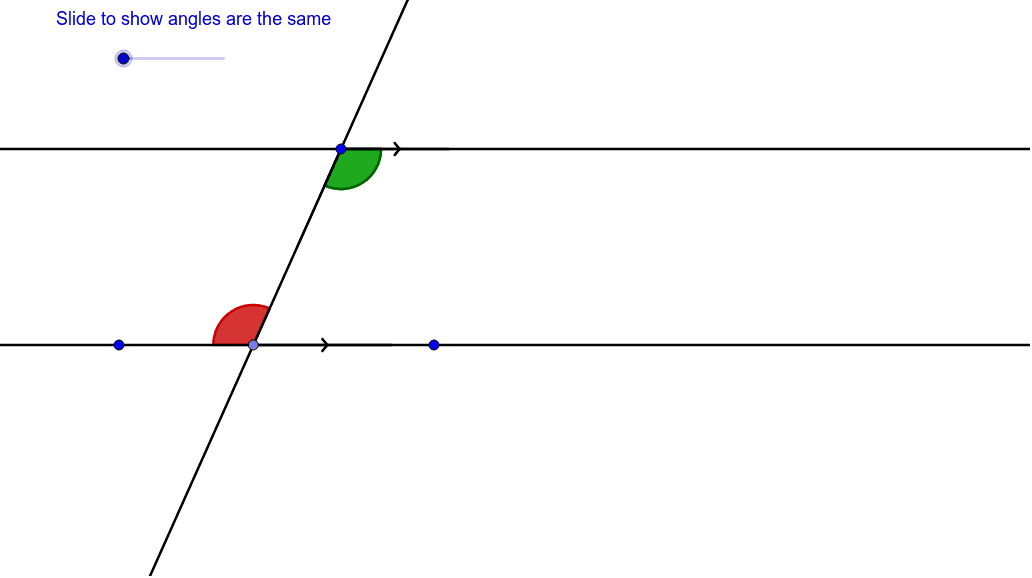
Demonstrating Alternate Angles
Loading the math board and drawing, please wait…
In collections
Introduction to Geometry
This example demonstrates the concept of alternate angles being equal. It involves core math concepts like angles, parallel lines, and triangle angle sum theorem. Construction highlights the use of GeoGebra commands and objects such as Line, Point, Midpoint, Angle, Circle, Intersect, Segment, and Rotate. Suitable for middle school and above students to learn geometric proofs.
GeoGebra Commands & Parameters
Line(A, B) → aPoint(a) → CLine(D, a) → bLine(D, C) → cMidpoint(D, C) → EAngle(c, b) → αAngle(E, C, A) → βCircle(D, E) → dIntersect(d, b, 2) → FSegment(D, E) → eSegment(D, F) → fRotate(D, -γ, E) → D'_1Rotate(F, -γ, E) → F'Segment(D'_1, F') → f'Rotate(D, -γ, E) → D'Rotate(E, -γ, E) → E'Segment(D', E') → e'Angle(e', f') → δPoint(a) → GSegment(D, F) → uSegment(C, G) → v
AI Drawing Prompt Reference
Draw a horizontal line with two base points on it. Place a point above the line and draw a parallel line through it. Connect this point to one base point on the horizontal line, forming a slanted line. Mark an angle at the intersection of the slanted line and the parallel line, and another angle between the slanted line and the horizontal line. Using the midpoint of the slanted line as center, draw a circle with radius equal to the distance from the midpoint to the base point. The circle intersects the parallel line at a point. Connect the midpoint to this intersection pointchers, then rotate both segments around the midpoint by a fixed angle. Mark the angle between the rotated segments. Finally, pick another point on the horizontal line and connect it to the intersection point on the slanted line to form an auxiliary segment.
The prompt above was compiled from the original drawing commands and is for reference only.