
Definition of Directional Derivative with Unit Vectors
Loading the math board and drawing, please wait…
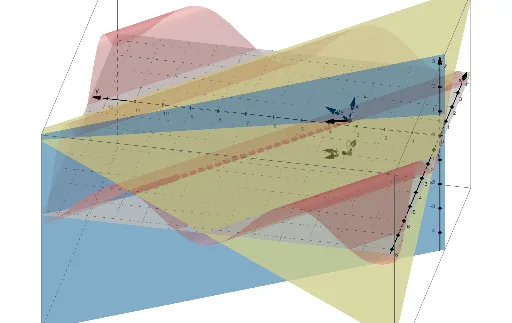
This GeoGebra example visualizes the geometric definition of the directional derivative on a 3D surface using unit vectors. It demonstrates how the rate of change of a function at a point along a specified direction is computed, emphasizing the role of unit vectors and the gradient. The construction employs commands such as NDerivative for numerical differentiation, Vector and UnitVector to define the direction, OrthogonalPlane and Plane to build the vertical and tangent planes, and IntersectPath with Line to show the intersection curves. A slider (theta) rotates the direction vector, dynamically updating the tangent plane and the slope of the intersection line. This is ideal for university-level calculus or multivariable analysis courses, helping students grasp the connection between directional derivatives, partial derivatives, and gradients, and why unit vectors are essential in the definition.
GeoGebra Commands & Parameters
NDerivative(f, y) → dyNDerivative(f, x) → dxVector(P, Px) → vxVector(P, Py) → vyVector(O, (x0 + 1, y0, 0)) → iVector(O, (x0, y0 + 1, 0)) → jVector(O, O1) → uOrthogonalPlane(P, Vector[vx ⊗ vy]) → tangentPlanePlane(O, O1, P) → verticalPlaneUnitVector(Vector[P, Pu]) → vIntersectPath(verticalPlane, f) → eq1Line(P, PplusH) → g
AI Drawing Prompt Reference
Draw the geometric definition of the directional derivative on a 3D surface using a unit vector to represent the specified direction. Use a slider to rotate the direction vector and dynamically show the changes in the tangent plane and the slope of the intersection line. Key elements include numerical differentiation, unit vectors, vertical plane, tangent plane, and intersection line.
The prompt above was compiled from the original drawing commands and is for reference only.