
Definite Integral, Area, and Riemann Sums
Loading the math board and drawing, please wait…
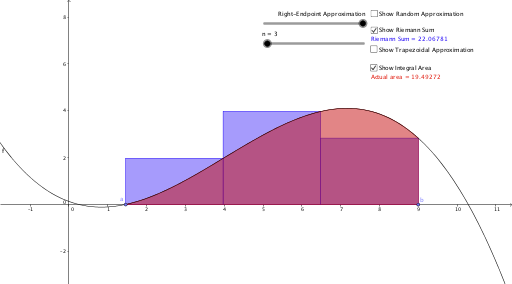
This example illustrates the concepts of definite integral, area calculation, and Riemann sums. It provides a geometric representation of Riemann sums to intuitively understand the definition of definite integrals. Commands used include Point, Sequence, BarChart, Integral, and Sum, suitable for high school mathematics education.
GeoGebra Commands & Parameters
Point(xAxis) → BPoint(xAxis) → ASequence(a + (i * Δx) + (Δx * random()), i, 0, n - 1) → RandListBarChart(a, b, f(RandList)) → RandApproxSequence(a + (i * Δx) + (m * Δx), i, 0, n - 1) → xListBarChart(a, b, f(xList)) → ApproxIntegral(f, a, b) → cSequence(a + (i * Δx), i, 0, n) → xList2Sequence(Polygon[(Element[xList2, i], 0), (Element[xList2, i + 1], 0), (Element[xList2, i + 1], f(Element[xList2, i + 1])), (Element[xList2, i], f(Element[xList2, i])), (Element[xList2, i], 0)], i, 1, n) → trapSum(trap) → TrapArea
AI Drawing Prompt Reference
Draw the definite integral of a function f(x) over the interval [a, b], including Riemann sums and approximated area. Start by creating points A and B on the x-axis, then generate random Riemann sums and approximated bar charts, followed by the integral curve, and finally calculate the approximated area using trapezoidal method.
The prompt above was compiled from the original drawing commands and is for reference only.