
Defining Similarity and Its Relationship to Dilation
Loading the math board and drawing, please wait…
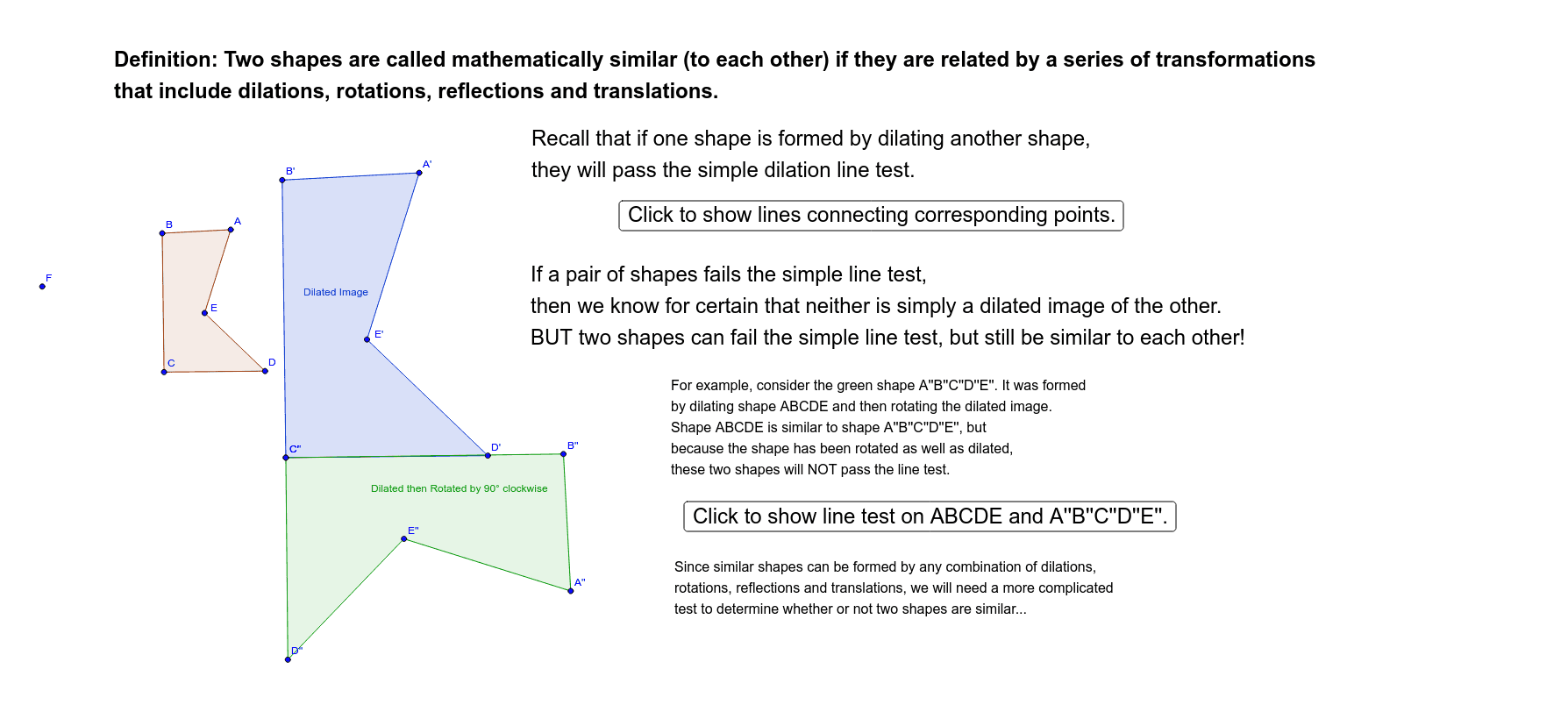
This GeoGebra example dynamically illustrates the connection between similarity and dilation (scaling). It shows a polygon that is dilated and rotated, producing images that preserve shape but may change size, thereby clarifying the definition of similar figures. Core mathematical concepts include similarity, dilation transformation, rotation, proportional corresponding sides, equal corresponding angles, and composition of transformations. Construction highlights: using the Polygon command to create the original polygon, then applying Dilate to scale it about a center, and Rotate to turn it, generating two levels of images (primed and double-primed copies) while keeping original and transformed edges for comparison. A button (button1) enables interactive control. Suitable for middle-to-high school geometry classes, this resource helps students understand the relationship between similarity and dilation, and can be used for teacher demonstrations or student self-exploration.
GeoGebra Commands & Parameters
Polygon(A, B, C, D, E) → poly1, a, b, c, d, eDilate(A, 2, F) → A'Dilate(B, 2, F) → B'Dilate(C, 2, F) → C'Dilate(D, 2, F) → D'Dilate(E, 2, F) → E'Polygon(A', B', C', D', E') → poly1', a', b', c', d', e'Rotate(A', (-(90°)), C') → A''Rotate(B', (-(90°)), C') → B''Rotate(C', (-(90°)), C') → C''Rotate(D', (-(90°)), C') → D''Rotate(E', (-(90°)), C') → E''Polygon(A'', B'', C'', D'', E'') → poly1'', a'', b'', c'', d'', e''Line(C', C) → fLine(E'', E) → gLine(B'', B) → hLine(A'', A) → iLine(D'', D) → jLine(D', D) → kLine(E', E) → lLine(A', F) → mLine(B', F) → n
AI Drawing Prompt Reference
Draw a pentagon ABCDE, then dilate it by a factor of 2 with center F to get A'B'C'D'E'. Rotate A'B'C'D'E' 90 degrees counterclockwise to get A''B''C''D''E''. Add the original pentagon ABCDE, the dilated pentagon A'B'C'D'E', the rotated pentagon A''B''C''D''E'', and their corresponding sides, including C'C, E'E, B'B, A'A, D'D, D'D', E'E', A'A', B'B', D'D'.
The prompt above was compiled from the original drawing commands and is for reference only.