
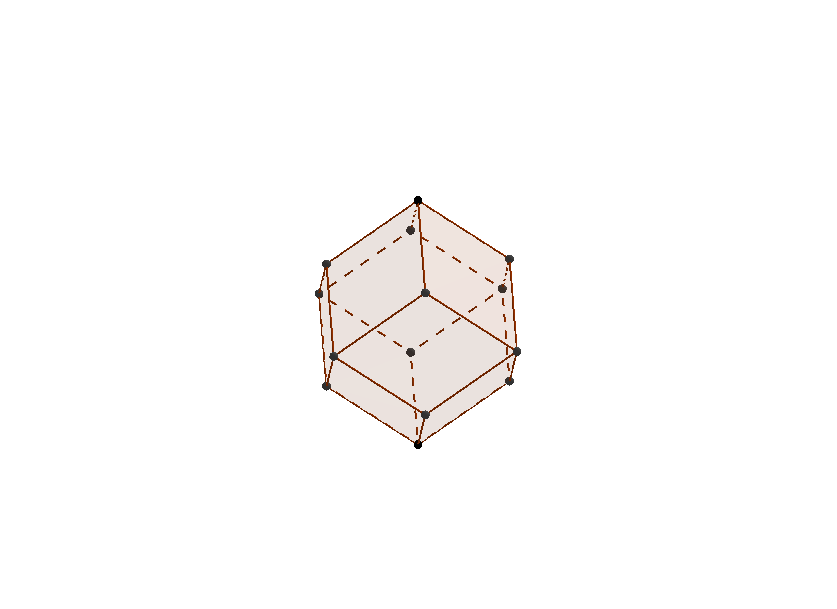
Decomposition of Rhombic Dodecahedron
Loading the math board and drawing, please wait…
This example demonstrates how a rhombic dodecahedron can be decomposed into a cube and several pyramids. Key mathematical concepts include the decomposition of polyhedra in solid geometry. Using GeoGebra commands such as Segment, Plane, Polygon, etc., the construction process of the polyhedron can be visually understood. Suitable for students at the junior high school level and above.
GeoGebra Commands & Parameters
Segment(L, N) → eSegment(M, N) → fSegment(M, K) → jSegment(L, K) → kSegment(N, I) → gSegment(K, E) → hSegment(I, D) → nSegment(C, D) → pSegment(C, A) → qSegment(N, J) → rSegment(K, F) → d_1Segment(D, J) → sPlane(C, F, B) → oOrthogonalLine(A, o) → f_1OrthogonalLine(B, o) → g_1Segment(B, D) → mSegment(H, C') → h_1Segment(M', H) → tSegment(J', H) → a_1Segment(H, F') → e_1Polygon(F', C', H) → poly2, k_1, l_1, m_1Polygon(K, M, F) → poly3, f_2, k_2, m_2Polygon(F', M', H) → poly4, n_1, p_1, q_1Polygon(M', J', H) → poly5, h_2, m', j'Polygon(C', H, J') → poly6, j'_1, c', h_3Polygon(C, J, D) → poly8, r_1, s_1, t_1Segment(G, E') → bSegment(B', G) → dSegment(G, L') → aSegment(G, I') → cPolygon(E', B', G) → poly9, g_2, e', b'Polygon(L', I', G) → poly10, g_3, l', i'Polygon(I, B, D) → poly13, d_2, i_3, b_3Polygon(I', B', G) → poly14, g_4, i'_1, b'_1Polygon(L', E', G) → poly15, g_5, l'_1, e'_1Polygon(L, E, K) → poly16, k_3, l_3, e_3Line(A, N) → c_1Line(C', c_1) → i_1Line(B, c_1) → j_1Line(E, c_1) → a_2Plane(C', F, B) → o_1OrthogonalLine(A, o_1) → b_2OrthogonalLine(C'', o_1) → e_2Plane(C, F', E') → u_1OrthogonalLine(E', u_1) → p_2Segment(C'', A') → c_2Segment(A', B'') → iSegment(A', E'') → lSegment(F'', A') → b_1Segment(N', M'') → q_2Segment(N', J'') → r_2Segment(N', I'') → s_2Segment(N', L'') → t_2Polygon(J'', M'', N') → poly1, n', j'', m''Polygon(M'', L'', N') → poly7, n'_1, m''_1, l''Polygon(I'', L'', N') → poly11, n'_2, i'', l''_1Polygon(J'', I'', N') → poly12, n'_3, j''_1, i''_1Polygon(C'', F'', A') → poly17, a', c'', f''Polygon(F'', E'', A') → poly18, a'_1, f''_1, e''Polygon(E'', B'', A') → poly19, a'_2, e''_1, b''Polygon(C'', A', B'') → poly20, b''_1, c''_1, a'_3Polygon(I''', B''', D') → poly21, d', i''', b'''Polygon(J''', I''', D') → poly22, d'_1, j''', i'''_1Polygon(B''', C''', D') → poly23, d'_2, b'''_1, c'''Polygon(C''', D', J''') → poly24, j'''_1, c'''_1, d'_3Polygon(K', E''', F''') → poly25, f''', k', e'''Polygon(K', M''', F''') → poly26, f'''_1, k'_1, m'''Polygon(L''', E''', K') → poly27, k'_2, l''', e'''_1Polygon(M''', L''', K') → poly28, k'_3, m'''_1, l'''_1Segment(C, F) → i_2Segment(F, M) → j_2Segment(M, J) → l_2Segment(J, C) → n_2Segment(C, B) → a_3Segment(B, E) → c_3Segment(E, L) → d_3Segment(L, I) → f_3Segment(I, B) → j_3Segment(J, I) → m_3Segment(F, E) → n_3Segment(M, L) → p_3Segment(F', M') → q_3Segment(M', J') → r_3Segment(J', C') → s_3Segment(C', F') → t_3Segment(J''', I''') → a_4Segment(B''', I''') → b_4Segment(B''', C''') → c_4Segment(C''', J''') → d_4Segment(C'', F'') → e_4Segment(E'', F'') → f_4Segment(E'', B'') → h_4Segment(B'', C'') → i_4Segment(B', I') → j_4Segment(I', L') → k_4Segment(E', L') → l_4Segment(E', B') → m_4Segment(E''', L''') → n_4Segment(L''', M''') → p_4Segment(M''', F''') → q_4Segment(E''', F''') → r_4Segment(J'', M'') → s_4Segment(L'', M'') → t_4Segment(L'', I'') → a_5Segment(I'', J'') → b_5
AI Drawing Prompt Reference
Draw a rhombic dodecahedron, showing how it decomposes into a cube and several pyramids. Start by sketching the edges of the cube, then create the bases and sides of the pyramids, ensuring their vertices align with those of the cube. Use distinct colors or textures to differentiate the cube from the pyramids for a clear visual decomposition.
The prompt above was compiled from the original drawing commands and is for reference only.