
Decomposition of Rhombic Dodecahedron by מכון דוידסון לחינוך מדעי
Loading the math board and drawing, please wait…
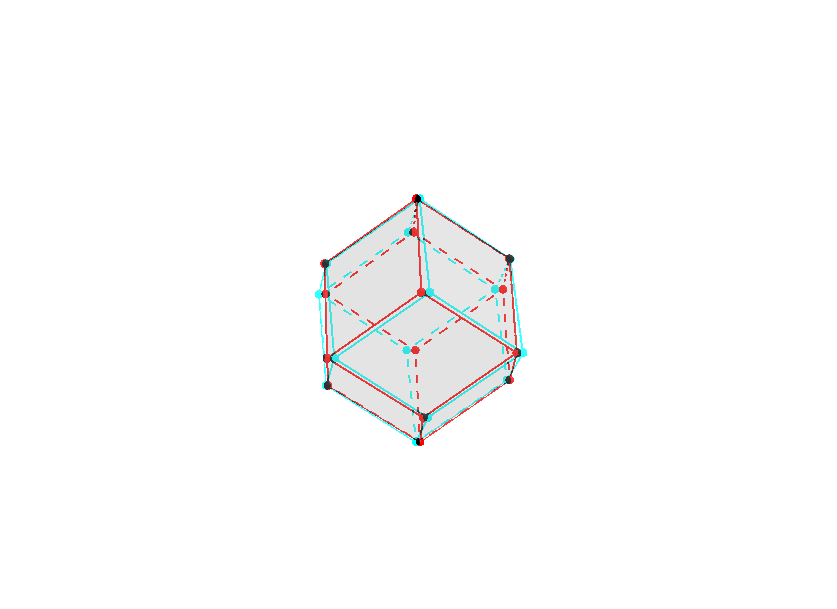
This example demonstrates how a rhombic dodecahedron can be decomposed into a cube and several pyramids, suitable for viewing with red-cyan 3D glasses. It involves basic concepts in solid geometry, such as the decomposition and recombination of polyhedra. Using GeoGebra commands like Segment, Plane, and Polygon, the process of geometric construction is visually demonstrated. Suitable for students at the junior high school level and above.
GeoGebra Commands & Parameters
Segment(L, N) → eSegment(M, N) → fSegment(M, K) → jSegment(L, K) → kSegment(N, I) → gSegment(K, E) → hSegment(I, D) → nSegment(C, D) → pSegment(C, A) → qSegment(N, J) → rSegment(K, F) → d_1Segment(D, J) → sPlane(C, F, B) → oOrthogonalLine(A, o) → f_1OrthogonalLine(B, o) → g_1Segment(B, D) → mSegment(H, C') → h_1Segment(M', H) → tSegment(J', H) → a_1Segment(H, F') → e_1Polygon(F', C', H) → poly2, k_1, l_1, m_1Polygon(K, M, F) → poly3, f_2, k_2, m_2Polygon(F', M', H) → poly4, n_1, p_1, q_1Polygon(M', J', H) → poly5, h_2, m', j'Polygon(C', H, J') → poly6, j'_1, c', h_3Polygon(C, J, D) → poly8, r_1, s_1, t_1Segment(G, E') → bSegment(B', G) → dSegment(G, L') → aSegment(G, I') → cPolygon(E', B', G) → poly9, g_2, e', b'Polygon(L', I', G) → poly10, g_3, l', i'Polygon(I, B, D) → poly13, d_2, i_3, b_3Polygon(I', B', G) → poly14, g_4, i'_1, b'_1Polygon(L', E', G) → poly15, g_5, l'_1, e'_1Polygon(L, E, K) → poly16, k_3, l_3, e_3Line(A, N) → c_1Line(C', c_1) → i_1Line(B, c_1) → j_1Line(E, c_1) → a_2Plane(C', F, B) → o_1OrthogonalLine(A, o_1) → b_2OrthogonalLine(C'', o_1) → e_2Plane(C, F', E') → u_1OrthogonalLine(E', u_1) → p_2Segment(C'', A') → c_2Segment(A', B'') → iSegment(A', E'') → lSegment(F'', A') → b_1Segment(N', M'') → q_2Segment(N', J'') → r_2Segment(N', I'') → s_2Segment(N', L'') → t_2Polygon(J'', M'', N') → poly1, n', j'', m''Polygon(M'', L'', N') → poly7, n'_1, m''_1, l''Polygon(I'', L'', N') → poly11, n'_2, i'', l''_1Polygon(J'', I'', N') → poly12, n'_3, j''_1, i''_1Polygon(C'', F'', A') → poly17, a', c'', f''Polygon(F'', E'', A') → poly18, a'_1, f''_1, e''Polygon(E'', B'', A') → poly19, a'_2, e''_1, b''Polygon(C'', A', B'') → poly20, b''_1, c''_1, a'_3Polygon(I''', B''', D') → poly21, d', i''', b'''Polygon(J''', I''', D') → poly22, d'_1, j''', i'''_1Polygon(B''', C''', D') → poly23, d'_2, b'''_1, c'''Polygon(C''', D', J''') → poly24, j'''_1, c'''_1, d'_3Polygon(K', E''', F''') → poly25, f''', k', e'''Polygon(K', M''', F''') → poly26, f'''_1, k'_1, m'''Polygon(L''', E''', K') → poly27, k'_2, l''', e'''_1Polygon(M''', L''', K') → poly28, k'_3, m'''_1, l'''_1Segment(C, F) → i_2Segment(F, M) → j_2Segment(M, J) → l_2Segment(J, C) → n_2Segment(C, B) → a_3Segment(B, E) → c_3Segment(E, L) → d_3Segment(L, I) → f_3Segment(I, B) → j_3Segment(J, I) → m_3Segment(F, E) → n_3Segment(M, L) → p_3Segment(F', M') → q_3Segment(M', J') → r_3Segment(J', C') → s_3Segment(C', F') → t_3Segment(J''', I''') → a_4Segment(B''', I''') → b_4Segment(B''', C''') → c_4Segment(C''', J''') → d_4Segment(C'', F'') → e_4Segment(E'', F'') → f_4Segment(E'', B'') → h_4Segment(B'', C'') → i_4Segment(B', I') → j_4Segment(I', L') → k_4Segment(E', L') → l_4Segment(E', B') → m_4Segment(E''', L''') → n_4Segment(L''', M''') → p_4Segment(M''', F''') → q_4Segment(E''', F''') → r_4Segment(J'', M'') → s_4Segment(L'', M'') → t_4Segment(L'', I'') → a_5Segment(I'', J'') → b_5
AI Drawing Prompt Reference
Draw a decomposition of a rhombic dodecahedron into a cube and several pyramids, suitable for red-cyan 3D glasses viewing. Start by sketching the basic shapes of the cube and pyramids, then connect their edges and vertices to form the complete decomposition structure. Use different colors to distinguish the parts and highlight the geometric construction process.
The prompt above was compiled from the original drawing commands and is for reference only.