
Decimals, Rounding, and Truncation
Loading the math board and drawing, please wait…
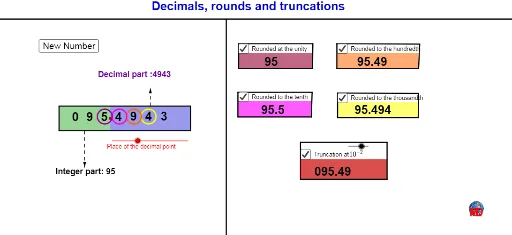
This example demonstrates the concepts of decimals, rounding, and truncation. Using GeoGebra commands such as Random, Sequence, and Element, the example provides a visual representation of these mathematical concepts. Suitable for middle school and above students.
GeoGebra Commands & Parameters
Random(1, 9) → hRandom(1, 9) → gRandom(1, 9) → fRandom(1, 9) → eRandom(1, 9) → dRandom(0, 9) → cRandom(0, 9) → bCircle(A, 0.5) → c_1Line(A, xAxis) → iPoint(i) → BSequence(Dilate[B, n / 18, A], n, 1, 17) → liste3Element(liste3, 5) → KElement(liste3, 3) → JSegment(J, K) → mMidpoint(P, B) → D_1OrthogonalLine(D_1, xAxis) → g_1Midpoint(A, P) → ZSegment(A, Z) → tOrthogonalLine(A, t) → nIntersect(c_1, n) → U, VOrthogonalLine(V, n) → b_1Intersect(b_1, g_1) → L_1Element(liste3, 15) → QSegment(A, B) → jSequence(Dilate[B, n / 9, A], n, 1, 8) → liste2Element(liste2, 1) → CElement(liste2, 2) → DElement(liste2, 3) → EElement(liste2, 4) → FElement(liste2, 5) → GElement(liste2, 6) → HElement(liste2, 7) → IElement(liste3, 7) → LElement(liste3, 9) → MElement(liste3, 11) → NElement(liste3, 13) → OSegment(J, Q) → kElement(liste2, 8) → RDistance(P, Q) → aIf(l ≟ 0, b, If[l ≟ 1, (10 * b) + c, If[l ≟ 2, (100 * b) + (10 * c) + d, If[l ≟ 3, (1000 * b) + (100 * c) + (10 * d) + e, If[l ≟ 4, (10000 * b) + (1000 * c) + (100 * d) + (10 * e) + f, If[l ≟ 5, (100000 * b) + (10000 * c) + (1000 * d) + (100 * e) + (10 * f) + g, If[l ≟ 6, (1000000 * b) + (100000 * c) + (10000 * d) + (1000 * e) + (100 * f) + (10 * g) + h]]]]]]) → oOrthogonalLine(P, t) → pCircle(A, 1) → qIntersect(q, n) → S, TOrthogonalLine(U, n) → f_1Circle(P, 0.5) → d_1Circle(B, 0.5) → e_1Intersect(d_1, p) → W, A_1Intersect(e_1, b_1) → B_1, C_1Intersect(e_1, f_1) → E_1, F_1Polygon(V, A_1, W, U) → poly1, v, a_1, w, uPolygon(A_1, C_1, F_1, W) → poly2, a_2, c_2, f_2, w_1OrthogonalLine(Z, xAxis) → rCircle(Z, 2) → sIntersect(s, r) → G_1, H_1Intersect(f_1, r) → I_1Vector(I_1, G_1) → zIf(l ≟ 0, (100000 * c) + (10000 * d) + (1000 * e) + (100 * f) + (10 * g) + h, If[l ≟ 1, (10000 * d) + (1000 * e) + (100 * f) + (10 * g) + h, If[l ≟ 2, (1000 * e) + (100 * f) + (10 * g) + h, If[l ≟ 3, (100 * f) + (10 * g) + h, If[l ≟ 4, (10 * g) + h, If[l ≟ 5, h, If[l ≟ 6, 0]]]]]]) → h_1Circle(D_1, 2) → k_1Vector(L_1, K_1) → u_1If(l_1, b + (c + 1) / 10, If[m_1, b + c / 10, If[o_1, (10 * b) + c + (d + 1) / 10, If[n_1, (10 * b) + c + d / 10, If[q_1, (100 * b) + (10 * c) + d + (e + 1) / 10, If[p_1, (100 * b) + (10 * c) + d + e / 10, If[s_1, (1000 * b) + (100 * c) + (10 * d) + e + (f + 1) / 10, If[r_1, (1000 * b) + (100 * c) + (10 * d) + e + f / 10, If[v_1, (10000 * b) + (1000 * c) + (100 * d) + (10 * e) + f + (g + 1) / 10, If[t_1, (10000 * b) + (1000 * c) + (100 * d) + (10 * e) + f + g / 10]]]]]]]]]) → z_1Line(M_1, xAxis) → b_2Point(b_2) → N_1OrthogonalLine(M_1, b_2) → i_2OrthogonalLine(N_1, b_2) → j_2Point(i_2) → O_1OrthogonalLine(O_1, i_2) → l_2Intersect(j_2, l_2) → P_1Polygon(M_1, O_1, P_1, N_1) → poly3, m_2, o_2, p_2, n_2If(q_2, a_3, If[r_2, b_3, If[s_2, c_3, If[t_2, d_3, If[u_2, e_3, If[v_2, f_3, If[w_2, g_3, If[z_2, h_3]]]]]]]) → i_3Line(Q_1, xAxis) → j_3Point(j_3) → R_1OrthogonalLine(Q_1, j_3) → l_3OrthogonalLine(R_1, j_3) → m_3Point(l_3) → S_1OrthogonalLine(S_1, l_3) → n_3Intersect(n_3, m_3) → T_1Polygon(Q_1, S_1, T_1, R_1) → poly4, q_4, s_3, t_3, r_4If(u_3, i_4, If[v_3, b, If[w_3, j_4, If[z_3, k_4, If[a_4, l_4, If[b_4, m_4, If[c_4, n_4, If[d_4, o_4, If[e_4, p_4, If[f_4, s_4, If[g_4, t_4, If[h_4, u_4]]]]]]]]]]]) → v_4Line(U_1, xAxis) → a_5Point(a_5) → V_1OrthogonalLine(U_1, a_5) → b_5OrthogonalLine(V_1, a_5) → c_5Point(b_5) → W_1OrthogonalLine(W_1, b_5) → d_5Intersect(d_5, c_5) → Z_1Polygon(U_1, W_1, Z_1, V_1) → poly5, u_5, w_4, z_4, v_5If(j_5, r_5, If[l_5, s_5, If[m_5, t_5, If[n_5, w_5, If[o_5, z_5, If[q_5, a_6]]]]]) → b_6Line(A_2, xAxis) → c_6Point(c_6) → B_2OrthogonalLine(A_2, c_6) → d_6OrthogonalLine(B_2, c_6) → e_6Point(d_6) → C_2OrthogonalLine(C_2, d_6) → f_6Intersect(e_6, f_6) → D_2Polygon(C_2, D_2, B_2, A_2) → poly6, c_7, d_7, b_7, a_7Polygon(V, C_1, F_1, U) → poly7, v_6, c_8, f_7, u_6Circle(H + (0.075, 0.075), 0.3) → k_6Circle(G + (0.075, 0.075), 0.3) → q_3Circle(F + (0.075, 0.075), 0.3) → g_2Circle(D + (0.075, 0.075), 0.3) → d_2Circle(E + (0.075, 0.075), 0.3) → e_2Circle(C + (0.075, 0.075), 0.3) → e_5Circle(D + (0.075, 0.075), 0.3) → f_5Circle(E + (0.075, 0.075), 0.3) → g_5Circle(F + (0.075, 0.075), 0.3) → g_6Circle(G + (0.075, 0.075), 0.3) → h_2Circle(F + (0.075, 0.075), 0.3) → h_5Circle(G + (0.075, 0.075), 0.3) → h_6Circle(H + (0.075, 0.075), 0.3) → k_2Circle(E + (0.075, 0.075), 0.3) → k_3Circle(G + (0.075, 0.075), 0.3) → k_5Circle(F + (0.075, 0.075), 0.3) → p_3Circle(H + (0.075, 0.075), 0.3) → p_5Circle(H + (0.075, 0.075), 0.3) → r_3Polygon(J_1, Q_2, V_1, U_1) → poly8, j_6, q_6, v_7, u_7Polygon(R_2, S_2, R_1, Q_1) → poly9, r_6, s_6, r_7, q_7Polygon(T_2, U_2, N_1, M_1) → poly10, t_6, u_8, n_6, m_6If(j_5, r6, If[l_5, s_5, If[m_5, t_5, If[n_5, w_5, If[o_5, z_5, If[q_5, a_6]]]]]) → bbPolygon(V_2, W_2, B_2, A_2) → poly11, v_8, w_6, b_8, a_8Point(u_6) → Z_2Vector(Z_2, A_3) → z_6Translate(P, z_6) → P'Translate(J, z_6) → J'LaTeX(Element[text, l_6]) → texte23If(l_1, b + c / 10, If[m_1, b + c / 10, If[o_1, (10 * b) + c + (d + 1) / 10, If[n_1, (10 * b) + c + d / 10, If[q_1, (100 * b) + (10 * c) + d + (e + 1) / 10, If[p_1, (100 * b) + (10 * c) + d + e / 10, If[s_1, (1000 * b) + (100 * c) + (10 * d) + e + (f + 1) / 10, If[r_1, (1000 * b) + (100 * c) + (10 * d) + e + f / 10, If[v_1, (10000 * b) + (1000 * c) + (100 * d) + (10 * e) + f + g / 10, If[t_1, (10000 * b) + (1000 * c) + (100 * d) + (10 * e) + f + g / 10]]]]]]]]]) → zzPolygon(B_3, C_3, D_3, E_3) → poly12, b_9, c_9, d_8, e_7Point(c_9) → F_3Point(e_7) → G_3Polygon(G_3, F_3, D_3, E_3) → poly13, g_7, f_8, d_9, e_8Ray(H_3, I_3) → p_6Point(p_6) → J_3OrthogonalLine(J_3, p_6) → h_7
AI Drawing Prompt Reference
Draw a circle centered at the origin with a radius of 0.5. Draw a line from the center to the x-axis and mark a point on it. Translate this point along the x-axis to the right in 18 equal parts, creating 17 points. Connect the center to the 3rd, 5th, 7th, 9th, 11th, 13th, and 15th points. Draw a line segment between the 3rd and 5th points. Find the midpoint of this segment and draw a line perpendicular to the x-axis. Draw a circle centered at the origin with a radius of 1, intersecting the perpendicular line at two points. Draw a circle centered at the 7th point with a radius of 0.5. Draw another circle centered at the 5th point with a radius of 0.5. Find the intersections of these circles with the perpendicular line and draw lines from these points to the 3rd and 5th points, ensuring they are perpendicular to the x-axis.
The prompt above was compiled from the original drawing commands and is for reference only.