
Cyclic Quadrilateral Opposite Angles Sum
Loading the math board and drawing, please wait…
In collections
Circle Theorems
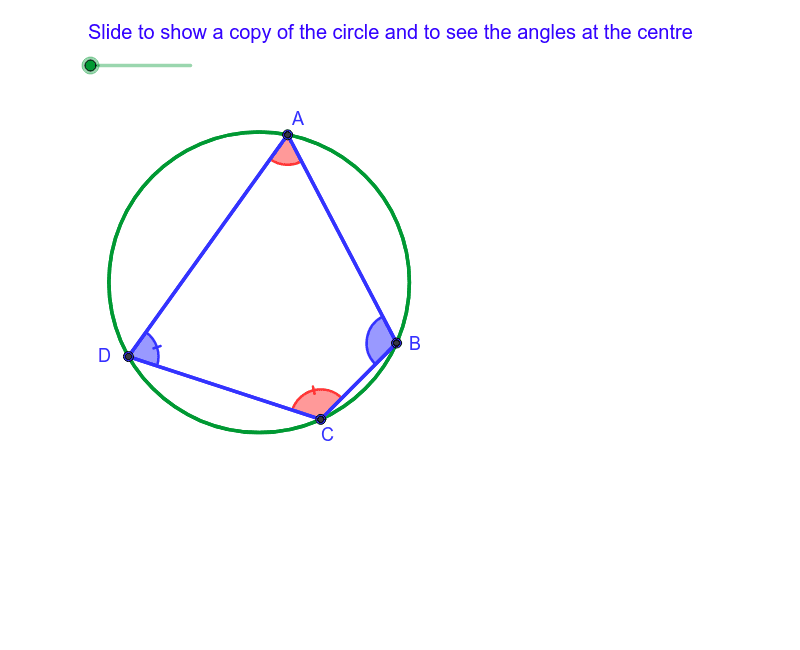
This example demonstrates the property of a cyclic quadrilateral where the sum of both pairs of opposite angles equals 180°. It involves core concepts like circles, polygons, angles, and geometric constructions. The construction uses GeoGebra commands such as Circle, Point, CircleArc, Segment, Angle, and Translate. Suitable for middle school students and mathematics education demonstrations.
GeoGebra Commands & Parameters
Circle(O, 4) → c_1Point(c_1) → dPoint(c_1) → bCircleArc(O, d, b) → a_1CircleArc(O, b, d) → gPoint(g) → aSegment(d, a) → a_2Segment(b, a) → b_1Point(a_1) → cSegment(d, c) → c_2Segment(b, c) → d_1Angle(d, a, b) → αAngle(d, c, b) → βSegment(d, O) → eSegment(b, O) → fAngle(d, O, b) → γTranslate(O, u) → O'Translate(c_1, u) → hTranslate(d, u) → d'Translate(c, u) → c'Translate(b, u) → b'Translate(a, u) → a'Translate(d, u) → d'_1Translate(a, u) → a'_1Segment(d'_1, a'_1) → iTranslate(d, u) → d'_2Translate(c, u) → c'_1Segment(d'_2, c'_1) → jTranslate(b, u) → b'_1Translate(c, u) → c'_2Segment(b'_1, c'_2) → kTranslate(b, u) → b'_2Translate(a, u) → a'_2Segment(b'_2, a'_2) → lSegment(a', O') → mSegment(O', c') → nAngle(c', d', a') → δAngle(a', b', c') → εAngle(d, O, b) → ζAngle(b, O, d) → ηAngle(c', O', a') → ιAngle(a'_2, O', c'_2) → θ
AI Drawing Prompt Reference
Draw a circle and select two points on it. Connect these points to form a line segment. Then, draw two arcs with these points as centers. The intersection of the arcs is the third point. Connect this point to the original two points to form a quadrilateral. Measure the angles between opposite sides and show that they sum to 180 degrees. Translate the quadrilateral along a direction, draw the translated shape, and measure the corresponding angles to verify that the sum remains unchanged.
The prompt above was compiled from the original drawing commands and is for reference only.