
Curved Surface Area of Cones by AMW0ng
Loading the math board and drawing, please wait…
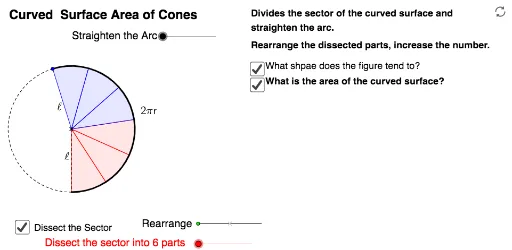
This example demonstrates calculating the curved surface area of a cone, involving concepts like cone geometry and area formulas. Key mathematical concepts include the curved surface area formula, the relationship between the cone's slant height and base radius. Construction involves using GeoGebra commands such as CircleSector and CircleArc to draw cones and sectors, with parameterized adjustments for radius and slant height. Suitable for middle school mathematics teaching or geometric learning, helping students understand surface area calculations in solid geometry.
GeoGebra Commands & Parameters
Point(CircleArc[(0, 1), (1, 1), (0, 0)]) → AIf(y(A) > 0, Angle[(0, 0), (0, 1), A], 6.283185307179586) → αSequence((sin((i * θ)), 1 - cos((i * θ))), i, 0, (2 * n)) → list1Segment(E, (x(E) + 1, y(E))) → aPoint(a) → FMin((2 * (x(F) - x(E))), 1) → kMax((2 * (x(F) - x(E))) - 1, 0) → k'Sequence(If[k < 1, (x(O) + ((l * sin((i * φ))) * cos((i * φ)) / sin(φ)), y(O) + ((l * sin((i * φ))) * sin((i * φ)) / sin(φ))), (x(O) + (l * i), y(O))], i, 0, (2 * n)) → list2Sequence(Sector[Rotate[Translate[Circle[(x(O) + 0, y(O) + 1), Element[list1, i]], Vector[Element[list1, i], Element[list2, i]]], (((-((2 * i) - 1)) * k) * θ / 2), Element[list2, i]], Rotate[Translate[Element[list1, i], Vector[Element[list1, i], Element[list2, i]]], (((-((2 * i) - 1)) * k) * θ / 2), Element[list2, i]], Rotate[Translate[Element[list1, i + 1], Vector[Element[list1, i], Element[list2, i]]], (((-((2 * i) - 1)) * k) * θ / 2), Element[list2, i]]], i, 1, n) → list3Sequence(Sector[Rotate[Rotate[Translate[Circle[(x(O) + 0, y(O) + 1), Element[list1, i]], Vector[Element[list1, i], Element[list2, i]]], (((-((2 * i) - 1)) * k) * θ / 2), Element[list2, i]], (180° * k'), (x(O) + (n * l) - sin(θ / 2) / 2, y(O) + cos(θ / 2) / 2)], Rotate[Rotate[Translate[Element[list1, i], Vector[Element[list1, i], Element[list2, i]]], (((-((2 * i) - 1)) * k) * θ / 2), Element[list2, i]], (180° * k'), (x(O) + (n * l) - sin(θ / 2) / 2, y(O) + cos(θ / 2) / 2)], Rotate[Rotate[Translate[Element[list1, i + 1], Vector[Element[list1, i], Element[list2, i]]], (((-((2 * i) - 1)) * k) * θ / 2), Element[list2, i]], (180° * k'), (x(O) + (n * l) - sin(θ / 2) / 2, y(O) + cos(θ / 2) / 2)]], i, n + 1, (2 * n)) → list4If(y(A) > 0, CircleArc[(0, 1), (0, 0), A], 6.283185307179586) → sCircleArc((0, 1 / (1 - m)), O, L) → bSegment((0, 0), (s, 0)) → dMidpoint(d) → B'CircleArc((0, 1), A, (0, 0)) → cMidpoint(a) → CPoint(Segment[(0, 1), (s, 1)]) → DSegment(D, (x(D), y(D) - 1)) → eMidpoint(e) → GCircleSector((0, 1), (0, 0), A) → fCircle((0, 1), 1) → gMidpoint(A, D) → H