
Curvature from Derivatives
Loading the math board and drawing, please wait…
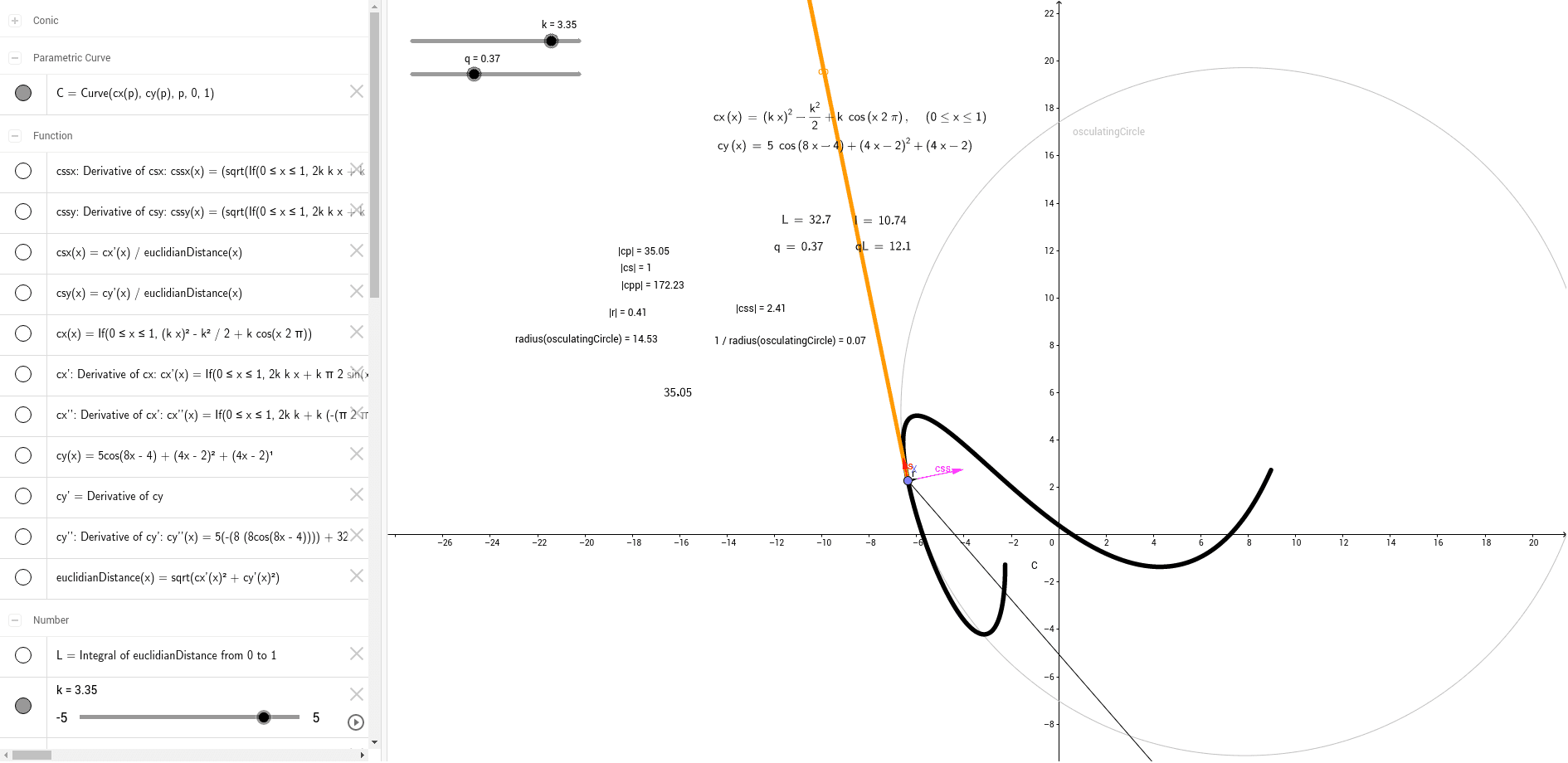
This example demonstrates how to calculate the curvature of a curve using derivatives. Key mathematical concepts include derivatives and curvature. Using GeoGebra commands such as Derivative and OsculatingCircle, the example provides a visual understanding of how curvature changes at a point on a curve. Suitable for high school calculus education.
GeoGebra Commands & Parameters
Derivative(cy) → cy'Derivative(cx) → cx'CurveCartesian(cx(p), cy(p), p, 0, 1) → CPoint(C, q) → XLength(cp) → lcpIntegral(euclidianDistance, 0, 1) → LLaTeX(L, true, true) → text2Integral(euclidianDistance, 0, q) → lLaTeX(qL, true, true) → text5Derivative(csx) → cssxDerivative(csy) → cssyLength(css) → kappaLaTeX(cx, false, true) → text8LaTeX(cy, false, true) → text9LaTeX(l, true, true) → text10Derivative(cx') → cx''Derivative(cy') → cy''LaTeX(q, true, true) → text6OsculatingCircle(X, C) → osculatingCircleLaTeX(Radius[osculatingCircle] / Length[r]) → text16