
Cuboid Shadow and Section Construction
Loading the math board and drawing, please wait…
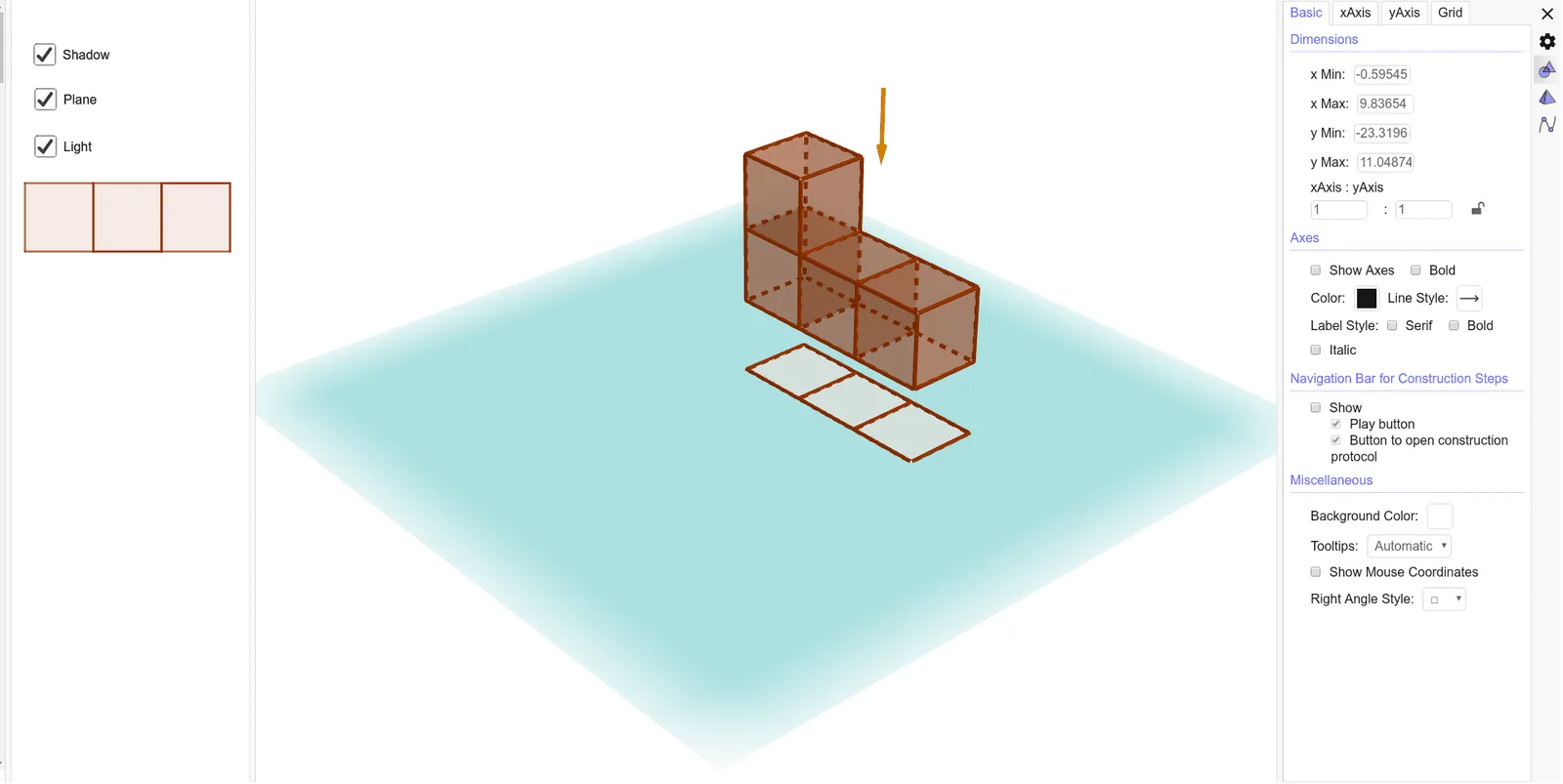
This example demonstrates the shadow cast by a cuboid under a light source, visualized by intersecting an inclined plane with the cuboid to form a polygonal shadow region. The core mathematical concepts involve solid geometry, including cuboids, plane-polyhedron intersections, cross-section polygons, and the spatial relationships among points, lines, and planes using vectors. Construction details: using GeoGebra commands such as Point, Cube, Intersect, Plane, PointIn, Polygon, and Vector, the cuboid's vertices and edges are created, an inclined plane is defined, points inside the shadow region are determined, and the shadow polygon is drawn. Suitable for high school or early college students to explore 3D sections and projections, and as a visual aid in teaching solid geometry.
GeoGebra Commands & Parameters
Point(zAxis) → APoint(zAxis) → BPoint(Circle[B, Distance[A, B], Segment[A, B]]) → CCube(A, B, C) → a, D, faceCDHG, faceEFGH, edgeAD, edgeAB, edgeBC, edgeCD_1, edgeAE, edgeDH, edgeEH, edgeEF, E, edgeBF, edgeFG, edgeCG, edgeGH, F, G, H, faceABCD, faceADHE, faceABFE, faceBCGFPoint(Circle[C, Distance[D, C], Segment[D, C]]) → ICube(D, C, I) → b, J, faceIJNM, faceKLMN, edgeDJ, edgeCD, edgeCI, edgeIJ_1, edgeDK, edgeJN, edgeKN, edgeKL, K, edgeCL_1, edgeLM, edgeIM, edgeMN, L, M, N, faceCDJI, faceDJNK, faceCDKL, faceCIMLPoint(Circle[I, Distance[J, I], Segment[J, I]]) → OCube(J, I, O) → c, P, faceOPTS, faceQRST, edgeJP, edgeIJ, edgeIO, edgeOP, edgeJQ, edgePT, edgeQT, edgeQR, Q, edgeIR, edgeRS, edgeOS, edgeST, R, S, T, faceIJPO, faceJPTQ, faceIJQR, faceIOSRPoint(Circle[L, Distance[C, L], Segment[C, L]]) → UCube(C, L, U) → d, V, face3, face4, edgeCV, edgeCL, edgeLU, edgeUV, edgeCW, edge2, edge3, edgeWZ, W, edgeLZ, edge4, edge1, edge5, Z, A_1, B_1, faceCLUV, face1, faceCLZW, face2Intersect(yAxis, zAxis) → C_1Point(yAxis) → D_1Point(xAxis) → E_1Plane(C_1, D_1, E_1) → eIntersect(zAxis, xAxis) → F_1Point(yAxis) → G_1PointIn(e) → H_1Point(xAxis) → I_1Point(xAxis) → K_1PointIn(e) → L_1PointIn(e) → M_1Point(xAxis) → N_1PointIn(e) → O_1Polygon(N_1, K_1, L_1, O_1) → q3, n_1, k_2, l_2, o_1Intersect(n_1, k_2) → J_1Point(xAxis) → P_1Polygon(J_1, P_1, Q_1, R_1) → q1, j_1, p_1, q_1, r_1Point(yAxis) → S_1Intersect(xAxis, yAxis) → T_1Polygon(Q_1, S_1, T_1, P_1) → q2, q_2, s_1, t_1, p_2Vector(U_1, V_1) → u