
Cube Root Function Graph with Equilateral Triangle Intersections
Loading the math board and drawing, please wait…
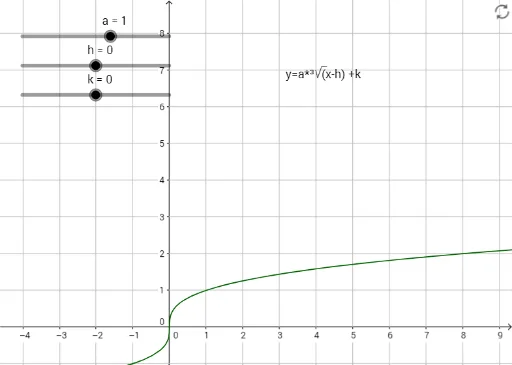
①This example demonstrates the graph of the cube root function y = a·∛(x - h) + k, and shows intersections with an equilateral triangle, combining function graphing with geometric construction. ②Core math concepts include cube root functions, vertical/horizontal translations and scaling via parameters a, h, k, properties of equilateral triangles, vectors, and solving intersection points. ③Construction details: using GeoGebra, objects a, h, k are created (likely as sliders), function f is defined, an equilateral triangle is constructed using vectors, intersection points between the function and triangle are marked, and a text object text1 displays relevant values or explanations. ④Suitable for high school students learning function transformations and coordinate geometry, or for pre-calculus review, helping to visualize how parameter changes affect the graph and the interplay between algebra and geometry.
GeoGebra Commands & Parameters
Numeric a(1)Numeric h(0)Numeric k(0)f(x) = (a * nroot(x - h,3)) + k