
Paper Folding Parabola: Exploring Focus and Directrix
Loading the math board and drawing, please wait…
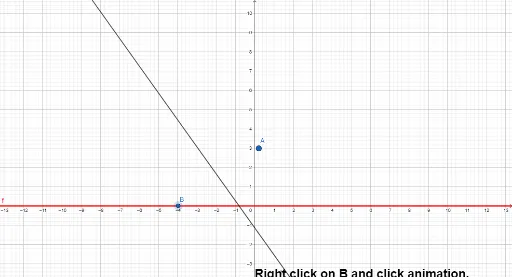
This GeoGebra example demonstrates how folding paper can construct a parabola: by repeatedly folding a fixed point (the focus) onto a fixed line (the directrix), the creases form an envelope that traces out the parabola. The core mathematical concept is the definition of a parabola as the locus of points equidistant from a focus and a directrix, with each crease acting as the perpendicular bisector of the segment joining the focus to a point on the directrix. The construction uses GeoGebra commands: Point to create focus A and directrix point B, LineBisector to generate the crease (perpendicular bisector of AB), Intersect to find points where creases meet auxiliary lines, and Segment/Line to build supporting geometry, with text1 labeling key elements. This resource is ideal for middle-to-high school students learning conic sections, offering a hands-on introduction to locus and envelope concepts, and can be extended to discuss quadratic equations and the reflective property of parabolas.
GeoGebra Commands & Parameters
Point(xAxis) → BIntersect(xAxis, yAxis) → CLine(B, C) → fSegment(B, A) → gLineBisector(g) → h
AI Drawing Prompt Reference
Draw a diagram showing how paper folding constructs a parabola: start with a horizontal line and a point on it as the directrix and focus, then draw a vertical line intersecting it to get another point, and connect these two points. From the focus to this line, draw a segment and find its perpendicular bisector as a fold line. Repeat this process to create multiple fold lines that envelope a parabola, illustrating the locus of points equidistant from the focus and directrix.
The prompt above was compiled from the original drawing commands and is for reference only.