
Cube Net Recognition Practice
Loading the math board and drawing, please wait…
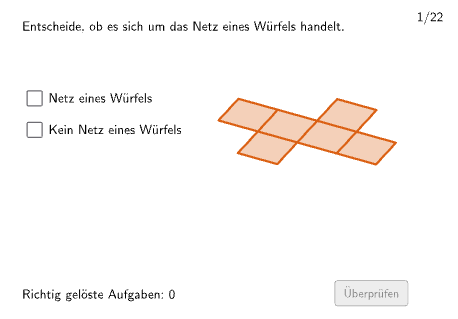
This GeoGebra interactive exercise helps students determine whether a given flat pattern can fold into a cube. Users observe various polygon nets and identify if they form valid cube nets. Core mathematical concepts include: cube/cuboid nets, spatial visualization, and the relationship between 2D and 3D shapes. Construction uses Shuffle for random questions, Element to select problems, Vector and Translate for drawing nets, Mirror for transformations, and Midpoint for key points. Interactive features include validation buttons, attempt tracking, and feedback. Suitable for grades 5-6 students to develop geometric intuition and spatial awareness as an introduction to solid geometry.
GeoGebra Commands & Parameters
Shuffle(1…numberOfQuestions) → randomQuestions, {2, 16, 3, 17, 5, 4, 15, 7, 19, 22, 13, 8, 9, 6, 1, 14, 20, 11, 12, 10, 21, 18}Element(randomQuestions, Mod[questionCount, Length[randomQuestions]] + 1) → randomQuestionVector(viewPointCenter, viewPointX) → vectorXVector(viewPointCenter, viewPointY) → vectorYVector(viewPointCenter, viewPointZ) → vectorZTranslate(A, Vector[(sizeAB * vectorY)]) → A'Midpoint(R, M) → DTranslate(S, Vector[(-((sizeAB * vectorY)))]) → S'Translate(M, Vector[((-sizeAB) * vectorY)]) → M'Translate(N, Vector[((-sizeAB) * vectorY)]) → N'Translate(Q, Vector[(-((sizeAB * vectorY)))]) → Q'_1Translate(Q, Vector[((-sizeAB) * vectorY)]) → Q'_2Translate(B, Vector[((-sizeAB) * vectorY)]) → B'_1Translate(K, Vector[(sizeAB * vectorY)]) → K'Translate(P, Vector[(sizeAB * vectorY)]) → P'_1Midpoint(N, P) → D_1Midpoint(K, N) → F_1Translate(P, Vector[(sizeAB * vectorY)]) → P'Mirror(L_1, F_1) → O_1Mirror(K_1, F_1) → P_1
AI Drawing Prompt Reference
Create an interactive diagram for cube net recognition practice. The center shows a flat pattern made of six connected squares, which may or may not fold into a cube. Around the pattern, place buttons for users to answer whether it is a valid cube net, along with a counter for attempts and feedback messages. The background is clean, focusing on the geometric shapes. The squares are equal-sized and arranged randomly, possibly with mirror or translation transformations. Below the pattern, include instructional text guiding the user. The design is suitable for grades 5-6 students to develop spatial reasoning.
The prompt above was compiled from the original drawing commands and is for reference only.