
Cube Cutting: Square of Triangular Numbers
Loading the math board and drawing, please wait…
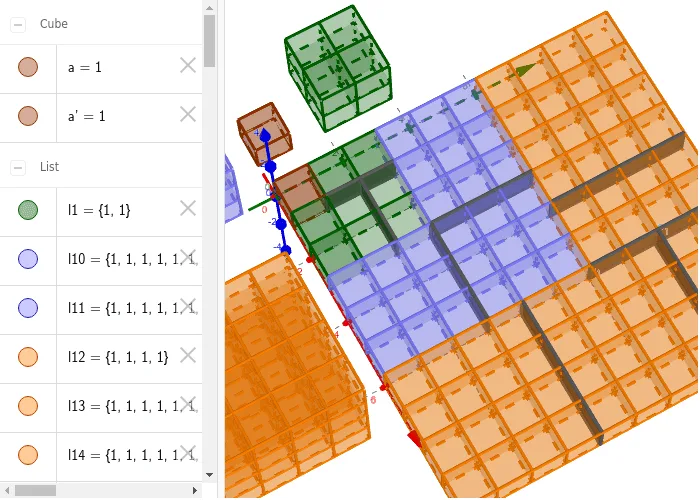
This example demonstrates the formation of a square of triangular numbers after cutting a cube. Key mathematical concepts include sequences, solid geometry, and geometric construction. Using GeoGebra commands such as Point, Cube, Sequence, and Flatten, the construction of the cut cube is illustrated. Suitable for high school mathematics education and learning.
GeoGebra Commands & Parameters
Point(Circle[(1, 0), Distance[(0, 0), (1, 0)], Segment[(0, 0), (1, 0)]]) → ACube((0, 0), (1, 0), A) → a, B, faceABFE, faceCDEF, edge2, edge1, edge4, edgeAB, edge3, edgeBF, edgeCF, edgeCD, C, edge5, edgeDE, edgeAE, edgeEF, D, E, F, face1, face3, face2, face4Sequence(Translate[a, Vector[(i, 0)]], i, 1, 2) → l1Sequence(Translate[a, Vector[(0, i)]], i, 1, 2) → l2Flatten(Sequence[Translate[l1, Vector[(0, i)]], i, 1, 2]) → l3Flatten(Translate[{a, l1, l2, l3}, Vector[(0, 3)]]) → l4Flatten(Translate[l4, Vector[(3, 0)]]) → l5Flatten(Translate[{a, l1, l2, l3}, Vector[(3, 0)]]) → l6Sequence(Translate[a, Vector[(i, 0)]], i, 6, 9) → l7Flatten(Sequence[Translate[l7, Vector[(0, i)]], i, 1, 9]) → l8Polygon((3, 2, 0), (1, 2, 0), (1, 2, 1), (3, 2, 1)) → q1, f, g, h, iFlatten(Sequence[Sequence[Translate[a, Vector[(j, i)]], i, 6, 9, 1], j, 0, 5, 1]) → l9Polygon((6, 0, 0), (6, 4, 0), (6, 4, 1), (6, 0, 1)) → q3, n, p, q, rPolygon((1, 1, 0), (1, 3, 0), (1, 3, 1), (1, 1, 1)) → q2, j, k, l, mPolygon((6, 3, 0), (3, 3, 0), (3, 3, 1), (6, 3, 1)) → q4, s, t, b, cPolygon((3, 3, 0), (3, 3, 1), (3, 6, 1), (3, 6, 0)) → q5, d, e, f_1, g_1Polygon((6, 4, 0), (10, 4, 0), (10, 4, 1), (6, 4, 1)) → q6, h_1, i_1, j_1, k_1Polygon((6, 6, 0), (6, 10, 0), (6, 10, 1), (6, 6, 1)) → q9, a_1, b_1, c_1, d_1Polygon((6, 8, 0), (10, 8, 0), (10, 8, 1), (6, 8, 1)) → q7, l_1, m_1, n_1, p_1Polygon((4, 6, 0), (4, 10, 0), (4, 10, 1), (4, 6, 1)) → q8, q_1, r_1, s_1, t_1Translate(a, Vector[(-2, 0)]) → a'Translate(l3, Vector[(-4, 1)]) → l3'Translate(l3', Vector[(0, 0, 1)]) → l3''Translate(l4, Vector[(-3, -7)]) → l10Flatten(Sequence[Translate[l10, Vector[(0, 0, i)]], i, 1, 2, 1]) → l11Translate(l7, Vector[(-3, -2)]) → l12Flatten(Sequence[Translate[l12, Vector[(0, i)]], i, -1, -3, -1]) → l13Flatten(Sequence[Translate[Flatten[{l12, l13}], Vector[(0, 0, i)]], i, 1, 3, 1]) → l14